The complete operational history of an outstanding Marine fighter squadron throughout the Cold War.
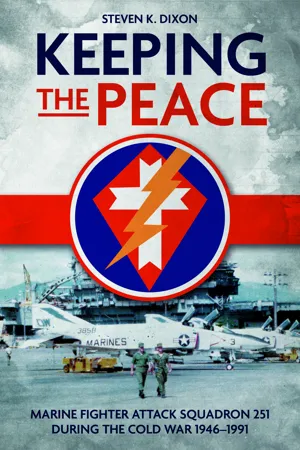
The Thunderbolts of VMFA-251 were reactivated as a Marine Air Reserve squadron in 1946. Their Cold War only included a few weeks of traditional combat operations—in Korea—but they would undertake constant training exercises and deployments from 1946 to 1991 as they prepared for a potential war against the USSR or China, the two giants of Communism. From South Korea to Norway to Turkey and points in between, the Thunderbolts found themselves defending the free world and living up to their motto, Custos Caelorum. Following the end of the Korean War, the squadron remained in the Far East until 1956. Back in the States it began flying the FJ-3 Fury, a jet fighter, before converting to its first supersonic fighter, the F-8U "Crusader." In early 1962, it was the first Marine F-8 squadron to deploy aboard an aircraft carrier, as part of CVW-10 (Carrier Air Wing) aboard the USS Shangri-La. During deployment in the Mediterranean Sea, the squadron set a record for the most flight time in one month for a Sixth Fleet-based F-8 squadron by flying over 500 hours. In 1964, the Thunderbolts were the first Marine squadron in 2nd Marine Aircraft Wing to transition to the F-4B "Phantom II," which they would fly for 21 years and 80,000 flight hours, until transitioning to the F/A-18 "Hornet" in 1987. These deployments and exercises, while not "at war," were not without dangers. The Thunderbolts lost many personnel and aircraft, but they persevered as the armed forces of freedom-loving nations faced the ongoing threat of communism for over four decades. Compiled from archive records and interviews by a veteran of VMFA-251, this account narrates how the Thunderbolts worked hard to maintain the peace. They were indeed Custodians of the Sky.
eBook - ePub
Keeping the Peace
Marine Fighter Attack Squadron 251 During the Cold War 1946–1991
- 288 pages
- English
- ePUB (mobile friendly)
- Available on iOS & Android
eBook - ePub
About this book
Information
Subtopic
Military BiographiesIndex
HistoryTable of contents
- COVER PAGE
- TITLE PAGE
- COPYRIGHT
- CONTENTS
- ACKNOWLEDGEMENTS
- PREFACE
- CHAPTER I
- CHAPTER II
- CHAPTER III
- CHAPTER IV
- CHAPTER V
- CHAPTER VI
- CHAPTER VII
- CHAPTER VIII
- EPILOGUE
- APPENDIX01
- APPENDIX02
- APPENDIX03
- APPENDIX04
- APPENDIX05
- APPENDIX06
- APPENDIX07
- NOTES
- INDEX
- PLATESECTION
Trusted by 375,005 students
Access to over 1.5 million titles for a fair monthly price.
Study more efficiently using our study tools.
Frequently asked questions
Yes, you can cancel anytime from the Subscription tab in your account settings on the Perlego website. Your subscription will stay active until the end of your current billing period. Learn how to cancel your subscription
No, books cannot be downloaded as external files, such as PDFs, for use outside of Perlego. However, you can download books within the Perlego app for offline reading on mobile or tablet. Learn how to download books offline
Perlego offers two plans: Essential and Complete
- Essential is ideal for learners and professionals who enjoy exploring a wide range of subjects. Access the Essential Library with 800,000+ trusted titles and best-sellers across business, personal growth, and the humanities. Includes unlimited reading time and Standard Read Aloud voice.
- Complete: Perfect for advanced learners and researchers needing full, unrestricted access. Unlock 1.5M+ books across hundreds of subjects, including academic and specialized titles. The Complete Plan also includes advanced features like Premium Read Aloud and Research Assistant.
We are an online textbook subscription service, where you can get access to an entire online library for less than the price of a single book per month. With over 1.5 million books across 990+ topics, we’ve got you covered! Learn about our mission
Look out for the read-aloud symbol on your next book to see if you can listen to it. The read-aloud tool reads text aloud for you, highlighting the text as it is being read. You can pause it, speed it up and slow it down. Learn more about Read Aloud
Yes! You can use the Perlego app on both iOS and Android devices to read anytime, anywhere — even offline. Perfect for commutes or when you’re on the go.
Please note we cannot support devices running on iOS 13 and Android 7 or earlier. Learn more about using the app
Please note we cannot support devices running on iOS 13 and Android 7 or earlier. Learn more about using the app
Yes, you can access Keeping the Peace by Steven K. Dixon in PDF and/or ePUB format, as well as other popular books in History & Military Biographies. We have over 1.5 million books available in our catalogue for you to explore.