WINNER, 25th ANNUAL SUSANNE M. GLASSCOCK BOOK PRIZE
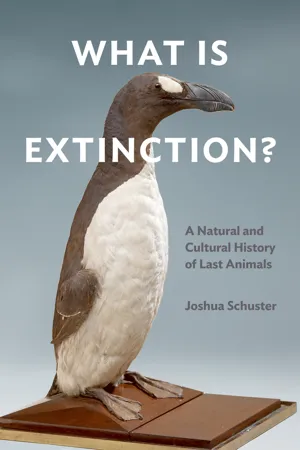
Life on Earth is facing a mass extinction event of our own making. Human activity is changing the biology and the meaning of extinction. What Is Extinction? examines several key moments that have come to define the terms of extinction over the past two centuries, exploring instances of animal and human finitude and the cultural forms used to document and interpret these events.
Offering a critical theory for the critically endangered, Joshua Schuster proposes that different discourses of limits and lastness appear in specific extinction events over time as a response to changing attitudes toward species frailty. Understanding these extinction events also involves examining what happens when the conceptual and cultural forms used to account for species finitude are pressed to their limits as well. Schuster provides close readings of several case studies of extinction that bring together environmental humanities and multispecies methods with media-specific analyses at the terminus of life.
What Is Extinction? delves into the development of last animal photography, the anthropological and psychoanalytic fascination with human origins and ends, the invention of new literary genres of last fictions, the rise of new extreme biopolitics in the Third Reich that attempted to change the meaning of extinction, and the current pursuit of de-extinction technologies. Schuster offers timely interpretations of how definitions and visions of extinction have changed in the past and continue to change in the present.
- 304 pages
- English
- ePUB (mobile friendly)
- Available on iOS & Android
eBook - ePub
About this book
Information
Publisher
Fordham University PressYear
2023Print ISBN
9781531501655
9781531501648
Edition
1eBook ISBN
9781531501662
Table of contents
- Cover
- Title Page
- Copyright
- Contents
- Introduction
- Part I
- Part II
- Part III
- Conclusion
- Acknowledgments
- Notes
- Index
- About the Author
Trusted by 375,005 students
Access to over 1.5 million titles for a fair monthly price.
Study more efficiently using our study tools.
Frequently asked questions
Yes, you can cancel anytime from the Subscription tab in your account settings on the Perlego website. Your subscription will stay active until the end of your current billing period. Learn how to cancel your subscription
No, books cannot be downloaded as external files, such as PDFs, for use outside of Perlego. However, you can download books within the Perlego app for offline reading on mobile or tablet. Learn how to download books offline
Perlego offers two plans: Essential and Complete
- Essential is ideal for learners and professionals who enjoy exploring a wide range of subjects. Access the Essential Library with 800,000+ trusted titles and best-sellers across business, personal growth, and the humanities. Includes unlimited reading time and Standard Read Aloud voice.
- Complete: Perfect for advanced learners and researchers needing full, unrestricted access. Unlock 1.5M+ books across hundreds of subjects, including academic and specialized titles. The Complete Plan also includes advanced features like Premium Read Aloud and Research Assistant.
We are an online textbook subscription service, where you can get access to an entire online library for less than the price of a single book per month. With over 1.5 million books across 990+ topics, we’ve got you covered! Learn about our mission
Look out for the read-aloud symbol on your next book to see if you can listen to it. The read-aloud tool reads text aloud for you, highlighting the text as it is being read. You can pause it, speed it up and slow it down. Learn more about Read Aloud
Yes! You can use the Perlego app on both iOS and Android devices to read anytime, anywhere — even offline. Perfect for commutes or when you’re on the go.
Please note we cannot support devices running on iOS 13 and Android 7 or earlier. Learn more about using the app
Please note we cannot support devices running on iOS 13 and Android 7 or earlier. Learn more about using the app
Yes, you can access What Is Extinction? by Joshua Schuster in PDF and/or ePUB format, as well as other popular books in Biological Sciences & Literary Criticism Theory. We have over 1.5 million books available in our catalogue for you to explore.