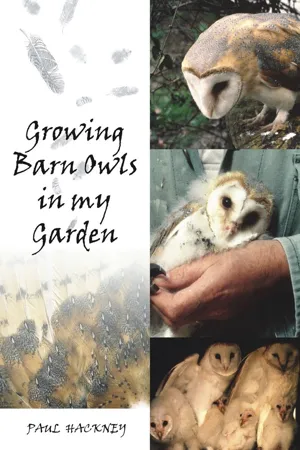
The barn owl is a 'flagship' species, at the top of the food chain, and its presence or absence is a good indicator of the health of the countryside. This is the enjoyable and informative story of the author's success in restoring this beautiful bird to areas of the country where its numbers had catastrophically declined.From an upbringing in the Lake District, the author developed a deep interest in natural history which became an all-consuming passion. As a 'licensed rehabilitation keeper', he cared for a wide range of injured and orphaned wildlife, giving individuals a second chance by returning them to the wild. He reveals how and why he later graduated to barn owl conservation.The author describes his many encounters with barn owls, from the acquisition of his first breeding pair; 'Barney', a completely humanised owl; to stories of the fascinating array of people involved in releasing, studying, and simply marvelling at this beautiful bird. Although there is a funny side to most situations, there are also the inevitable disasters and disappointments of conservation work, such as the accidental or deliberate sabotaging of releases or the killing of released birds. The reader shares in the author's disappointment and frustration at the sheer cost in time and money and his frequent self-doubt about the success of the whole exercise. However, there are descriptions of more enjoyable activities such as bird ringing, watching home-grown birds metamorphose from ugly pink scraps into creatures of ethereal beauty, and the seemingly limitless energy and enthusiasm of countless landowners and volunteers who are totally committed to the reintroduction of the barn owl.After almost 20 years, there is now evidence of a marked increase in barn owl numbers in areas where the author has worked. During this period, he bred and released around 250 birds, put up nest boxes and advised on barn owl-friendly approaches to land management. These activities helped to reverse the decline in population as areas were repopulated and also created reservoirs of wild breeding barn owls, whose offspring colonised other under-populated parts of the country.The return of the barn owl not only heralds a brighter future for the British countryside, but also shows, at a time of great public concern about the state of planet Earth, that the negative effects of human activity on the environment can be reversed with effort, goodwill and determination.
eBook - PDF
Growing Barn Owls in my Garden
About this book
Information
Print ISBN
9781849950275
Table of contents
- Contents
- Acknowledgements
- 1 Escape to the Lakes
- 2 A budding naturalist
- 3 Bannisdale days
- 4 Down on the farm
- 5 Getting to know Jane and Teddy
- 6 My first barn owls
- 7 Other owl encounters
- 8 The arrival of Barney
- 9 Home-bred success
- 10 Hunting skills
- 11 Preparations for release
- 12 Bird ringing
- 13 Increasing my breeding stock
- 14 Back on the farm
- 15 Farm-bred success
- 16 An unexpected treat
- 17 Free to come and go at last
- 18 Working with Chester Zoo
- 19 The decline of the barn owl in Britain
- 20 An early setback
- 21 Back at the zoo
- 22 Money problems
- 23 A barn owl "shoot" (part one)
- 24 A barn owl "shoot" (part two)
- 25 The price of success
- 26 Finding release sites
- 27 Public presentations
- 28 Equipping sites and trapping prey
- 29 Monitoring relsease sites
- 30 The secretive barn owl
- 31 A different approach
- 32 Some ups and downs
- 33 Fred's story
- 34 A fortunate rescue
- 35 Hazards of the job
- 36 Last release
- 37 Reflections on barn owl conservation
- Appendix: barn owl facts
- Some useful contacts
- Further reading
Trusted by 375,005 students
Access to over 1.5 million titles for a fair monthly price.
Study more efficiently using our study tools.