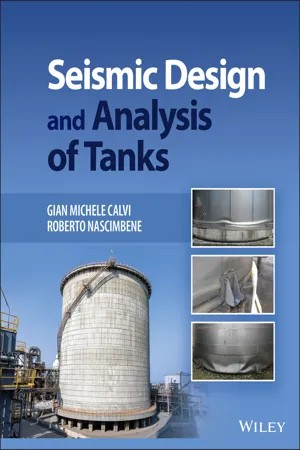
A detailed view on the effects of seismic activity on tank structures
As the use of above-ground and underground storage tanks (ASTs and USTs) continues to grow—with approximately 545,000 in the USA alone—the greatest threat to ASTs and USTs is earthquakes, causing the contamination of groundwater, a vital source of drinking water throughout the world. These tanks suffer a great deal of strain during an earthquake, as a complicated pattern of stress affects them, such that poorly designed tanks have leaked, buckled, or even collapsed during seismic events. Furthermore, in oil and gas industrial plants, the risk of damage is even more critical due to the effects of explosion, collapse, and air or soil contamination by chemical fluid spillages.
Seismic Design and Analysis of Tanks provides the first in-depth discussion of the principles and applications of shell structure design and earthquake engineering analyses focused on tank structures, and it explains how these methodologies can help prevent the destruction of ASTs and USTs during earthquakes. Providing a thorough examination of the design, analysis, and performance of steel, reinforced concrete, and precast tanks, this book takes a look at tanks that are above-ground, underground, or elevated, anchored and unanchored, and rigid or flexible, and evaluates the efficacy of each method during times of seismic shaking—and it does so without getting bogged down in impenetrable mathematics and theory.
Seismic Design and Analysis of Tanks readers will also find:
- A global approach to the best analytical and practical solutions available in each region:
- discussion of the latest US codes and standards from the American Society of Civil Engineers (ACSE 7), the American Concrete Institute (ACI 350,3, 371.R), the American Water Works Association (AWWA D100, D110, D115), and the American Petroleum Institute (API 650)
- an overview of the European codes and standards, including Eurocode 8-4 and CEN-EN 14015
- Hundreds of step-by-step equations, accompanied by illustrations
- Photographs illustrating real-world damage to tanks caused by seismic events
Perfect for practising structural engineers, geotechnical engineers, civil engineers, and engineers of all kinds who are responsible for the design, analysis, and performance of tanks and their foundations—as well as students studying engineering—Seismic Design and Analysis of Tanks is a landmark text, the first work of its kind to deal with the seismic engineering performance of all types of storage tanks.