Systemizing the Past takes the reader to the fascinating world of Caucasian archaeology demonstrating the essential role of the region in shaping the prehistoric cultural landscape of the Ancient Near East. It is dedicated to Pavel Avetisyan, a leading modern Armenian archaeologist with wide international recognition, whose contributions are notable for their integration of present-day theoretical approaches, application of scientific methodology, and multidisciplinary research and stand out for their scientific value, raising Armenian archaeology to an international level.The volume touches on issues of special interest to Pavel Avetisyan, among them fieldwork reports, and various problems of prehistoric archaeology, from the early farming societies of the Neolithic/Chalcolithic periods to the complex societies of the Bronze and Iron Ages. Questions regarding the chronology and periodization of Armenian and Caucasian archaeological traditions; theoretical problems concerning the formation and development of complex societies in the Armenian Highland and the Caucasus, demonstrating the features typical to regional shifts within the common Near Eastern context; as well as various topics dealing with ceramic typology, burial rites, sacred landscapes, chronology and periodization, transformation of social environments and culture sequences, palaeodemography, 'World-System' theory and its main concepts (such as borderland, marginal zone, and frontier) are also considered in the volume. Various contributions dedicated to the fundamental archaeological problems of the region gradually shift the research perspective to meta-levels of understanding the past.
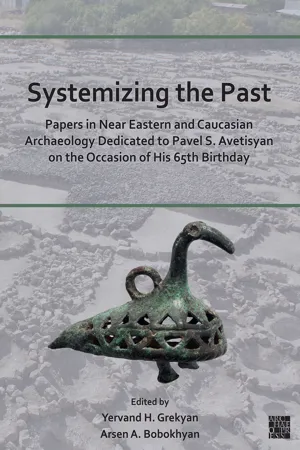
eBook - PDF
Systemizing the Past
Papers in Near Eastern and Caucasian Archaeology Dedicated to Pavel S. Avetisyan on the Occasion of His 65th Birthday
- 506 pages
- English
- PDF
- Available on iOS & Android
eBook - PDF
Systemizing the Past
Papers in Near Eastern and Caucasian Archaeology Dedicated to Pavel S. Avetisyan on the Occasion of His 65th Birthday
About this book
Information
Topic
Sciences socialesSubtopic
ArchéologieTable of contents
- Cover
- Title Page
- Copyright page
- Contents Page
- Foreword
- ‘Axe-Bull’: An Iron-Age Iconic Anagram
- Armenian Standing Stones as an Object of Archaeological Study*
- Neolithization of Armenia: General Trends and Patterns of Development
- Groups of Three Deities in Middle and Neo-Assyrian Times
- Water Management in Ancient Armenia: Problems and Perspectives
- The Archaeological Site of Garni, Armenia. Pre-Arsacid Archaeological Evidence and an Urartian Inscription of Argišti on a Vishap
- The Kurtan Belt
- Achaemenid Habitats in Beniamin II (Shirak, Armenia) from the End of the 6th Century BC to the End of the 4th Century BC
- New Findings on Urartian Rock-Cut Tomb in Mazgirt/Kaleköy Fortress*
- Dalarik-1: A New Lower Paleolithic Cave Site in the Republic of Armenia
- The Tušpa Mound Columned Hall
- Climate Change and the Transition from the Early to the Middle Bronze Age in the Armenian Highland
- A Prehistoric Aggregated Cell Structure at 2850 m asl on Mount Aragats, Armenia
- Ceramic Technology at the Kura-Araxes I and II Site of Khizanaant Gora, Shida Kartli, Georgia
- Inscribed and Seal-Impressed Clay Finds from the Urartian Fortress of Çavuştepe
- Iron Age Pottery from Metsamor. New Observations Based on Assemblage Discovered in 2019 Season
- Urartian Priestesses, How Important They Were? Some Observations of the Iconographic Features
- Getahovit - 2 Cave in the Middle Ages
- Shaft Hole Axes of Stone and Metal from the Checon Settlement of the Maikop-Novosvobodnaya Community*
- Hatti and Išuwa: Anatolians in the Upper Euphrates Valley
- The Fortress of Aramus in the Early Iron Age
- Woven Traces: Notes from the 2017 and 2018 Excavation Seasons at Masis Blur
- New Evidence from the Necropolis of Karashamb: Excavations of the Tomb no. 444
- Who were the Caucasian Owners of the Mitannian Cylinder Seals?
- Archaeological Prospection in the Ararat Valley – Drilling into the History of Ancient Artaxata, Armenia
- A Middle and Late Bronze Age Settlement in Armenia: the Aggregated Cells of Arteni
- ‘Axe-Bull’ – Order of the Thunder God*
- Overlooking the River Hrazdan Valley: The Fortified Site of Tghit in the Tsaghkunyats Mountains, Kotayk Region, Armenia*
- From Landjik to Dvin: Armenian Evidence of Decapitation from Prehistory to the Mediaeval Era
- Reconstructing the Lifeways of the Kura-Araxes*
- Middle Bronze Age Ceramics in Macro and Micro Perspectives*
- Monitoring Heritage At Risk: Caucasus Heritage Watch and the Armenian Monuments of Nagorno-Karabakh
- Tigran the Great and Mithradates Eupator: Two Parallel Kings of Kings?
- Modelling of Bronze and Iron Age Monuments at the Northwestern Slopes of Mount Aragats based on a Case Study of Lernakert*
- The Early Medieval Complex of Agarak
- Women in Urartian Rituals
Trusted by 375,005 students
Access to over 1.5 million titles for a fair monthly price.
Study more efficiently using our study tools.
Frequently asked questions
Yes, you can cancel anytime from the Subscription tab in your account settings on the Perlego website. Your subscription will stay active until the end of your current billing period. Learn how to cancel your subscription
No, books cannot be downloaded as external files, such as PDFs, for use outside of Perlego. However, you can download books within the Perlego app for offline reading on mobile or tablet. Learn how to download books offline
Perlego offers two plans: Essential and Complete
- Essential is ideal for learners and professionals who enjoy exploring a wide range of subjects. Access the Essential Library with 800,000+ trusted titles and best-sellers across business, personal growth, and the humanities. Includes unlimited reading time and Standard Read Aloud voice.
- Complete: Perfect for advanced learners and researchers needing full, unrestricted access. Unlock 1.5M+ books across hundreds of subjects, including academic and specialized titles. The Complete Plan also includes advanced features like Premium Read Aloud and Research Assistant.
We are an online textbook subscription service, where you can get access to an entire online library for less than the price of a single book per month. With over 1.5 million books across 990+ topics, we’ve got you covered! Learn about our mission
Look out for the read-aloud symbol on your next book to see if you can listen to it. The read-aloud tool reads text aloud for you, highlighting the text as it is being read. You can pause it, speed it up and slow it down. Learn more about Read Aloud
Yes! You can use the Perlego app on both iOS and Android devices to read anytime, anywhere — even offline. Perfect for commutes or when you’re on the go.
Please note we cannot support devices running on iOS 13 and Android 7 or earlier. Learn more about using the app
Please note we cannot support devices running on iOS 13 and Android 7 or earlier. Learn more about using the app
Yes, you can access Systemizing the Past by Yervand Grekyan, Arsen Bobokhyan, Yervand Grekyan,Arsen Bobokhyan in PDF and/or ePUB format, as well as other popular books in Sciences sociales & Archéologie. We have over 1.5 million books available in our catalogue for you to explore.