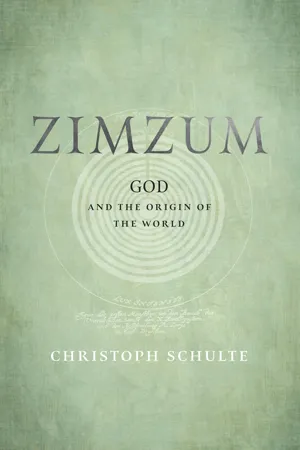
The Hebrew word zimzum originally means "contraction," "withdrawal," "retreat," "limitation," and "concentration." In Kabbalah, zimzum is a term for God's self-limitation, done before creating the world to create the world. Jewish mystic Isaac Luria coined this term in Galilee in the sixteenth century, positing that the God who was "Ein-Sof," unlimited and omnipresent before creation, must concentrate himself in the zimzum and withdraw in order to make room for the creation of the world in God's own center. At the same time, God also limits his infinite omnipotence to allow the finite world to arise. Without the zimzum there is no creation, making zimzum one of the basic concepts of Judaism.
The Lurianic doctrine of the zimzum has been considered an intellectual showpiece of the Kabbalah and of Jewish philosophy. The teaching of the zimzum has appeared in the Kabbalistic literature across Central and Eastern Europe, perhaps most famously in Hasidic literature up to the present day and in philosopher and historian Gershom Scholem's epoch-making research on Jewish mysticism. The Zimzum has fascinated Jewish and Christian theologians, philosophers, and writers like no other Kabbalistic teaching. This can be seen across the philosophy and cultural history of the twentieth century as it gained prominence among such diverse authors and artists as Franz Rosenzweig, Hans Jonas, Isaac Bashevis Singer, Harold Bloom, Barnett Newman, and Anselm Kiefer.
This book follows the traces of the zimzum across the Jewish and Christian intellectual history of Europe and North America over more than four centuries, where Judaism and Christianity, theosophy and philosophy, divine and human, mysticism and literature, Kabbalah and the arts encounter, mix, and cross-fertilize the interpretations and appropriations of this doctrine of God's self-entanglement and limitation.
- 424 pages
- English
- ePUB (mobile friendly)
- Available on iOS & Android
eBook - ePub
About this book
Information
Topic
SozialwissenschaftenSubtopic
Jüdische GeschichteTable of contents
- Cover
- Series Page
- Title Page
- Copyright
- Contents
- Preface to the English Edition
- Introduction
- Chapter 1. Origins in the Holy Land
- Chapter 2. From Esoteric to Exoteric: European Kabbalists Transmitting Texts and Ideas in the First Half of the Seventeenth Century
- Chapter 3. Christians Unveil the Kabbalah in the Seventeenth and Eighteenth Centuries
- Chapter 4. Shabbateans and Anti-Shabbateans
- Chapter 5. The Origins of Chassidism
- Chapter 6. God’s Contraction in German Idealism and Romanticism
- Chapter 7. The Haskalah and Wissenschaft des Judentums
- Chapter 8. Zimzum in the Twentieth Century
- Conclusion. The Anthropology of Zimzum
- Appendix A. Sources on Zimzum: Texts, Art, and Music
- Appendix B. Four Hundred Fifty Years of Zimzum Diffusion
- Notes
- Selected Bibliography
- Index
- Acknowledgments
Trusted by 375,005 students
Access to over 1.5 million titles for a fair monthly price.
Study more efficiently using our study tools.
Frequently asked questions
Yes, you can cancel anytime from the Subscription tab in your account settings on the Perlego website. Your subscription will stay active until the end of your current billing period. Learn how to cancel your subscription
No, books cannot be downloaded as external files, such as PDFs, for use outside of Perlego. However, you can download books within the Perlego app for offline reading on mobile or tablet. Learn how to download books offline
Perlego offers two plans: Essential and Complete
- Essential is ideal for learners and professionals who enjoy exploring a wide range of subjects. Access the Essential Library with 800,000+ trusted titles and best-sellers across business, personal growth, and the humanities. Includes unlimited reading time and Standard Read Aloud voice.
- Complete: Perfect for advanced learners and researchers needing full, unrestricted access. Unlock 1.5M+ books across hundreds of subjects, including academic and specialized titles. The Complete Plan also includes advanced features like Premium Read Aloud and Research Assistant.
We are an online textbook subscription service, where you can get access to an entire online library for less than the price of a single book per month. With over 1.5 million books across 990+ topics, we’ve got you covered! Learn about our mission
Look out for the read-aloud symbol on your next book to see if you can listen to it. The read-aloud tool reads text aloud for you, highlighting the text as it is being read. You can pause it, speed it up and slow it down. Learn more about Read Aloud
Yes! You can use the Perlego app on both iOS and Android devices to read anytime, anywhere — even offline. Perfect for commutes or when you’re on the go.
Please note we cannot support devices running on iOS 13 and Android 7 or earlier. Learn more about using the app
Please note we cannot support devices running on iOS 13 and Android 7 or earlier. Learn more about using the app
Yes, you can access Zimzum by Christoph Schulte, Corey L. Twitchell in PDF and/or ePUB format, as well as other popular books in Sozialwissenschaften & Jüdische Geschichte. We have over 1.5 million books available in our catalogue for you to explore.