How the idea of the author was born in the battleground of gender
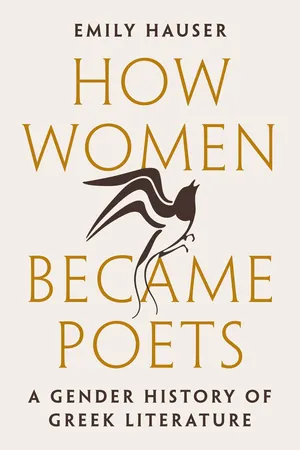
When Sappho sang her songs, the only word that existed to describe a poet was a male one—aoidos, or “singer-man.” The most famous woman poet of ancient Greece, whose craft was one of words, had no words with which to talk about who she was and what she did. In How Women Became Poets, Emily Hauser rewrites the story of Greek literature as one of gender, arguing that the ways the Greeks talked about their identity as poets constructed, played with, and broke down gender expectations that literature was for men alone. Bringing together recent studies in ancient authorship, gender, and performativity, Hauser offers a new history of classical literature that redefines the canon as a constant struggle to be heard through, and sometimes despite, gender.
Women, as Virginia Woolf recognized, need rooms of their own in order to write. So, too, have women writers through history needed a name to describe what it is they do. Hauser traces the invention of that name in ancient Greece, exploring the archaeology of the gendering of the poet. She follows ancient Greek poets, philosophers, and historians as they developed and debated the vocabulary for authorship on the battleground of gender—building up and reinforcing the word for male poet, then in response creating a language with which to describe women who write. Crucially, Hauser reinserts women into the traditionally all-male canon of Greek literature, arguing for the centrality of their role in shaping ideas around authorship and literary production.
- 360 pages
- English
- ePUB (mobile friendly)
- Available on iOS & Android
eBook - ePub
About this book
Information
Publisher
Princeton University PressYear
2023Print ISBN
9780691248769
9780691201078
eBook ISBN
9780691239286
Table of contents
- Cover Page
- Title Page
- Copyright Page
- Dedication
- Epigraphs
- Contents
- Note on Transliterations and Texts
- Acknowledgments
- List of Abbreviations
- Introduction: A Name of One’s Own
- Part I. Lyre: The Singer-Man: Making Poets Male from the Beginning
- Part II. Tool: The Man-Maker: Male Poets Making Male Citizens
- Part III. Wreath: The Female Homer: Toward a Language for Women Poets
- Part IV. Bird: A New Kind of Language: Women Poets in Their Own Words
- Conclusion: Beyond Words
- References
- Index of Passages
- General Index
Trusted by 375,005 students
Access to over 1.5 million titles for a fair monthly price.
Study more efficiently using our study tools.
Frequently asked questions
Yes, you can cancel anytime from the Subscription tab in your account settings on the Perlego website. Your subscription will stay active until the end of your current billing period. Learn how to cancel your subscription
No, books cannot be downloaded as external files, such as PDFs, for use outside of Perlego. However, you can download books within the Perlego app for offline reading on mobile or tablet. Learn how to download books offline
Perlego offers two plans: Essential and Complete
- Essential is ideal for learners and professionals who enjoy exploring a wide range of subjects. Access the Essential Library with 800,000+ trusted titles and best-sellers across business, personal growth, and the humanities. Includes unlimited reading time and Standard Read Aloud voice.
- Complete: Perfect for advanced learners and researchers needing full, unrestricted access. Unlock 1.5M+ books across hundreds of subjects, including academic and specialized titles. The Complete Plan also includes advanced features like Premium Read Aloud and Research Assistant.
We are an online textbook subscription service, where you can get access to an entire online library for less than the price of a single book per month. With over 1.5 million books across 990+ topics, we’ve got you covered! Learn about our mission
Look out for the read-aloud symbol on your next book to see if you can listen to it. The read-aloud tool reads text aloud for you, highlighting the text as it is being read. You can pause it, speed it up and slow it down. Learn more about Read Aloud
Yes! You can use the Perlego app on both iOS and Android devices to read anytime, anywhere — even offline. Perfect for commutes or when you’re on the go.
Please note we cannot support devices running on iOS 13 and Android 7 or earlier. Learn more about using the app
Please note we cannot support devices running on iOS 13 and Android 7 or earlier. Learn more about using the app
Yes, you can access How Women Became Poets by Emily Hauser in PDF and/or ePUB format, as well as other popular books in Literature & Greek Ancient History. We have over 1.5 million books available in our catalogue for you to explore.