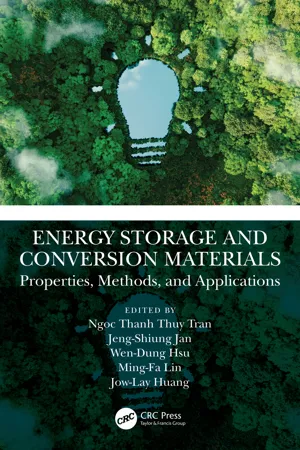
Energy Storage and Conversion Materials
Properties, Methods, and Applications
- 339 pages
- English
- ePUB (mobile friendly)
- Available on iOS & Android
Energy Storage and Conversion Materials
Properties, Methods, and Applications
About this book
This book explores the fundamental properties of a wide range of energy storage and conversion materials, covering mainstream theoretical and experimental studies and their applications in green energy. It presents a thorough investigation of diverse physical, chemical, and material properties of rechargeable batteries, supercapacitors, solar cells, and fuel cells, covering the development of theoretical simulations, machine learning, high-resolution experimental measurements, and excellent device performance.
- Covers potential energy storage (rechargeable batteries and supercapacitors) and energy conversion (solar cells and fuel cells) materials
- Develops theoretical predictions and experimental observations under a unified quasi-particle framework
- Illustrates up-to-date calculation results and experimental measurements
- Describes successful synthesis, fabrication, and measurements, as well as potential applications and near-future challenges
Promoting a deep understanding of basic science, application engineering, and commercial products, this work is appropriate for senior graduate students and researchers in materials, chemical, and energy engineering and related disciplines.
Tools to learn more effectively

Saving Books

Keyword Search

Annotating Text

Listen to it instead
Information
Table of contents
- Cover
- Half Title
- Title Page
- Copyright Page
- Contents
- Preface
- Acknowledgment
- Editors
- Contributors
- Chapter 1 Introduction
- Chapter 2 Molecular Dynamics Simulation of Amorphous Silicon Anode in Li-Ion Batteries
- Chapter 3 Rich Intercalations in Graphite Magnesium Compounds
- Chapter 4 Na-Intercalation Compounds and Na-Ion Batteries
- Chapter 5 Electronic Properties of LiLaTiO4 Compound
- Chapter 6 Electronic Properties of Li2S-Si Heterojunction
- Chapter 7 Electronic and Magnetic Properties of LiMnO2 Compound
- Chapter 8 Surface Property of High-Voltage Cathode LiNiPO4 in Lithium-Ion Batteries: A First-Principles Study
- Chapter 9 Introductory to Machine Learning Method and Its Applications in Li-Ion Batteries
- Chapter 10 SnOx (x = 0,1,2) and Mo Doped SnO2 Nanocomposite as Possible Anode Materials in Lithium-Ion Battery
- Chapter 11 Polymer Electrolytes Based on Ionic Liquid and Poly(ethylene glycol) via in-situ Photopolymerization of Lithium-Ion Batteries
- Chapter 12 Synthesis of Multiporous Carbons with Biomaterials for Applications in Supercapacitors and Capacitive Deionization
- Chapter 13 Low-Dimensional Heterostructure-Based Solar Cells
- Chapter 14 Towards High-Performance Indoor Dye-Sensitized Photovoltaics: A Review of Electrodes and Electrolytes Development
- Chapter 15 Progress and Prospects of Intermediate-Temperature Solid Oxide Fuel Cells
- Chapter 16 Concluding Remarks
- Chapter 17 Energy Resources and Challenges
- Chapter 18 Problems under Classical and Quantum Pictures
- Index
Frequently asked questions
- Essential is ideal for learners and professionals who enjoy exploring a wide range of subjects. Access the Essential Library with 800,000+ trusted titles and best-sellers across business, personal growth, and the humanities. Includes unlimited reading time and Standard Read Aloud voice.
- Complete: Perfect for advanced learners and researchers needing full, unrestricted access. Unlock 1.4M+ books across hundreds of subjects, including academic and specialized titles. The Complete Plan also includes advanced features like Premium Read Aloud and Research Assistant.
Please note we cannot support devices running on iOS 13 and Android 7 or earlier. Learn more about using the app