- 321 pages
- English
- PDF
- Available on iOS & Android
eBook - PDF
About this book
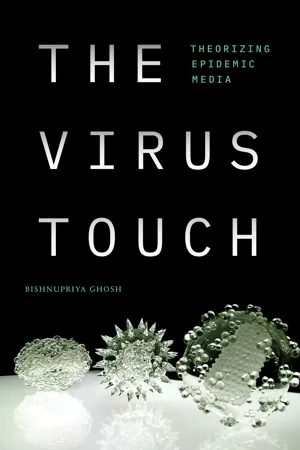
In The Virus Touch Bishnupriya Ghosh argues that media are central to understanding emergent relations between viruses, humans, and nonhuman life. Writing in the shadow of the HIV/AIDS and COVID-19 global pandemics, Ghosh theorizes "epidemic media" to show how epidemics are mediated in images, numbers, and movements through the processes of reading test results and tracking infection and mortality rates. Scientific, artistic, and activist epidemic media that make multispecies relations sensible and manageable eschew anthropocentric survival strategies and instead recast global public health crises as biological, social, and ecological catastrophes, pushing us toward a multispecies politics of health. Ghosh trains her analytic gaze on these mediations as expressed in the collection and analysis of blood samples as a form of viral media; the geospatialization of data that track viral hosts like wild primates; and the use of multisensory images to trace fluctuations in viral mutations. Studying how epidemic media inscribe, store, and transmit multispecies relations attunes us to the anthropogenic drivers of pathogenicity like deforestation or illegal wildlife trading and the vulnerabilities accruing from diseases that arise from socioeconomic inequities and biopolitical neglect.
Information
Publisher
Duke University Press BooksYear
2023Print ISBN
9781478019213
9781478016571
eBook ISBN
9781478023845
Table of contents
- Cover
- Contents
- List of Illustrations
- List of Abbreviations
- Acknowledgments
- Color Plates
- Introduction: Epidemic Media
- 1. The Epidemic Episteme: Health as Multispecies Politics
- 2. The -Morphic Image: Visualizing the Virus
- 3. The Sensible Medium: Clinical Translations of Blood
- 4. The Multispecies Kinesthetic: Tracking Animal Host Movement
- Conclusion: Media Theory (in a Pandemic)
- Notes
- Bibliography
- Index
Trusted by 375,005 students
Access to over 1.5 million titles for a fair monthly price.
Study more efficiently using our study tools.
Frequently asked questions
Yes, you can cancel anytime from the Subscription tab in your account settings on the Perlego website. Your subscription will stay active until the end of your current billing period. Learn how to cancel your subscription
No, books cannot be downloaded as external files, such as PDFs, for use outside of Perlego. However, you can download books within the Perlego app for offline reading on mobile or tablet. Learn how to download books offline
Perlego offers two plans: Essential and Complete
- Essential is ideal for learners and professionals who enjoy exploring a wide range of subjects. Access the Essential Library with 800,000+ trusted titles and best-sellers across business, personal growth, and the humanities. Includes unlimited reading time and Standard Read Aloud voice.
- Complete: Perfect for advanced learners and researchers needing full, unrestricted access. Unlock 1.5M+ books across hundreds of subjects, including academic and specialized titles. The Complete Plan also includes advanced features like Premium Read Aloud and Research Assistant.
We are an online textbook subscription service, where you can get access to an entire online library for less than the price of a single book per month. With over 1.5 million books across 990+ topics, we’ve got you covered! Learn about our mission
Look out for the read-aloud symbol on your next book to see if you can listen to it. The read-aloud tool reads text aloud for you, highlighting the text as it is being read. You can pause it, speed it up and slow it down. Learn more about Read Aloud
Yes! You can use the Perlego app on both iOS and Android devices to read anytime, anywhere — even offline. Perfect for commutes or when you’re on the go.
Please note we cannot support devices running on iOS 13 and Android 7 or earlier. Learn more about using the app
Please note we cannot support devices running on iOS 13 and Android 7 or earlier. Learn more about using the app
Yes, you can access The Virus Touch by Bishnupriya Ghosh in PDF and/or ePUB format, as well as other popular books in Social Sciences & Media Studies. We have over 1.5 million books available in our catalogue for you to explore.