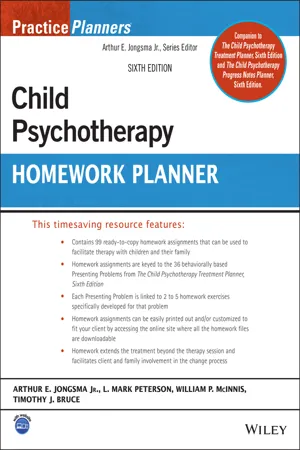
Child Psychotherapy Homework Planner
eBook - PDF

Child Psychotherapy Homework Planner

  1. English
  2. PDF
  3. Available on iOS & Android
eBook - PDF

About this book

Beneficial take-home assignments for young psychotherapy clients and their parents

The Child Psychotherapy Homework Planner, Sixth Edition provides ready-to-use, between-session assignments designed to fit most therapeutic modes. Organized by presenting problem, this homework planner covers 36 issues, including anxiety, depression, adoption, academic underachievement, ADHD, low self-esteem, and PTSD. In this new edition, the homework assignments have been modified to be more accessible to children. Assignment sheets can be easily photocopied, and they are also available online to download and print—making client-specific modification simple. This easy-to-use sourcebook features:

  • Nearly 100 ready-to-copy exercises covering the most common issues encountered by children
  • A format that's easy to navigate, including cross-references to alternate assignments that are relevant across multiple presentations
  • Expert guidance on how and when to make the most efficient use of the exercises
  • Clearly referenced correspondence with the The Child Psychotherapy Treatment Planner for a complete treatment approach

The Child Psychotherapy Homework Planner is a high-quality resource that practitioners can use to improve care and accountability. This is a valuable planner that will save therapists time on office work so they can focus on patients.

Frequently asked questions

Yes, you can cancel anytime from the Subscription tab in your account settings on the Perlego website. Your subscription will stay active until the end of your current billing period. Learn how to cancel your subscription.
No, books cannot be downloaded as external files, such as PDFs, for use outside of Perlego. However, you can download books within the Perlego app for offline reading on mobile or tablet. Learn more here.
Perlego offers two plans: Essential and Complete
  • Essential is ideal for learners and professionals who enjoy exploring a wide range of subjects. Access the Essential Library with 800,000+ trusted titles and best-sellers across business, personal growth, and the humanities. Includes unlimited reading time and Standard Read Aloud voice.
  • Complete: Perfect for advanced learners and researchers needing full, unrestricted access. Unlock 1.4M+ books across hundreds of subjects, including academic and specialized titles. The Complete Plan also includes advanced features like Premium Read Aloud and Research Assistant.
Both plans are available with monthly, semester, or annual billing cycles.
We are an online textbook subscription service, where you can get access to an entire online library for less than the price of a single book per month. With over 1 million books across 1000+ topics, we’ve got you covered! Learn more here.
Look out for the read-aloud symbol on your next book to see if you can listen to it. The read-aloud tool reads text aloud for you, highlighting the text as it is being read. You can pause it, speed it up and slow it down. Learn more here.
Yes! You can use the Perlego app on both iOS or Android devices to read anytime, anywhere — even offline. Perfect for commutes or when you’re on the go.
Please note we cannot support devices running on iOS 13 and Android 7 or earlier. Learn more about using the app.
Yes, you can access Child Psychotherapy Homework Planner by Arthur E. Jongsma, Jr.,L. Mark Peterson,William P. McInnis,Timothy J. Bruce in PDF and/or ePUB format, as well as other popular books in Psychology & Psychotherapy. We have over one million books available in our catalogue for you to explore.

Information

Publisher
Wiley
Year
2023
Print ISBN
9781119981619
eBook ISBN
9781119981633
Edition
6

Table of contents

  1. Cover
  2. Title Page
  3. Copyright Page
  4. Contents
  5. About the Downloadable Assignments
  6. Wiley PracticePlannersĀ® Series Preface
  7. Acknowledgments
  8. Introduction
  9. Section 1: Academic Underachievement
  10. Section 2: Adoption
  11. Section 3: Anger Control Problems
  12. Section 4: Anxiety
  13. Section 5: Attention-Deficit/Hyperactivity Disorder (ADHD)
  14. Section 6: Autism Spectrum Disorder (ASD)
  15. Section 7: Blended Family
  16. Section 8: Bullying/Aggression Perpetrator
  17. Section 9: Bullying/Aggression Victim
  18. Section 10: Conduct Disorder/Delinquency
  19. Section 11: Depression
  20. Section 12: Disruptive Mood Dysregulation Disorder (DMDD)
  21. Section 13: Divorce Reaction
  22. Section 14: Enuresis/Encopresis
  23. Section 15: Fire Setting
  24. Section 16: Gender Dysphoria
  25. Section 17: Grief/Loss Unresolved
  26. Section 18: Intellectual Disability
  27. Section 19: Low Self-Esteem
  28. Section 20: Lying/Manipulative
  29. Section 21: Medical Condition
  30. Section 22: Obsessive-Compulsive Disorder (OCD)
  31. Section 23: Oppositional Defiant
  32. Section 24: Overweight/Obesity
  33. Section 25: Parenting
  34. Section 26: Peer/Sibling Conflict
  35. Section 27: Physical/Emotional Abuse Victim
  36. Section 28: Posttraumatic Stress Disorder (PTSD)
  37. Section 29: Reactive Attachment/Disinhibited Social Engagement Disorder
  38. Section 30: School Refusal
  39. Section 31: Separation Anxiety
  40. Section 32: Sexual Abuse Victim
  41. Section 33: Sleep Disturbance
  42. Section 34: Social Anxiety
  43. Section 35: Specific Phobia
  44. Section 36: Speech/Language Disorders
  45. Appendix A: Alternate Assignments for Presenting Problems
  46. Appendix B: Alphabetical Index of Exercises
  47. EULA