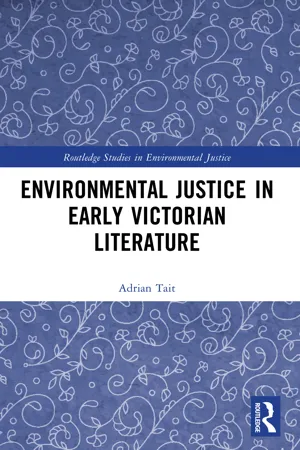
Environmental Justice in Early Victorian Literature
eBook - ePub

Environmental Justice in Early Victorian Literature

  1. 248 pages
  2. English
  3. ePUB (mobile friendly)
  4. Available on iOS & Android
eBook - ePub

Environmental Justice in Early Victorian Literature

About this book

This innovative new book combines environmental justice scholarship with a material ecocriticism to explore the way in which early Victorian literature (1837–1860) responded to the growing problem of environmental injustice.

As this book emphasises, environmental injustice – simply, the convergence of poverty and pollution – was not an isolated phenomenon, but a structural form of inequality; a product of industrial modernity's radical reformation of British society, it particularly affected the working classes. As each chapter reveals in detail, this form of environmental inequality (or 'classism') drew sharply critical reactions from figures as diverse as Thomas Carlyle, Friedrich Engels, Charles Dickens, and John Ruskin, and from within the Chartist movement, as working-class writers themselves reacted to the hazardous realities of a divided society. But as this book also reveals, these writers recognised that a truly just society respects the needs of the nonhuman and takes account of the material world in all its own aliveness; even if only tentatively, they reached for a more inclusive, emergent form of justice that might address the social and ecological impacts of industrial modernity, an idea which is no less relevant today.

This book represents an indispensable resource for scholars and students working in the fields of Victorian literature, environmental justice, and ecocriticism.

Frequently asked questions

Yes, you can cancel anytime from the Subscription tab in your account settings on the Perlego website. Your subscription will stay active until the end of your current billing period. Learn how to cancel your subscription.
No, books cannot be downloaded as external files, such as PDFs, for use outside of Perlego. However, you can download books within the Perlego app for offline reading on mobile or tablet. Learn more here.
Perlego offers two plans: Essential and Complete
  • Essential is ideal for learners and professionals who enjoy exploring a wide range of subjects. Access the Essential Library with 800,000+ trusted titles and best-sellers across business, personal growth, and the humanities. Includes unlimited reading time and Standard Read Aloud voice.
  • Complete: Perfect for advanced learners and researchers needing full, unrestricted access. Unlock 1.4M+ books across hundreds of subjects, including academic and specialized titles. The Complete Plan also includes advanced features like Premium Read Aloud and Research Assistant.
Both plans are available with monthly, semester, or annual billing cycles.
We are an online textbook subscription service, where you can get access to an entire online library for less than the price of a single book per month. With over 1 million books across 1000+ topics, we’ve got you covered! Learn more here.
Look out for the read-aloud symbol on your next book to see if you can listen to it. The read-aloud tool reads text aloud for you, highlighting the text as it is being read. You can pause it, speed it up and slow it down. Learn more here.
Yes! You can use the Perlego app on both iOS or Android devices to read anytime, anywhere — even offline. Perfect for commutes or when you’re on the go.
Please note we cannot support devices running on iOS 13 and Android 7 or earlier. Learn more about using the app.
Yes, you can access Environmental Justice in Early Victorian Literature by Adrian Tait in PDF and/or ePUB format, as well as other popular books in Literature & Ecology. We have over one million books available in our catalogue for you to explore.

Information

Publisher
Routledge
Year
2023
Print ISBN
9780367420789
eBook ISBN
9781000923124
Subtopic
Ecology

Table of contents

  1. Cover
  2. Half-Title
  3. Series
  4. Title
  5. Copyright
  6. Dedication
  7. Contents
  8. Preface
  9. Acknowledgements
  10. Introduction: The Victorian experience of environmental injustice
  11. 1 Thomas Carlyle’s ‘Condition-of-England Question’
  12. 2 Friedrich Engels, environmental classism, and ‘social murder’
  13. 3 Environmental determinism and the Chartist counter-narrative
  14. 4 Seeking justice in Charles Dickens’s Bleak House
  15. 5 Beyond class, gender, species? Charles Dickens’s Hard Times
  16. 6 John Ruskin’s Unto this Last: towards a ‘deeper felicity’
  17. Conclusion: Looking forward
  18. Index