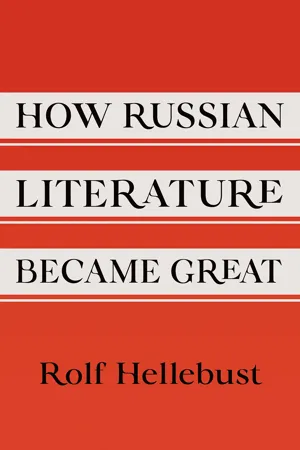
How Russian Literature Became Great
eBook - ePub

How Russian Literature Became Great

  1. 264 pages
  2. English
  3. ePUB (mobile friendly)
  4. Available on iOS & Android
eBook - ePub

How Russian Literature Became Great

About this book

How Russian Literature Became Great explores the cultural and political role of a modern national literature, orchestrated in a Slavonic key but resonating far beyond Russia's borders.

Rolf Hellebust investigates a range of literary tendencies, philosophies, and theories from antiquity to the present: Roman jurisprudence to German Romanticism, French Enlightenment to Czech Structuralism, Herder to Hobsbawm, Samuel Johnson to Sainte-Beuve, and so on. Besides the usual Russian suspects from Pushkin to Chekhov, Hellebust includes European writers: Byron and Shelley, Goethe and Schiller, Chateaubriand and Baudelaire, Dante, Mickiewicz, and more.

As elsewhere, writing in Russia advertises itself via a canon of literary monuments constituting an atemporal "ideal order among themselves" (T.S. Eliot). And yet this is a tradition that could only have been born at a specific moment in the golden nineteenth-century age of historiography and nation-building. The Russian example reveals the contradictions between immutability and innovation, universality and specificity at the heart of modern conceptions of tradition from Sainte-Beuve through Eliot and down to the present day.

The conditions of its era of formation—the prominence of the crucial literary-historical question of the writer's social function, and the equation of literature with national identity—make the Russian classical tradition the epitome of a unified cultural text, with a complex narrative in which competing stories of progress and decline unfold through the symbolic biographical encounters of the authors who constitute its members. How Russian Literature Became Great thus offers a new paradigm for understanding the paradoxes of modern tradition.

Frequently asked questions

Yes, you can cancel anytime from the Subscription tab in your account settings on the Perlego website. Your subscription will stay active until the end of your current billing period. Learn how to cancel your subscription.
No, books cannot be downloaded as external files, such as PDFs, for use outside of Perlego. However, you can download books within the Perlego app for offline reading on mobile or tablet. Learn more here.
Perlego offers two plans: Essential and Complete
  • Essential is ideal for learners and professionals who enjoy exploring a wide range of subjects. Access the Essential Library with 800,000+ trusted titles and best-sellers across business, personal growth, and the humanities. Includes unlimited reading time and Standard Read Aloud voice.
  • Complete: Perfect for advanced learners and researchers needing full, unrestricted access. Unlock 1.4M+ books across hundreds of subjects, including academic and specialized titles. The Complete Plan also includes advanced features like Premium Read Aloud and Research Assistant.
Both plans are available with monthly, semester, or annual billing cycles.
We are an online textbook subscription service, where you can get access to an entire online library for less than the price of a single book per month. With over 1 million books across 1000+ topics, we’ve got you covered! Learn more here.
Look out for the read-aloud symbol on your next book to see if you can listen to it. The read-aloud tool reads text aloud for you, highlighting the text as it is being read. You can pause it, speed it up and slow it down. Learn more here.
Yes! You can use the Perlego app on both iOS or Android devices to read anytime, anywhere — even offline. Perfect for commutes or when you’re on the go.
Please note we cannot support devices running on iOS 13 and Android 7 or earlier. Learn more about using the app.
Yes, you can access How Russian Literature Became Great by Rolf Hellebust in PDF and/or ePUB format. We have over one million books available in our catalogue for you to explore.

Table of contents

  1. Acknowledgments
  2. Introduction
  3. Part One: The Idea of a Literary Tradition
  4. Part Two: Seeking a Text for Russian Culture
  5. Part Three: The Narrative Structure of the Nineteenth-Century Russian Literary Tradition
  6. Conclusion
  7. Notes
  8. Works Cited
  9. Index