- 240 pages
- English
- ePUB (mobile friendly)
- Available on iOS & Android
eBook - ePub
About this book
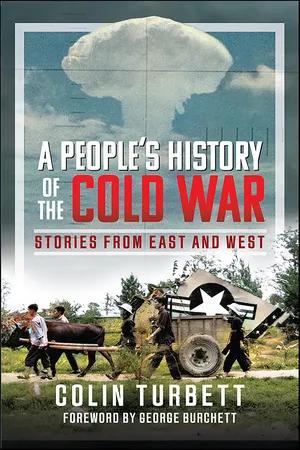
Between the closing battles of the Second World War and the collapse of the Soviet Union in 1991, the Cold War cast a shadow over the lives of people throughout the world. while open conflict was avoided between the ideologically competing superpowers and their principal allies, millions died in battlegrounds in parts of the world that were usually far from Moscow, Washington and London. The threat of nuclear annihilation was omnipresent, but at the same time mutually assured destruction tempered conflict and focused minds. Subtle (and not so subtle) attempts to influence popular opinion either way were apparent in everyday life on both sides of the divide. while the power of the dollar and the burgeoning costs of the arms race eventually broke the Soviet economy, the idea that capitalism 'won' the the Cold War seems misplaced, especially if one considers events that have happened since, including very recent armed conflict. The book takes the reader through main events of the period, but focuses on the impact on ordinary citizens East and West and the view of events from their perspective. This is a story of how economies on both sides were built around war preparations and the advance of destructive technologies that had no social benefits apart from the provision of employment. Sources used are unusual in not fitting the western-based narratives that pervade both academic histories and popular accounts. However, this book is not an apology for the more oppressive aspects of Soviet policy as the USSR struggled to build 'really existing socialism' within its own borders and the Eastern Bloc countries under its immediate influence. Instead, it brings a people's perspective from both sides onto this important period of recent history, whose consequences are very much still with us as we face modern challenges around climate change and growing inequality across our world. A People's History of the Cold War – Stories from East and West captures the mood of the times with its extensive contemporary illustrations.
Information
Subtopic
20th Century HistoryIndex
HistoryTable of contents
- Cover
- Title
- Copyright
- Contents
- Foreword
- Acknowledgements
- Key Definitions Used Throughout the Book
- Abbreviations
- Introduction
- Chapter 1 The Cold War – a Timeline of Significant Events
- Chapter 2 Whose Victory? – The End of the Second World War and the Division of Germany
- Chapter 3 Armageddon Beckoning – Mutually Assured Destruction and the Myth of Defence
- Chapter 4 The Military Industrial Complex and the Profitable Race to Go Further and Faster
- Chapter 5 Proxy Wars or Chimes of Freedom Flashing? – Decolonisation and National Liberation, from Korea to Afghanistan
- Chapter 6 Resistance, Dissent and Protest at Home
- Chapter 7 The War of Words – Ideology and Propaganda
- Chapter 8 Tuning In to The Cold War – Stories 1
- Chapter 9 Cold War Frontlines – Stories 2
- Chapter 10 The 1980s and the End of Really Existing Socialism
- Chapter 11 Afterword – the Legacy of the Cold War
- Appendix: Wilfred Burchett (1911–1983)
- Bibliography
Trusted by 375,005 students
Access to over 1.5 million titles for a fair monthly price.
Study more efficiently using our study tools.
Frequently asked questions
Yes, you can cancel anytime from the Subscription tab in your account settings on the Perlego website. Your subscription will stay active until the end of your current billing period. Learn how to cancel your subscription
No, books cannot be downloaded as external files, such as PDFs, for use outside of Perlego. However, you can download books within the Perlego app for offline reading on mobile or tablet. Learn how to download books offline
Perlego offers two plans: Essential and Complete
- Essential is ideal for learners and professionals who enjoy exploring a wide range of subjects. Access the Essential Library with 800,000+ trusted titles and best-sellers across business, personal growth, and the humanities. Includes unlimited reading time and Standard Read Aloud voice.
- Complete: Perfect for advanced learners and researchers needing full, unrestricted access. Unlock 1.5M+ books across hundreds of subjects, including academic and specialized titles. The Complete Plan also includes advanced features like Premium Read Aloud and Research Assistant.
We are an online textbook subscription service, where you can get access to an entire online library for less than the price of a single book per month. With over 1.5 million books across 990+ topics, we’ve got you covered! Learn about our mission
Look out for the read-aloud symbol on your next book to see if you can listen to it. The read-aloud tool reads text aloud for you, highlighting the text as it is being read. You can pause it, speed it up and slow it down. Learn more about Read Aloud
Yes! You can use the Perlego app on both iOS and Android devices to read anytime, anywhere — even offline. Perfect for commutes or when you’re on the go.
Please note we cannot support devices running on iOS 13 and Android 7 or earlier. Learn more about using the app
Please note we cannot support devices running on iOS 13 and Android 7 or earlier. Learn more about using the app
Yes, you can access A People's History of the Cold War by Colin Turbett in PDF and/or ePUB format, as well as other popular books in History & 20th Century History. We have over 1.5 million books available in our catalogue for you to explore.