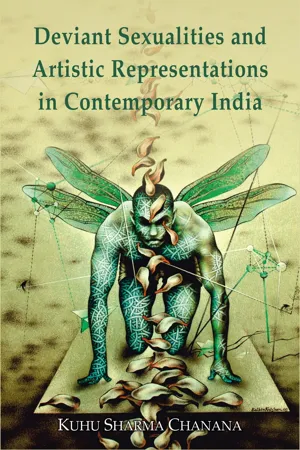
Representation of non-normative sexualities is still a tantalizing dream in India, even within the oblique and supposedly more liberal platforms like art and literature. Catering to this need, this study focuses on the exploration of the deviant sexualities in cinema, photography and literature, specially in the Indian context. Unfortunately, even within the queer artistic explorations, hijras have not been much represented and therefore the first part of the book aims to excavate the multiplicity of the transgender lives by analysing various art forms, having transgender cinema and hijra photographic series as the major thrust areas. These tales of plain subjugation hide convoluted issues like necropolitics, overlap among sports, gender identity and nationalism, crazy-queen syndrome, pansexuality, transfeminism and transmisogyny.
The second part of this book deals with the contemporary gay and lesbian literature and how a specific kind of spatial appropriation is visible there. Through these artistic works, there is an attempt to excavate the specific Indian queer spatial experiences which are quite different from the visibility-centric coming out narratives of the West. As opposed to perceiving invisibility only as a monolithic technique of erasure, these works demonstrate that secrecy and camouflage are also strategies to combat the insidious effects of homophobia. And since Indian spatial configuration produces many homosocial spaces, the unique coexistence of homo and hetero desires is a specific feature of Indian ethos. Thus, the mutually symbiotic relationship between art and emancipatory politics is quite evident from the detailed discussion on various art forms that depict queer lives. The key issues that have been explored through this book are necropolitics, issues surrounding sex-reassignment surgery (SRS), transfeminism, exploration of queer geographies including death scapes, AIDs citizenship and queer flânerie. It indubitably legitimizes somewhat the role of art in queer politics at a fundamental level.
eBook - ePub
Deviant Sexualities and Artistic Representations in Contemporary India
- English
- ePUB (mobile friendly)
- Available on iOS & Android
eBook - ePub
Deviant Sexualities and Artistic Representations in Contemporary India
About this book
Information
Topic
Scienze socialiSubtopic
Studi su tematiche LGBTTable of contents
- Acknowledgements
- Introduction
- 1. Questions of Adaptation Techniques and Spectatorship as Raised through Mainstream Transgender Cinema
- 2. The Ontology of Hijras: Analysis of the Various Photographic Series by Anita Khemka, Tejal Shah and Takeshi Ishikawa
- 3. Travelling Imagination and Gay Spatial Consumption: Critique of the Works of Raj Rao and Nikhil Yadav
- 4. Deathscapes, Decaying Bodies and Queer Citizenship: In the Contemporary Writings of R. Raj Rao, Dibyajyoti Sarma and Arundhati Roy
- 5. Negotiating Boundaries: Exotic Geographies, Gay Bars and Parks in the Writings of Mahesh Dattani, Raj Rao and Sandip Roy
- 6. Lesbian Leanings and Spatial Transgressions: As Reflected in the Writings of Ismat Chughtai,Keval Sood, Sitara Sachdev, Karishma Kripalani and Mary Anne Mohanraj
- Bibliography
- Index
- Name Index
Trusted by 375,005 students
Access to over 1.5 million titles for a fair monthly price.
Study more efficiently using our study tools.
Frequently asked questions
Yes, you can cancel anytime from the Subscription tab in your account settings on the Perlego website. Your subscription will stay active until the end of your current billing period. Learn how to cancel your subscription
No, books cannot be downloaded as external files, such as PDFs, for use outside of Perlego. However, you can download books within the Perlego app for offline reading on mobile or tablet. Learn how to download books offline
Perlego offers two plans: Essential and Complete
- Essential is ideal for learners and professionals who enjoy exploring a wide range of subjects. Access the Essential Library with 800,000+ trusted titles and best-sellers across business, personal growth, and the humanities. Includes unlimited reading time and Standard Read Aloud voice.
- Complete: Perfect for advanced learners and researchers needing full, unrestricted access. Unlock 1.5M+ books across hundreds of subjects, including academic and specialized titles. The Complete Plan also includes advanced features like Premium Read Aloud and Research Assistant.
We are an online textbook subscription service, where you can get access to an entire online library for less than the price of a single book per month. With over 1.5 million books across 990+ topics, we’ve got you covered! Learn about our mission
Look out for the read-aloud symbol on your next book to see if you can listen to it. The read-aloud tool reads text aloud for you, highlighting the text as it is being read. You can pause it, speed it up and slow it down. Learn more about Read Aloud
Yes! You can use the Perlego app on both iOS and Android devices to read anytime, anywhere — even offline. Perfect for commutes or when you’re on the go.
Please note we cannot support devices running on iOS 13 and Android 7 or earlier. Learn more about using the app
Please note we cannot support devices running on iOS 13 and Android 7 or earlier. Learn more about using the app
Yes, you can access Deviant Sexualities and Artistic Representations in Contemporary India by Kuhu Sharma Chanana in PDF and/or ePUB format, as well as other popular books in Scienze sociali & Studi su tematiche LGBT. We have over 1.5 million books available in our catalogue for you to explore.