eBook - ePub
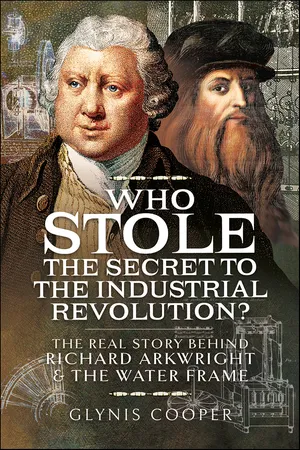
Who Stole the Secret to the Industrial Revolution?
The Real Story Behind Richard Arkwright & the Water Frame
- 184 pages
- English
- ePUB (mobile friendly)
- Available on iOS & Android
eBook - ePub
Who Stole the Secret to the Industrial Revolution?
The Real Story Behind Richard Arkwright & the Water Frame
About this book
English schoolchildren are taught that Sir Richard Arkwright 'invented the water-frame and was the father of the Industrial Revolution and the factory system.' That is simply not true. The water-powered spinning frame and the 'modern factory system' were pioneered in Italy over 300 years before Richard Arkwright was born. This book tells the story of how the Industrial Revolution in textile manufacture really began. Not in England with Richard Arkwright and the English cotton industry, but in Italy, with Italian Renaissance engineers and the Italian silk industry. Proof lies in the achievements of medieval Italian engineering, English archives and English legal case records. Italy was the leading technological power in Europe from the 13th to the 17th centuries. The Italian Renaissance and the devastation caused by the Black Death (1347-49) brought forth a wealth of technological innovation and invention and the Italians automated much of the production of silk fabrics, using water as their power source, because there were no longer enough people left alive to carry out the work. English organzine was inferior to Italian organzine. In the first recorded case of industrial espionage a young Derby engineer resolved to steal Italian silk manufacturing secrets. Water powered silk throwing machinery, reconstructed by John Lombe from his stolen plans and drawings, provided the blueprint for water powered cotton spinning machinery (water frame), and Cromford Mill, (built 1771), was modelled on Derby Silk Mill (built 1719). This book marks the 300th anniversary of John Lombe's premature death. Part of the mystery surrounding his actions is why has the truth been concealed for so long and why has the Italian connection remained unacknowledged? It is time to place this episode of history in a proper context, to set the record straight, and to fully acknowledge the part played by Italy in the English Industrial Revolution.
Information
Subtopic
European HistoryIndex
HistoryTable of contents
- Cover
- Title
- Copyright
- Contents
- Foreword
- Introduction
- Chapter 1 Brief History of Silk
- Chapter 2 Italian Industrial History before the Black Death 1347–1349
- Chapter 3 Italian Silk-Spinning and Throwing Machinery Powered by Wind and Water in Medieval Times
- Chapter 4 Italian Medieval and Renaissance Engineers and Inventors
- Chapter 5 Savants in Eighteenth-Century Italy
- Chapter 6 The English Silk Industry and the Growth of other English Textile Industries
- Chapter 7 The English Industrial Revolution from 1700 onwards
- Chapter 8 The English Silk Industry and the Lombe Family
- Chapter 9 The Lombe Patent of 1719
- Chapter 10 Derby Silk Mill
- Chapter 11 End of the Lombe Monopoly
- Chapter 12 The Eighteenth-Century Silk Industry in England after 1732
- Chapter 13 The Water Frame Controversy and Richard Arkwright
- Chapter 14 The Early Court Cases
- Chapter 15 The Final Case against Richard Arkwright
- Chapter 16 Aftermath of the Court Cases
- Chapter 17 An English Postscript
- Chapter 18 An Italian Postscript
- Epilogue
- Bibliography
- Institutions
- Timeline
- Plates
Trusted by 375,005 students
Access to over 1.5 million titles for a fair monthly price.
Study more efficiently using our study tools.
Frequently asked questions
Yes, you can cancel anytime from the Subscription tab in your account settings on the Perlego website. Your subscription will stay active until the end of your current billing period. Learn how to cancel your subscription
No, books cannot be downloaded as external files, such as PDFs, for use outside of Perlego. However, you can download books within the Perlego app for offline reading on mobile or tablet. Learn how to download books offline
Perlego offers two plans: Essential and Complete
- Essential is ideal for learners and professionals who enjoy exploring a wide range of subjects. Access the Essential Library with 800,000+ trusted titles and best-sellers across business, personal growth, and the humanities. Includes unlimited reading time and Standard Read Aloud voice.
- Complete: Perfect for advanced learners and researchers needing full, unrestricted access. Unlock 1.5M+ books across hundreds of subjects, including academic and specialized titles. The Complete Plan also includes advanced features like Premium Read Aloud and Research Assistant.
We are an online textbook subscription service, where you can get access to an entire online library for less than the price of a single book per month. With over 1.5 million books across 990+ topics, we’ve got you covered! Learn about our mission
Look out for the read-aloud symbol on your next book to see if you can listen to it. The read-aloud tool reads text aloud for you, highlighting the text as it is being read. You can pause it, speed it up and slow it down. Learn more about Read Aloud
Yes! You can use the Perlego app on both iOS and Android devices to read anytime, anywhere — even offline. Perfect for commutes or when you’re on the go.
Please note we cannot support devices running on iOS 13 and Android 7 or earlier. Learn more about using the app
Please note we cannot support devices running on iOS 13 and Android 7 or earlier. Learn more about using the app
Yes, you can access Who Stole the Secret to the Industrial Revolution? by Glynis Cooper in PDF and/or ePUB format, as well as other popular books in History & European History. We have over 1.5 million books available in our catalogue for you to explore.