Stories of combat from a man who embedded with Chechen guerrilla forces: "His insights . . . are second to none." —Thomas de Waal, author of
Black Garden
Books on guerrilla war are seldom written from the tactical perspective, and even less seldom from the guerrilla's perspective.
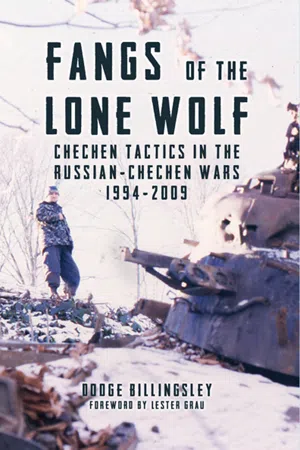
Fangs of the Lone Wolf: Chechen Tactics in the Russian-Chechen Wars 1994-2009 is an exception. These are the stories of low-level guerrilla combat as told by the survivors. They cover fighting from the cities of Grozny and Argun to the villages of Bamut and Serzhen-yurt, and finally the hills, river valleys, and mountains that make up so much of Chechnya.
The author embedded with Chechen guerrilla forces and knows the conflict, country, and culture. Yet, as a Western outsider, he is able to maintain perspective and objectivity. He traveled extensively to interview Chechen former combatants now displaced, some in hiding or on the run from Russian retribution and justice. Crisp narration, organization by type of combat, accurate color maps, and insightful analysis and commentary help to convey the complexity of "simple guerrilla tactics" and the demands on individual perseverance and endurance that guerrilla warfare exacts.
The book is organized into vignettes that provide insight on the nature of both Chechen and Russian tactics utilized during the two wars. They show the chronic problem of guerrilla logistics, the necessity of digging in fighting positions, the value of the correct use of terrain and the price paid in individual discipline and unit cohesion when guerrillas are not bound by a military code and law. Guerrilla warfare is probably as old as man, but has been overshadowed by maneuver war by modern armies and recent developments in the technology of war. As Iraq, Afghanistan, the Philippines, and Chechnya demonstrate, guerrilla war is not only still viable, but increasingly common.
Fangs of the Lone Wolf provides a unique insight into what is becoming modern and future war.
Includes maps and photographs
eBook - ePub
Fangs of the Lone Wolf
Chechen Tactics in the Russian-Chechen War 1994–2009
- 208 pages
- English
- ePUB (mobile friendly)
- Available on iOS & Android
eBook - ePub
About this book
Information
Print ISBN
9781909384774
Subtopic
Russian History-- Chapter One --
A Brief History of the Chechen Conflict
This work is not meant to be a retelling of the history of the Russian-Chechen War, as there have been many publications that have already addressed that in sufficient detail. Still, when examining Chechen combatant tactics it helps to have a basic understanding of the events, conditions and patterns that make up the conflict in order to anchor the events examined into their historical context. The post-Soviet history of Chechnya, while dominated by conflict, can be characterized by and divided into the following parts; a pre-war period and path to confrontation (1991-1994), the first war (1994-1996), the interwar period (1996-1999), and the second war (1999-2009).1
As the Soviet Union dissolved, Russian President Boris Yeltsin encouraged peoples to ‘grab as much freedom as they can.’ This was directed at the major ethnic groups in such distinct former Soviet Republics such as the Ukraine, Kazakhstan, Uzbekistan and the Baltic Republics. Chechnya “grabbed” its freedom and declared independence from Russia; however, Yeltsin, had not included the Chechens among the people that should grab their freedom for many reasons, including the following: Chechnya sits on the southern mountain wall of Russia, blocking the Caucasus region from southern peoples; Chechnya’s 30 oilfields produce low-sulfur oil that requires little refining to produce high-grade aviation fuel; a major oil pipeline crossing Chechnya and Grozny was a major oil-refining center.
Chechnya is a small country. Northern Chechnya consists of plains and lowlands and is cut off from the rest of the country by the Terek River. South of the Terek a long hill mass stretches east to west. The hill mass is bordered to its south by the Sunzha River. The bulk of the population lives in the rolling plains that lie between the Sunzha River and the northern face of the Caucasus mountains.
Russia and Chechnya have a long history of confrontation and conflict. The path to the current confrontation turned violent when Moscow-supported Chechen opposition forces tried to topple Chechen President Djokhar Dudaev’s regime and seize power on two occasions, first in summer 1994 and then again in late fall 1994. Both attempts to destroy Dudaev’s regime failed miserably. The second attempt rallied separatist Chechens when it became apparent that the coup attempt had been supported by Russian tanks and crews.
Russian forces rolled into the tiny republic shortly afterwards, intent on seizing the capital city of Grozny and destroying Dudaev’s “bandit” regime once and for all. On New Year’s Eve 1994 Russian armored units struck the capital of Grozny. The three-pronged advance turned into a significant loss for the Russians as Chechen combatants were able to destroy, pin down and capture most of the enemy combatants in the capital, forcing the Russians to pull back, regroup and strike the city with aircraft and artillery. Russian military might was finally able to force the Chechens to retreat from Grozny in February 1995. The Chechen combatants fanned out from Grozny towards the second largest city, Argun, and into the villages on the plains. Clinging to fixed positions, the Chechens took devastating losses against the Russians, who could bring their tanks, artillery, and air assets to bear against the Chechen positions before Chechens could get within maximum effective range of their primary weapon system, the RPG.
By June 1995 the Chechen insurgency had lost all the major cities and towns. On General Aslan Maskhadov’s orders the Chechen insurgency abandoned the conventional struggle and shifted to guerrilla warfare, utilizing the mountains that had always been important to Chechen national survival. It was a raid in late June 1995, however, that had the most impact of any Chechen combat during the first war. When studying Chechen tactics, most readers are likely to be familiar with what has become known as the four “spectaculars,” the four large-scale hostage-taking operations on Russian territory outside of Chechnya between 1995 and 2004. The fortunes of the first war were dramatically changed by Shamil Basaev’s June 1995 raid into Russia, which ended with the hospital siege at Buddennovsk. The raid led to a ceasefire in Chechnya and the safe return of Basaev and his fellow combatants to Chechen territory. His action has been widely credited within Chechnya as the turning point in the conflict in favor of the separatist insurgency.
The raid’s success inspired others in Chechnya to do the same. In January 1996 another Chechen commander, Salman Raduev, attacked a Russian air base in nearby Kizlar, ending with a hostage-taking operation and battle against Russian forces in Pervomayskoye in neighboring Dagestan. Raduev’s raid was a copycat operation, which yielded nothing positive for the Chechen side of the war and led to increased hostilities in the spring of 1996 between Russian federal forces and Chechen combatant units.
In early March 1996 the Chechens conducted a remarkable raid into Grozny, laying siege to most of the Russian positions in the city before withdrawing three days later. The attack was well planned and demonstrated that the Chechens were capable of striking Russian forces across a broad front. Chechen veterans of the operation claim the attack was meant to demonstrate that they could still operate against Russian forces, while also serving as a dress rehearsal for the yet to be planned final assault on Russian forces occupying Grozny.
In August 1996 the Chechens attacked Grozny again, killing, capturing or encircling all the Russian units in the city. This third and final battle for Grozny was the last battle of the first war. Weeks later Russian President Boris Yeltsin accepted de facto Chechen independence and signed the Khasavyurt Accord.2
With the war behind them and the withdrawal of Russian forces from Chechnya, the Chechens set out to rebuild their fragile nation state. The interwar years in Chechnya were chaotic. Establishing a functioning state proved difficult for the Chechen leadership. Former warlords or commanders dominated politics. No single instrument of state power was strong enough to demobilize the various combatant forces. Divisions over religion were also surfacing. Rule of law broke down and kidnapping became rampant throughout the republic. For the record, most Chechen veteran combatants state that these actions go contrary to Chechen culture and blame Russians and pro-Russian Chechens for these crimes. However, there is ample evidence that many Chechens from both camps were involved in the kidnapping trade, perhaps with collaboration with various Russian elements.3
During the interwar period Chechen attacks against Russian positions surrounding the republic were not common, but did take place. On 22 December 1997 a multi-ethnic combatant group attacked the 136th Armored Brigade of the 58th Army in Buinaksk, Dagestan. Chechen sources reported the destruction of all 300 vehicles at the base, including 50 brand-new T-72 tanks, while Russian sources reported only 10 armored vehicles destroyed and 15 damaged vehicles. The mixed force successfully retreated across the Terek River and back into Chechen territory.4
A year and a half later, the second war began on the heels of two controversial events. On 7 August 1999, the Islamic International Brigade (IIB), under the command of Basaev and al Khattab (a Wahabi Arab who commanded foreign fundamentalist forces in Chechnya), invaded Dagestan in support of the Shura of Dagestan. Russian units responded with force and the brigade was forced to retreat back into Chechen territory. The short lived incursion served as the casus belli for the Second Chechen War.5
Whatever the reasons, the Second Russian-Chechen war began in late August 1999 with the aerial bombardment of Grozny. On 1 October 1999 Russian troops entered the Chechen Republic, surrounding the capital and seizing the strategic heights in southern Chechnya. Unlike the initial battle for Grozny in the first war, the Russian forces were able to successfully seal off the southern escape routes from Grozny and methodically begin taking the city block-by-block. According to plan the Chechens began withdrawing from Grozny on the night of 31 January 2000. It was not the easy walk out of the city that it had been five years earlier. Most of the force, as many as two or three thousand combatants led by Shamil Basaev and many other notable commanders, was caught in a Russian minefield and artillery barrage while exiting Grozny. As many as 600 Chechens and 9 major commanders, including Lecha Dudaev and Khunkar-Pasha Israpilov, were killed. Shamil Basaev lost his foot in the retreat.
Chechnya is a small country with a population of about one million. Combat attrition played a significant role in changing the nature of the conflict. Senior leaders were killed and replaced by junior leaders. Personnel losses were harder and harder to replace. Two months later another major Chechen commander, Ruslan (Khamzat) Galaev, and his men were trapped by Russian forces in his home village of Komsomolskoye. Additional Chechen units and individuals who came to the village to help were trapped as well. As many as 800 Chechen combatants were killed or captured during the battle.
These two costly confrontations devastated the original Chechen separatist movement, as many of the leaders and rank and file combatants were now gone. There were still many separatists in Chechnya after these events, including Chechen president elect Aslan Maskhadov. However, many of the new combatants and leaders, such as Doku Umarov, who was a junior commander under Galaev, were more radical. Major leaders like Basaev were shifting the cause from Chechen separatism to a trans-regional Islamic jihad.
While the very rationale of the Chechen resistance seemed to be changing, the second war ground on. By late spring/early summer 2000 the Chechens had given up all fixed positions and reverted to guerrilla war. Periodic strikes against targets in Grozny and other Russian-occupied population centers occurred, but there were no significant operations against Grozny or other locations of Russian power as there had been during the first war. The Chechen forces lacked the manpower, materiel, and, more frequently, local support.
Attrition, desperation and radicalization led to an increased number of small-scale terrorist attacks in Russian territory and two additional “spectaculars,” beginning with Mosvar Baraev’s siege of the Nord-Ost Theater in Moscow in October 2002. This was followed by the Beslan School siege in September 2004, which led to the death of hundreds of Russian school children. Neither of the hostage-taking operations of the second war led to any significant gains for the Chechen insurgency; on the contrary, they appear to have been gross miscalculations on its part. The international community was repulsed by these attacks and the Chechen cause lost considerable outside sympathy and support. Within the splintered insurgency some Chechen leaders condemned these attacks, while others supported them.
The presence of foreign Islamic fighters in Chechnya had a decided impact. They clearly contributed to an ideological shift within the insurgency. By far the most significant foreigner was the Arab, al Khattab. Khattab, arrived in Chechnya shortly after the first war began in the spring of 1995. He brought with him a small contingent of foreign combatants who, like Khattab, were Wahabi. According to many Chechen combatants, Khattab’s most significant contribution to the war effort was not ideology, but small group tactics. The Chechens referred to him as the “Russian tank killer” for his ability to destroy Russian armored vehicles during the first war. Khattab set up a training camp near Serzhen-Yurt between the two wars, and hundreds of Chechen combatants attended. They learned basic Arabic and studied the Quran, and, more importantly, they learned basic military tactics.
By Chechen accounts Khattab and the other international Islamic fighters in Chechnya never amounted to more than 100 personnel at any given time. The majority of these foreign volunteers were from Syria, Jordan and Turkey. They were returning to their ancestral homes: their ancestors had been kicked out of the North Caucasus region by the Russians during the forced deportations of the 19th century. Their influence was not without impact. During the first war and initial stages of the second war, most Chechen combatants remained Sufi adherents and failed to embrace Wahhabism or any other form of Islam. Some Chechens did convert to these outside Islamic ideologies. Basaev is the clearest example of the debate surrounding this issue. In 1997, at the time when he was supposed to be shifting towards a more radical Islam than the Sufism practiced by the Chechen community at large, I asked him what significance Islam has in the daily life of the Chechen people. He replied, “Well, you see, that’s not the right way to put it. Islam can’t play some kind of a role in life when life is Islam in itself.” While this statement is not enough by itself to pin radical Islam on Basaev, it did signify a departure from the socioreligious order by which most Chechens lived, where their distinct culture, adat, was the dominant force in the society for which religion was a singular part.
Khattab was not immediately welcomed in Chechnya and was viewed with suspicion by many. He had to earn his place through combat, and did so. Eventually Khattab and his Islamic battalion were co-located in Basaev’s area of influence on the southeastern front, specifically in the Vedeno district. The relationship between the two combatant leaders was reportedly close and Khattab no doubt influenced Basaev’s thinking. This is especially evident in Basaev’s idea of an Islamic caliphate, postulated during the interwar period (1997-1999).6 While speaking to me near his headquarters in Grozny, Basaev stated, “It is possible to unite everyone, as a matter of fact there is a great possibility because all of the nations of the Caucuses, and I stress all without exception, want freedom and independence from Russia. They are sick of Russia.”7
Khattab and the foreign mujahadeen continued to play a minor role during the second war until Khattab was killed by a poisoned letter delivered by an agent of the Russian security services on 20 March 2002. Another foreign mujahadeen replaced Khattab until he too was killed and replaced as well. This pattern continues.
After Khattab’s death, the war continued under the often conflicting rhetoric of Chechen president-elect Aslan Maskhadov and Basaev, the insurgency’s most well-known commander. Many analysts see Maskhadov’s death at the hands of Russian federal forces on 8 March 2005 as the end of the hope for a moderate Chechen leader. Russian President Vladimir Putin demonstrated no interest in seeking out or supporting negotiations with Maskhadov. After Maskhadov’s death Basaev remained the dominating force behind the insurgency until his death on 10 July 2006. Doku Umarov has led the insurgency since then.
1. Russia officially announced an end to counterterrorist operations in Chechnya on 16 April 2009. However, this admission by the Russian leadership has not stopped the conflict between pro-Moscow Chechen forces under the command of Chechen President Ramzan Kadyrov and insurgent combatants under the command of Doku Umarov.
2. The Khasavyurt Agreement was first signed on 30 August 1996 by Alexander Lebed and Aslan Maskhadov in Khasavyurt Dagestan. A final version of the accord was signed by Boris Yeltsin and Aslan Maskhadov on 12 May 1997 in Moscow.
3. Interestingly, our interpreter, who remained in Chechnya after I left in late December 1997, was kidnapped by Chechens with whom we stayed. He was held in a pit for months, given very little to eat and was beaten and traumatized repeatedly. There was one other person being held with him, an Ossetian, the brother of a well-off Ossetian businessman. On one occasion, the kidnappers cut off the Ossetian’s ear and sent it to his brother in Vladikavkaz, seeking a ransom. The wealthy Ossetian appealed to Maskhadov and then Basaev for help securing his brother. Basaev was eventually tipped off and his men surrounded the kidnappers house. After the threat of a gun battle the victims, including our interpreter, were pulled from the cellar. Basaev wasn’t even aware that our interpreter was being held and thought that he had just left Chechnya shortly after our departure.
4. I was on the Terek River on that day and could hear the battle, but had no idea what was going on. Shortly after the attack started, we heard Russian helicopters nearby. Eventually, some of the combatants retreated right past us, over a partially destroyed pipeline crossing the river. They told us to leave the area immediately as Russian forces were in pursuit. They expected that the Russian helicopters would fire on anybody in the line of retreat.
5. There was also a set of apartm...
Table of contents
- Cover
- Title Page
- Copyright
- Contents
- List of images
- List of maps
- Foreword
- Preface
- Acknowledgements
- Map: Vignettes by Location
- Chapter One: A Brief History of the Chechen Conflict
- Chapter Two: Defense of an Urban Area
- Chapter Three: Breakout of an Encirclement
- Chapter Four: Raids
- Chapter Five: Ambush and Counter-Ambush
- Chapter Six: Defense of Lines of Communication
- Chapter Seven: Defense of a River Line
- Chapter Eight: Mine and Anti-Tank
- Chapter Nine: Attack
- Chapter Ten: Shelling and Sniping Attacks
- Chapter Eleven: Conclusions
- Guide to Symbols
- Bibliography
Trusted by 375,005 students
Access to over 1.5 million titles for a fair monthly price.
Study more efficiently using our study tools.
Frequently asked questions
Yes, you can cancel anytime from the Subscription tab in your account settings on the Perlego website. Your subscription will stay active until the end of your current billing period. Learn how to cancel your subscription
No, books cannot be downloaded as external files, such as PDFs, for use outside of Perlego. However, you can download books within the Perlego app for offline reading on mobile or tablet. Learn how to download books offline
Perlego offers two plans: Essential and Complete
- Essential is ideal for learners and professionals who enjoy exploring a wide range of subjects. Access the Essential Library with 800,000+ trusted titles and best-sellers across business, personal growth, and the humanities. Includes unlimited reading time and Standard Read Aloud voice.
- Complete: Perfect for advanced learners and researchers needing full, unrestricted access. Unlock 1.5M+ books across hundreds of subjects, including academic and specialized titles. The Complete Plan also includes advanced features like Premium Read Aloud and Research Assistant.
We are an online textbook subscription service, where you can get access to an entire online library for less than the price of a single book per month. With over 1.5 million books across 990+ topics, we’ve got you covered! Learn about our mission
Look out for the read-aloud symbol on your next book to see if you can listen to it. The read-aloud tool reads text aloud for you, highlighting the text as it is being read. You can pause it, speed it up and slow it down. Learn more about Read Aloud
Yes! You can use the Perlego app on both iOS and Android devices to read anytime, anywhere — even offline. Perfect for commutes or when you’re on the go.
Please note we cannot support devices running on iOS 13 and Android 7 or earlier. Learn more about using the app
Please note we cannot support devices running on iOS 13 and Android 7 or earlier. Learn more about using the app
Yes, you can access Fangs of the Lone Wolf by Dodge Billingsley in PDF and/or ePUB format. We have over 1.5 million books available in our catalogue for you to explore.