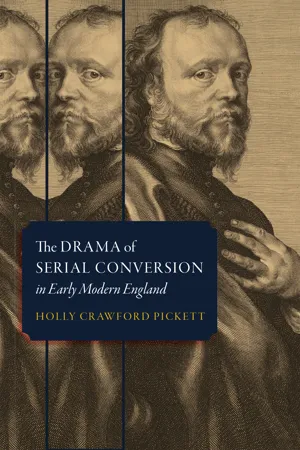
In The Drama of Serial Conversion in Early Modern England, Holly Crawford Pickett reconceptualizes early modern religious identity by exploring the astonishing stories of serial converts: historical figures such as William Alabaster, Kenelm Digby, William Chillingworth, and Marc Antonio De Dominis, along with fictional ones, who changed their religious affiliations between Catholicism and Protestantism multiple times. Pickett argues that serial converts both reveal and helped revise early modern understandings of the self. Through investigation of the techniques that serial converts used to stage and justify their conversions, Pickett demonstrates the performative nature of the act of conversion itself, offering a counternarrative to the paradigm of sincere, private conversion that was on the rise in the tumultuous years following the Reformation. Drawing from archival investigation into the lives and works of serial converts and performance studies theory, this book shows how the genres and conventions associated with conversion shaped not only forms of communication but also the very experience of conversion. By juxtaposing plays about serial conversion—by Thomas Dekker and Philip Massinger, Thomas Middleton, Elizabeth Cary, Ben Jonson, and William Shakespeare—with spiritual autobiographies, Pickett highlights the shared task of convert and playwright: performing conversion for an audience.Serial converts served as uncomfortable reminders to their contemporaries that religious identity is always unverifiable. The first study to explore serial conversion as a discrete phenomenon in this era, The Drama of Serial Conversion in Early Modern England challenges confessional divisions within much early modern historiography by analyzing the surprising convergence of Protestant and Catholic in the figure of the serial convert. It also reveals a neglected strain of religious discourse in early modern England that valued mutability and flexibility even in the midst of hardening and increasingly narrow understandings of conversion.
- 304 pages
- English
- ePUB (mobile friendly)
- Available on iOS & Android
eBook - ePub
The Drama of Serial Conversion in Early Modern England
About this book
Information
Table of contents
- Cover
- Title Page
- Copyright
- Dedication
- Contents
- Introduction
- Chapter 1. “I Must Dissemble Now”: Performing Conversion in Anthony Tyrrell and in Nathaniel Woodes’s The Conflict of Conscience
- Chapter 2. “Wonderfully and Sencybly Chaunged”: Reading Conversion in William Alabaster, Augustine, and the Motives Genre
- Chapter 3. “All to All”: Elizabeth Cary, William Chillingworth, and the Pauline Theater of Conversion
- Chapter 4. “Unstable Bodies”: Ecumenism and the Science of Motion
- Chapter 5. “Contagion of the Imagination”: Alchemy and Conversion in Ben Jonson and Kenelm Digby
- Chapter 6. “I Will Performe It”: Dramatic Nostalgia and Spectacular Conversion in Thomas Dekker and Philip Massinger’s The Virgin Martyr
- Notes
- Bibliography
- Index
- Acknowledgments
Trusted by 375,005 students
Access to over 1.5 million titles for a fair monthly price.
Study more efficiently using our study tools.
Frequently asked questions
Yes, you can cancel anytime from the Subscription tab in your account settings on the Perlego website. Your subscription will stay active until the end of your current billing period. Learn how to cancel your subscription
No, books cannot be downloaded as external files, such as PDFs, for use outside of Perlego. However, you can download books within the Perlego app for offline reading on mobile or tablet. Learn how to download books offline
Perlego offers two plans: Essential and Complete
- Essential is ideal for learners and professionals who enjoy exploring a wide range of subjects. Access the Essential Library with 800,000+ trusted titles and best-sellers across business, personal growth, and the humanities. Includes unlimited reading time and Standard Read Aloud voice.
- Complete: Perfect for advanced learners and researchers needing full, unrestricted access. Unlock 1.5M+ books across hundreds of subjects, including academic and specialized titles. The Complete Plan also includes advanced features like Premium Read Aloud and Research Assistant.
We are an online textbook subscription service, where you can get access to an entire online library for less than the price of a single book per month. With over 1.5 million books across 990+ topics, we’ve got you covered! Learn about our mission
Look out for the read-aloud symbol on your next book to see if you can listen to it. The read-aloud tool reads text aloud for you, highlighting the text as it is being read. You can pause it, speed it up and slow it down. Learn more about Read Aloud
Yes! You can use the Perlego app on both iOS and Android devices to read anytime, anywhere — even offline. Perfect for commutes or when you’re on the go.
Please note we cannot support devices running on iOS 13 and Android 7 or earlier. Learn more about using the app
Please note we cannot support devices running on iOS 13 and Android 7 or earlier. Learn more about using the app
Yes, you can access The Drama of Serial Conversion in Early Modern England by Holly Crawford Pickett in PDF and/or ePUB format, as well as other popular books in Literature & English Literary Criticism. We have over 1.5 million books available in our catalogue for you to explore.