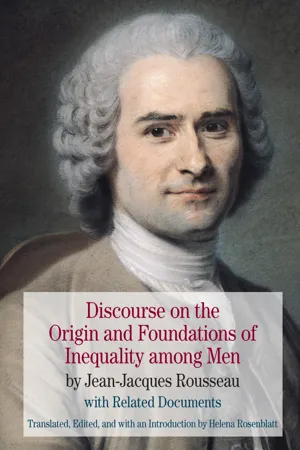
EPUB3 DISCOURSE ORIGIN OF INEQ
by Jean-Jacques Rousseau with Related Documents
- 176 pages
- English
- ePUB (mobile friendly)
- Available on iOS & Android
EPUB3 DISCOURSE ORIGIN OF INEQ
by Jean-Jacques Rousseau with Related Documents
About this book
A provocative essay that challenged the superiority of civilized society and modern government, Jean-Jacques Rousseaus Discourse on the Origin and Foundations of Inequality made him an outcast among fellow Enlightenment thinkers but stands today as one of the most important political texts in Western history. Helena Rosenblatts new translation, introduction, and selection of related documents help students comprehend why Rousseaus criticisms of human nature, political hierarchy, and private property were so controversial in his time yet later were hailed as a foundation of democracy. The introduction explores life experiences that shaped Rousseaus philosophy, explains contemporary ideas about political authority and social order, and guides students through Rousseaus thought, including explanations of how his work anticipated theories about evolution and inspired leaders of the French Revolution. Related primary documents -- including a selection from Rousseaus Social Contract -- situate Rousseaus ideas in contemporary political and social thought. Questions for consideration, a chronology of Rousseaus life and work, and a selected bibliography enrich students understanding of the man and his times.
Frequently asked questions
- Essential is ideal for learners and professionals who enjoy exploring a wide range of subjects. Access the Essential Library with 800,000+ trusted titles and best-sellers across business, personal growth, and the humanities. Includes unlimited reading time and Standard Read Aloud voice.
- Complete: Perfect for advanced learners and researchers needing full, unrestricted access. Unlock 1.4M+ books across hundreds of subjects, including academic and specialized titles. The Complete Plan also includes advanced features like Premium Read Aloud and Research Assistant.
Please note we cannot support devices running on iOS 13 and Android 7 or earlier. Learn more about using the app.
Information
Table of contents
- About this Book
- Part One Introduction: The Life and Thought of Jean-Jacques Rousseau
- Part Two Discourse on the Origin and Foundations of Inequality among Men by Jean-Jacques Rousseau, Citizen of Geneva
- Part Three Documents
- Appendixes
- Acknowledgments
- Index