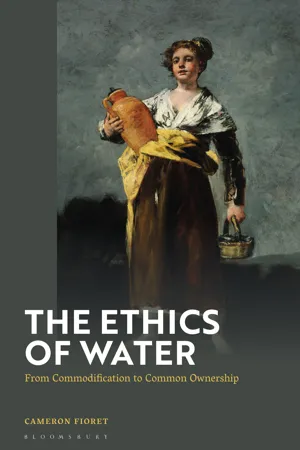
In this global approach to climate change and freshwater access, Cameron Fioret explores the harmful effects of water commodification. Making use of deliberative democratic theory, Fioret suggests tools that can change the balance of democratic decision-making power by rethinking the governance of water more broadly.
Five main case studies including Detroit, Cochabamba, and Kerala span four continents to convey the global and local scope of normative water issues. These examples draw on contemporary water justice movements to explore how anti-water-commodification struggles can utilize water recommoning practices to make water governance processes more deeply democratic. Highlighting the ethical and sociopolitical ramifications of water injustice, this study moves beyond the surface issue of distributional concerns. To this end, Fioret draws on research in democratic political theory and environmental philosophy to consider what right people have to water, the putative harms of privatizing and commodifying water, common ownership, and legal protections, alongside local and transnational political activism. In navigating these pressing issues, The Ethics of Water provides a searing analysis of water commodification and political domination today.
- 216 pages
- English
- ePUB (mobile friendly)
- Available on iOS & Android
eBook - ePub
About this book
Information
Table of contents
- Cover
- Half-Title Page
- Dedication
- Series Page
- Title Page
- Contents
- Acknowledgements
- 1 Introduction
- 2 Water, Rights-based Arguments and Social Entitlement
- 3 An Explication of Common Ownership and Common Territory
- 4 Water Justice as Socioenvironmental Justice
- 5 The Protection of Rights to Water Through Law, Politics and Social Movements
- 6 Conclusion
- Notes
- Bibliography
- Index
- Copyright
Trusted by 375,005 students
Access to over 1.5 million titles for a fair monthly price.
Study more efficiently using our study tools.
Frequently asked questions
Yes, you can cancel anytime from the Subscription tab in your account settings on the Perlego website. Your subscription will stay active until the end of your current billing period. Learn how to cancel your subscription
No, books cannot be downloaded as external files, such as PDFs, for use outside of Perlego. However, you can download books within the Perlego app for offline reading on mobile or tablet. Learn how to download books offline
Perlego offers two plans: Essential and Complete
- Essential is ideal for learners and professionals who enjoy exploring a wide range of subjects. Access the Essential Library with 800,000+ trusted titles and best-sellers across business, personal growth, and the humanities. Includes unlimited reading time and Standard Read Aloud voice.
- Complete: Perfect for advanced learners and researchers needing full, unrestricted access. Unlock 1.5M+ books across hundreds of subjects, including academic and specialized titles. The Complete Plan also includes advanced features like Premium Read Aloud and Research Assistant.
We are an online textbook subscription service, where you can get access to an entire online library for less than the price of a single book per month. With over 1.5 million books across 990+ topics, we’ve got you covered! Learn about our mission
Look out for the read-aloud symbol on your next book to see if you can listen to it. The read-aloud tool reads text aloud for you, highlighting the text as it is being read. You can pause it, speed it up and slow it down. Learn more about Read Aloud
Yes! You can use the Perlego app on both iOS and Android devices to read anytime, anywhere — even offline. Perfect for commutes or when you’re on the go.
Please note we cannot support devices running on iOS 13 and Android 7 or earlier. Learn more about using the app
Please note we cannot support devices running on iOS 13 and Android 7 or earlier. Learn more about using the app
Yes, you can access The Ethics of Water by Cameron Fioret in PDF and/or ePUB format, as well as other popular books in Philosophy & Ethics & Moral Philosophy. We have over 1.5 million books available in our catalogue for you to explore.