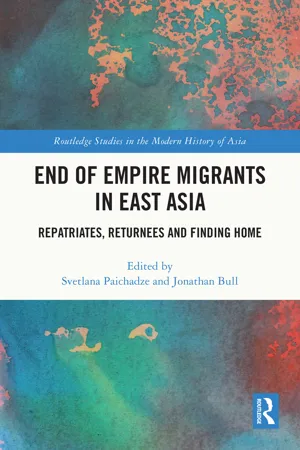
End of Empire Migrants in East Asia
eBook - ePub

End of Empire Migrants in East Asia

Repatriates, Returnees and Finding Home

  1. 336 pages
  2. English
  3. ePUB (mobile friendly)
  4. Available on iOS & Android
eBook - ePub

End of Empire Migrants in East Asia

Repatriates, Returnees and Finding Home

About this book

This book provides an interdisciplinary study about the migration of approximately 9 million people who became end of empire migrants in East Asia following the collapse of the Japanese Empire in 1945.

Through the collection of first-hand testimonies and examination of four key themes, the book uncovers how the Japanese government's repatriation policy intersected with people's experiences of end of empire migration in East Asia. The first theme, repatriation as historiography and discourse, examines how repatriation has been studied, debated and represented in Japan since the end of the Second World War. The second theme, finding home in the former empire, reveals the diversity of experiences of the peoples of former colonies as the borders 'shifted under their feet' through first-hand testimony. The third theme, government policy, explores the changing Japanese government policy from the 1950s to the 1970s. The fourth theme, integration after repatriation, reveals how Japanese former colonial residents integrated into Japanese society following repatriation.

Presenting the collective research of 14 international authors, this book will be of interest for researchers of East Asian history, modern Japanese history, migration studies, postcolonial studies, Japanese studies, Korean studies, post-war international relations and Cold War history.

Frequently asked questions

Yes, you can cancel anytime from the Subscription tab in your account settings on the Perlego website. Your subscription will stay active until the end of your current billing period. Learn how to cancel your subscription.
No, books cannot be downloaded as external files, such as PDFs, for use outside of Perlego. However, you can download books within the Perlego app for offline reading on mobile or tablet. Learn more here.
Perlego offers two plans: Essential and Complete
  • Essential is ideal for learners and professionals who enjoy exploring a wide range of subjects. Access the Essential Library with 800,000+ trusted titles and best-sellers across business, personal growth, and the humanities. Includes unlimited reading time and Standard Read Aloud voice.
  • Complete: Perfect for advanced learners and researchers needing full, unrestricted access. Unlock 1.4M+ books across hundreds of subjects, including academic and specialized titles. The Complete Plan also includes advanced features like Premium Read Aloud and Research Assistant.
Both plans are available with monthly, semester, or annual billing cycles.
We are an online textbook subscription service, where you can get access to an entire online library for less than the price of a single book per month. With over 1 million books across 1000+ topics, we’ve got you covered! Learn more here.
Look out for the read-aloud symbol on your next book to see if you can listen to it. The read-aloud tool reads text aloud for you, highlighting the text as it is being read. You can pause it, speed it up and slow it down. Learn more here.
Yes! You can use the Perlego app on both iOS or Android devices to read anytime, anywhere — even offline. Perfect for commutes or when you’re on the go.
Please note we cannot support devices running on iOS 13 and Android 7 or earlier. Learn more about using the app.
Yes, you can access End of Empire Migrants in East Asia by Svetlana Paichadze, Jonathan Bull, Svetlana Paichadze,Jonathan Bull in PDF and/or ePUB format, as well as other popular books in History & 20th Century History. We have over one million books available in our catalogue for you to explore.

Information

Publisher
Routledge
Year
2023
Print ISBN
9781032284972
eBook ISBN
9781000869842
Edition
1
Topic
History
Index
History

Table of contents

  1. Cover Page
  2. Half Title page
  3. Series Page
  4. Title Page
  5. Copyright Page
  6. Contents
  7. Figures
  8. Tables
  9. Acknowledgements
  10. Notes on transliteration
  11. Contributors
  12. Introduction
  13. Part I Repatriation in historiography, political discourse and the history of Indigenous Peoples
  14. Part II Finding ‘home’ in the former Japanese Empire
  15. Part III Repatriation policy and returning home in the 1950s–1960s
  16. Part IV Repatriation and integration: life after hikiage
  17. Index