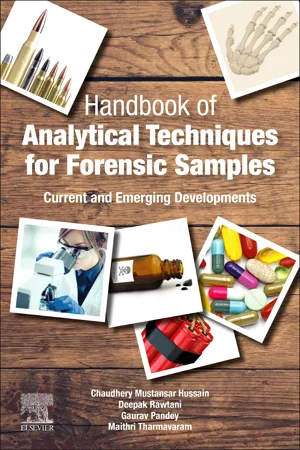
eBook - ePub
Handbook of Analytical Techniques for Forensic Samples
Current and Emerging Developments
- 452 pages
- English
- ePUB (mobile friendly)
- Available on iOS & Android
eBook - ePub
Handbook of Analytical Techniques for Forensic Samples
Current and Emerging Developments
About this book
Handbook of Analytical Techniques for Forensic Samples: Current and Emerging Developments discusses in detail the current trends and latest analytical techniques and methods commonly employed in forensic analysis in order to ensure the proper facilitation of justice. This book is useful for readers who wish to stay updated on the latest trends in the forensic analysis of samples encountered at crime scenes. Technological advancements, such as biosensors, nanotechnology, and taggant technology have upped the level of analysis in forensic science. These emergent technologies, incorporated with existing analytical techniques, are leading to more precise, accurate, and specific examination of forensic samples. Lab-on-a-chip technology has also eased several kinds of on-site analyses done by investigating teams at different types of crime scenes. This book covers the evolution of forensic sample analysis as well as these emerging trends and new technologies.
- Includes an entire section of experimental exercises for self-teaching and key concept review
- Covers laboratory protocols used in forensic science laboratories for the analysis of various samples through different analytical techniques
- Condenses the many aspects of forensic analytical chemistry into a single resource with easy-to-understand language for everyone from students to practitioners
Information
Topic
Physical SciencesSubtopic
Analytic ChemistryTable of contents
- Cover image
- Title page
- Table of Contents
- Copyright
- Dedication
- Preface
- Chapter 1: Introduction to chemical analysis of forensic samples
- Chapter 2: Forensic sampling and sample preparation techniques
- Chapter 3: UV-visible and fluorescence spectroscopy for forensic samples
- Chapter 4: FTIR and NIR spectroscopy in forensic science
- Chapter 5: Atomic absorption and emission spectrometry in forensic analysis
- Chapter 6: NMR spectroscopy for forensic samples
- Chapter 7: Raman spectroscopy in forensic science
- Chapter 8: HPLC for the toxicological analysis of forensic samples
- Chapter 9: Gas chromatography in forensic science
- Chapter 10: HPTLC in forensic science
- Chapter 11: Hyphenated techniques for forensic sample analysis
- Chapter 12: Optical microscopy for forensic samples
- Chapter 13: Electron microscopy for forensic samples
- Chapter 14: Atomic force microscopy for forensic samples
- Chapter 15: Energy dispersive X-ray (EDX) coupled microscopy in forensic science
- Chapter 16: Mass spectrometry in forensic chemistry
- Chapter 17: X-ray diffraction for forensic samples
- Chapter 18: Lab-on-chip devices
- Chapter 19: Nanotechnology in forensic science
- Chapter 20: Ethics and legal issues of forensic analysis techniques
- Chapter 21: Accreditations for forensic science laboratories
- Chapter 22: Quality control and quality assurance in forensic science laboratories
- Chapter 23: Concluding notes
- Exercise 1: UV-visible spectroscopic analysis of forensic samples (chemical and biological)
- Exercise 2: Fluorescence spectroscopic analysis of forensic samples (biological)
- Exercise 3: FTIR analysis of forensic samples (chemical, physical, and biological)
- Exercise 4: NIR spectroscopic analysis of forensic samples (chemical and biological)
- Exercise 5: Atomic absorption spectrometric analysis of forensic samples (chemical and biological)
- Exercise 6: Optical microscopic analysis of physical and biological forensic samples
- Exercise 7: SEM analysis of physical and biological forensic samples
- Exercise 8: TEM analysis of physical and biological forensic samples
- Exercise 9: AFM analysis of physical and biological forensic samples
- Exercise 10: Mass spectrometric analysis of forensic samples (chemical and biological)
- Index
Trusted by 375,005 students
Access to over 1.5 million titles for a fair monthly price.
Study more efficiently using our study tools.
Frequently asked questions
Yes, you can cancel anytime from the Subscription tab in your account settings on the Perlego website. Your subscription will stay active until the end of your current billing period. Learn how to cancel your subscription
No, books cannot be downloaded as external files, such as PDFs, for use outside of Perlego. However, you can download books within the Perlego app for offline reading on mobile or tablet. Learn how to download books offline
Perlego offers two plans: Essential and Complete
- Essential is ideal for learners and professionals who enjoy exploring a wide range of subjects. Access the Essential Library with 800,000+ trusted titles and best-sellers across business, personal growth, and the humanities. Includes unlimited reading time and Standard Read Aloud voice.
- Complete: Perfect for advanced learners and researchers needing full, unrestricted access. Unlock 1.5M+ books across hundreds of subjects, including academic and specialized titles. The Complete Plan also includes advanced features like Premium Read Aloud and Research Assistant.
We are an online textbook subscription service, where you can get access to an entire online library for less than the price of a single book per month. With over 1.5 million books across 990+ topics, we’ve got you covered! Learn about our mission
Look out for the read-aloud symbol on your next book to see if you can listen to it. The read-aloud tool reads text aloud for you, highlighting the text as it is being read. You can pause it, speed it up and slow it down. Learn more about Read Aloud
Yes! You can use the Perlego app on both iOS and Android devices to read anytime, anywhere — even offline. Perfect for commutes or when you’re on the go.
Please note we cannot support devices running on iOS 13 and Android 7 or earlier. Learn more about using the app
Please note we cannot support devices running on iOS 13 and Android 7 or earlier. Learn more about using the app
Yes, you can access Handbook of Analytical Techniques for Forensic Samples by Deepak Rawtani,Gaurav Pandey,Maithri Tharmavaram,Chaudhery Mustansar Hussain in PDF and/or ePUB format, as well as other popular books in Physical Sciences & Analytic Chemistry. We have over 1.5 million books available in our catalogue for you to explore.