eBook - ePub
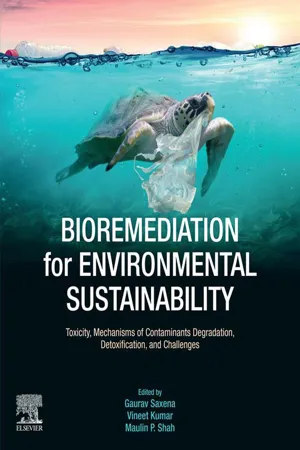
Bioremediation for Environmental Sustainability
Toxicity, Mechanisms of Contaminants Degradation, Detoxification and Challenges
- 692 pages
- English
- ePUB (mobile friendly)
- Available on iOS & Android
eBook - ePub
Bioremediation for Environmental Sustainability
Toxicity, Mechanisms of Contaminants Degradation, Detoxification and Challenges
About this book
Bioremediation for Environmental Sustainability: Toxicity, Mechanisms of Contaminants Degradation, Detoxification and Challenges introduces pollution and toxicity profiles of various organic and inorganic contaminants, including mechanisms of toxicity, degradation, and detoxification by microbes and plants, and their bioremediation approaches for environmental sustainability. The book also covers many advanced technologies in the field of bioremediation and phytoremediation, including electro-bioremediation, microbial fuel cells, nano-bioremediation, constructed wetlands, phytotechnologies, and many more, which are lacking in other competitive titles existing in the market. The book includes updated information, as well as future directions for research, in the field of bioremediation of industrial wastes.
This book is a reference for students, researchers, scientists, and professionals in the fields of microbiology, biotechnology, environmental sciences, eco-toxicology, environmental remediation, and waste management, especially those who aspire to work on the biodegradation and bioremediation of industrial wastes and environmental pollutants for environmental sustainability. Environmental safety and sustainability with rapid industrialization is one of the major challenges worldwide. Industries are the key drivers in the world economy, but these are also the major polluters due to discharge of potentially toxic and hazardous wastes containing various organic and inorganic pollutants, which cause environmental pollution and severe toxic effects in living beings.
- Introduces pollution and toxicity profiles of environmental contaminants and industrial wastes, including oil refinery wastewater, distillery wastewater, tannery wastewater, textile wastewater, mine tailing wastes, plastic wastes, and more
- Describes underlying mechanisms of degradation and detoxification of emerging organic and inorganic contaminants with enzymatic roles
- Focuses on recent advances and challenges in bioremediation and phytoremediation, including microbial enzymes, biosurfactants, microalgae, biofilm, archaea, genetically engineered organisms, and more
- Describes how microbes and plants can be successfully applied for the remediation of potentially toxic industrial wastes and chemical pollutants to protect the environment and public health
Information
Table of contents
- Cover image
- Title page
- Table of Contents
- Copyright
- Dedication
- List of contributors
- Editor biographies
- Preface
- Acknowledgements
- Section I: Introduction to bioremediation
- Section II: Bioremediation of inorganic contaminants
- Section III: Bioremediation of organic contaminants
- Section IV: Bioremediation of industrial wastes
- Section V: Recent advances and challenges in bioremediation
- Index
Trusted by 375,005 students
Access to over 1.5 million titles for a fair monthly price.
Study more efficiently using our study tools.
Frequently asked questions
Yes, you can cancel anytime from the Subscription tab in your account settings on the Perlego website. Your subscription will stay active until the end of your current billing period. Learn how to cancel your subscription
No, books cannot be downloaded as external files, such as PDFs, for use outside of Perlego. However, you can download books within the Perlego app for offline reading on mobile or tablet. Learn how to download books offline
Perlego offers two plans: Essential and Complete
- Essential is ideal for learners and professionals who enjoy exploring a wide range of subjects. Access the Essential Library with 800,000+ trusted titles and best-sellers across business, personal growth, and the humanities. Includes unlimited reading time and Standard Read Aloud voice.
- Complete: Perfect for advanced learners and researchers needing full, unrestricted access. Unlock 1.5M+ books across hundreds of subjects, including academic and specialized titles. The Complete Plan also includes advanced features like Premium Read Aloud and Research Assistant.
We are an online textbook subscription service, where you can get access to an entire online library for less than the price of a single book per month. With over 1.5 million books across 990+ topics, we’ve got you covered! Learn about our mission
Look out for the read-aloud symbol on your next book to see if you can listen to it. The read-aloud tool reads text aloud for you, highlighting the text as it is being read. You can pause it, speed it up and slow it down. Learn more about Read Aloud
Yes! You can use the Perlego app on both iOS and Android devices to read anytime, anywhere — even offline. Perfect for commutes or when you’re on the go.
Please note we cannot support devices running on iOS 13 and Android 7 or earlier. Learn more about using the app
Please note we cannot support devices running on iOS 13 and Android 7 or earlier. Learn more about using the app
Yes, you can access Bioremediation for Environmental Sustainability by Gaurav Saxena, Vineet Kumar, Maulin P. Shah, Gaurav Saxena,Vineet Kumar,Maulin P. Shah,Maulin P. P Shah in PDF and/or ePUB format, as well as other popular books in Technology & Engineering & Chemical & Biochemical Engineering. We have over 1.5 million books available in our catalogue for you to explore.