- 376 pages
- English
- ePUB (mobile friendly)
- Available on iOS & Android
eBook - ePub
The Microbiology of Nuclear Waste Disposal
About this book
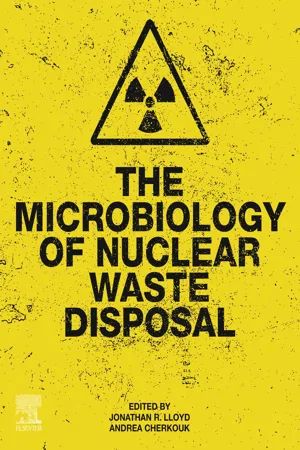
The Microbiology of Nuclear Waste Disposal is a state-of-the-art reference featuring contributions focusing on the impact of microbes on the safe long-term disposal of nuclear waste. This book is the first to cover this important emerging topic, and is written for a wide audience encompassing regulators, implementers, academics, and other stakeholders. The book is also of interest to those working on the wider exploitation of the subsurface, such as bioremediation, carbon capture and storage, geothermal energy, and water quality.
Planning for suitable facilities in the U.S., Europe, and Asia has been based mainly on knowledge from the geological and physical sciences. However, recent studies have shown that microbial life can proliferate in the inhospitable environments associated with radioactive waste disposal, and can control the long-term fate of nuclear materials. This can have beneficial and damaging impacts, which need to be quantified.
- Encompasses expertise from both the bio and geo disciplines, aiming to foster important collaborations across this disciplinary divide
- Includes reviews and research papers from leading groups in the field
- Provides helpful guidance in light of plans progressing worldwide for geological disposal facilities
- Includes timely research for planning and safety case development
Information
Table of contents
- Cover image
- Title page
- Table of Contents
- Copyright
- Contributors
- Introduction
- Chapter 1: Organic-containing nuclear wastes and national inventories across Europe
- Chapter 2: The microbiology of natural analogue sites
- Chapter 3: Microbial metabolic potential in deep crystalline bedrock
- Chapter 4: Molecular techniques for understanding microbial abundance and activity in clay barriers used for geodisposal
- Chapter 5: Potential microbial influence on the performance of subsurface, salt-based nuclear waste repositories
- Chapter 6: Microbially influenced corrosion of container material
- Chapter 7: Bentonite geomicrobiology
- Chapter 8: Microbial colonization of cementitious geodisposal facilities, and potential “biobarrier” formation
- Chapter 9: Microbial impacts on gas production in LLW/ILW
- Chapter 10: Organic materials and their microbial fate in radioactive waste
- Chapter 11: Microbial transformations of radionuclides in geodisposal systems
- Chapter 12: Modeling of microbial processes to support the safety case for nuclear waste disposal
- Chapter 13: Communication and stakeholder engagement of microbiology in radioactive waste disposal
- Author Index
- Subject Index
Trusted by 375,005 students
Access to over 1.5 million titles for a fair monthly price.
Study more efficiently using our study tools.
Frequently asked questions
Yes, you can cancel anytime from the Subscription tab in your account settings on the Perlego website. Your subscription will stay active until the end of your current billing period. Learn how to cancel your subscription
No, books cannot be downloaded as external files, such as PDFs, for use outside of Perlego. However, you can download books within the Perlego app for offline reading on mobile or tablet. Learn how to download books offline
Perlego offers two plans: Essential and Complete
- Essential is ideal for learners and professionals who enjoy exploring a wide range of subjects. Access the Essential Library with 800,000+ trusted titles and best-sellers across business, personal growth, and the humanities. Includes unlimited reading time and Standard Read Aloud voice.
- Complete: Perfect for advanced learners and researchers needing full, unrestricted access. Unlock 1.5M+ books across hundreds of subjects, including academic and specialized titles. The Complete Plan also includes advanced features like Premium Read Aloud and Research Assistant.
We are an online textbook subscription service, where you can get access to an entire online library for less than the price of a single book per month. With over 1.5 million books across 990+ topics, we’ve got you covered! Learn about our mission
Look out for the read-aloud symbol on your next book to see if you can listen to it. The read-aloud tool reads text aloud for you, highlighting the text as it is being read. You can pause it, speed it up and slow it down. Learn more about Read Aloud
Yes! You can use the Perlego app on both iOS and Android devices to read anytime, anywhere — even offline. Perfect for commutes or when you’re on the go.
Please note we cannot support devices running on iOS 13 and Android 7 or earlier. Learn more about using the app
Please note we cannot support devices running on iOS 13 and Android 7 or earlier. Learn more about using the app
Yes, you can access The Microbiology of Nuclear Waste Disposal by Jonathan R. Lloyd,Andrea Cherkouk in PDF and/or ePUB format, as well as other popular books in Biological Sciences & Environmental Science. We have over 1.5 million books available in our catalogue for you to explore.