eBook - ePub
Twin Research for Everyone
From Biology to Health, Epigenetics, and Psychology
- 738 pages
- English
- ePUB (mobile friendly)
- Available on iOS & Android
eBook - ePub
Twin Research for Everyone
From Biology to Health, Epigenetics, and Psychology
About this book
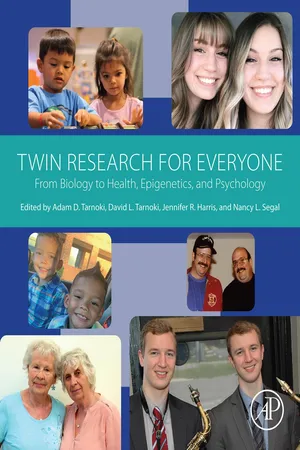
Twin Research: Biology, Health, Epigenetics, and Psychology is a comprehensive, applied resource in twinning and twin studies that is grounded in the most impactful findings from twin research in recent years. While targeted to undergraduate and graduate students, this compendium will prove a valuable resource for scholars already familiar with twin studies, as well as those coming to the field for the first time. Here, more than forty experts across an array of disciplines examine twinning and twin research methodologies from the perspectives of biology, medicine, genetic and epigenetic influences, and neuroscience. Chapters provide clear instruction in both basic and advanced research methods, family and parenting aspects of twinning, twin studies as applied across various disease areas and medical specialties, genetic and epigenetic determinants of differentiation, and academic, neurological and cognitive development.
The presentation of existing studies and methods instruction empowers students and researchers to apply twin-based research and advance new studies across a range of biomedical and behavioral fields, highlighting current research trends and future directions.
- Offers unique insights into twinning rates, mechanisms and factors surrounding twinship
- Provides clear instruction on both basic and advanced twin research methods and study design
- Features leading international experts in twin biology, genetics, health and psychology
- Examines findings from recent twin studies across a broad array of health and behavioral studies
Information
Topic
MedicineSubtopic
Genetics in MedicineTable of contents
- Cover
- Front Matter
- Table of Contents
- Front Matter
- Copyright
- Contents
- Contributors
- Editor Biographies
- Preface
- Introduction to twin research for everyone: From biology to health, epigenetics, and psychology
- List of Illustrations
- List of Tables
- Section1 : Background
- Chapter 1 : History of Twin Studies
- Chapter 2 : Prevalence of twinning worldwide
- Chapter 3 : Twin family registries worldwide
- Section2 : Phenomenon of Twinning
- Chapter 4 : Biology of natural twinning
- Chapter 5 : Management and outcome of twin pregnancies
- Chapter 6 : Conjoined twins
- Section3 : Twin Families
- Chapter7 : Growing up as twins: the perspectives of twin researchers
- Chapter 8 : Parenting twins, triplets, or more
- Chapter 9 : Reared apart twins: Background, research, case studies and what they reveal about human development
- Chapter10 : Opposite-sex twins in medical research
- Section4 : Twin Methodologies
- Chapter 11 : Establishing a resource for genetic, epidemiological, and biomarker studies: The important role of twin registers
- Chapter12 : Methodology of twin studies
- Chapter 13 : Twin studies of complex traits and diseases
- Chapter 14 : Use of twin studies to make inference about causation for measured exposures by examining familial confounding
- Chapter 15 : Twins in clinical trials
- Section5 : Behavior
- Chapter 16 : Twin studies in social science
- Chapter 17 : Childhood development of psychiatric disorders and related traits
- Chapter 18 : Happiness and well-being: The value and findings from genetic studies
- Chapter 19 : Twin study of personality
- Chapter 20 : Twin research in psychopathology
- Chapter 21 : Cognitive aging: the role of genes and environments in patterns of change
- Chapter 22 : Twin studies of smoking and tobacco use
- Section6 : Health
- Chapter 23 : Anthropometric twin studies
- Chapter24 : Twin studies of cardiorespiratory disease, daily cardiovascular activity and imaging
- Chapter 25 : Pediatric twin studies
- Chapter 26 : Twin-singleton differences
- Chapter27 : Twin studies of puberty and behavior
- Chapter28 : Musculoskeletal twin studies
- Chapter29 : Contributions of twin studies to cancer epidemiology
- Chapter30 : Epigenetic studies of neurodevelopment in twins
- Chapter31 : Contributions of twin research to the study of Alzheimer’s disease and related dementias
- Section7 : Twin Research: Genetics, Epigenetics, Microbiome, and Environmental Adaptation
- Chapter 32 : Twins and omics: the role of twin studies in multi-omics
- Chapter 33 : Epigenetics
- Chapter34 : An experiment in cotwin control: Adaptation to space travel1
- Chapter35 : Environmental risk factors for neurodevelopmental disorders: Evidence from twin studies
- Chapter 36 : Microbiome studies and twin research
- Chapter37 : Chromosomal anomalies, monogenetic diseases, and leukaemia in twins
- Section8 : Conclusion
- Summary and concluding statement
- Appendix—Resources
- Index
- A
Trusted by 375,005 students
Access to over 1.5 million titles for a fair monthly price.
Study more efficiently using our study tools.
Frequently asked questions
Yes, you can cancel anytime from the Subscription tab in your account settings on the Perlego website. Your subscription will stay active until the end of your current billing period. Learn how to cancel your subscription
No, books cannot be downloaded as external files, such as PDFs, for use outside of Perlego. However, you can download books within the Perlego app for offline reading on mobile or tablet. Learn how to download books offline
Perlego offers two plans: Essential and Complete
- Essential is ideal for learners and professionals who enjoy exploring a wide range of subjects. Access the Essential Library with 800,000+ trusted titles and best-sellers across business, personal growth, and the humanities. Includes unlimited reading time and Standard Read Aloud voice.
- Complete: Perfect for advanced learners and researchers needing full, unrestricted access. Unlock 1.5M+ books across hundreds of subjects, including academic and specialized titles. The Complete Plan also includes advanced features like Premium Read Aloud and Research Assistant.
We are an online textbook subscription service, where you can get access to an entire online library for less than the price of a single book per month. With over 1.5 million books across 990+ topics, we’ve got you covered! Learn about our mission
Look out for the read-aloud symbol on your next book to see if you can listen to it. The read-aloud tool reads text aloud for you, highlighting the text as it is being read. You can pause it, speed it up and slow it down. Learn more about Read Aloud
Yes! You can use the Perlego app on both iOS and Android devices to read anytime, anywhere — even offline. Perfect for commutes or when you’re on the go.
Please note we cannot support devices running on iOS 13 and Android 7 or earlier. Learn more about using the app
Please note we cannot support devices running on iOS 13 and Android 7 or earlier. Learn more about using the app
Yes, you can access Twin Research for Everyone by Adam D. Tarnoki,David L. Tarnoki,Jennifer R. Harris,Nancy L. Segal,Jennifer Harris in PDF and/or ePUB format, as well as other popular books in Medicine & Genetics in Medicine. We have over 1.5 million books available in our catalogue for you to explore.