eBook - ePub
Phenotyping of Human iPSC-derived Neurons
Patient-Driven Research
- 372 pages
- English
- ePUB (mobile friendly)
- Available on iOS & Android
eBook - ePub
About this book
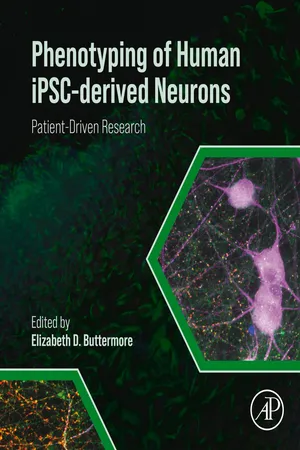
Phenotyping of Human iPSC-derived Neurons: Patient-Driven Research examines the steps in a preclinical pipeline that utilizes iPSC-derived neuronal technology to better understand neurological disorders and identify novel therapeutics, also providing considerations and best practices. By presenting example projects that identify phenotypes and mechanisms relevant to autism spectrum disorder and epilepsy, this book allows readers to understand what considerations are important to assess at the start of project design. Sections address reproducibility issues and advances in technology at each stage of the pipeline and provide suggestions for improvement. From patient sample collection and proper controls to neuronal differentiation, phenotyping, screening, and considerations for moving to the clinic, these detailed descriptions of each stage of the pipeline will help everyone, regardless of stage in the pipeline.
In recent years, drug discovery in the neurosciences has struggled to identify novel therapeutics for patients with varying indications, including epilepsy, chronic pain, and psychosis. Current treatment options for such patients are decades old and offer little relief with many side effects. One explanation for this lull in novel therapeutics is a lack of novel target identification for neurological disorders (and target identification requires exemplar preclinical data). To improve on the preclinical work that often relies on rodent modeling, the field has begun utilizing patient-derived induced pluripotent stem cells (iPSCs) to differentiate neurons in vitro for preclinical characterization of neurological disease and target identification.
- Discusses techniques and new technology for iPSC culturing and neuronal differentiation to establish best practices in the lab
- Outlines considerations for phenotypic assay development
- Provides information about the successes, failures, and implications of phenotyping and screening with iPSC-derived neurons
- Describes how human iPSC-derived neurons are being used for preclinical discovery research as well as the development of therapeutics utilizing hiPSC-derived neurons
Information
Table of contents
- Cover
- Front Matter
- Table of Contents
- Copyright
- Dedication
- Contributors
- List of Illustrations
- List of Tables
- Chapter 1 : iPSC culture: best practices from sample procurement to reprogramming and differentiation
- Chapter 2 : Phenotypic assay development with iPSC-derived neurons: technical considerations from plating to analysis
- Chapter 3 : Derivation of cortical interneurons from human pluripotent stem cells to model neurodevelopmental disorders
- Chapter 4 : Development of transcription factor-based strategies for neuronal differentiation from pluripotent stem cells
- Chapter 5 : Differentiation of Purkinje cells from pluripotent stem cells for disease phenotyping in vitro
- Chapter 6 : Brain organoids: models of cell type diversity, connectivity, and disease phenotypes
- Chapter 7 : Human models as new tools for drug development and precision medicine
- Chapter 8 : Use of cerebral organoids to model environmental and gene x environment interactions in the developing fetus and neurodegenerative disorders
- Chapter 9 : iPSC-derived models of autism: Tools for patient phenotyping and assay-based drug discovery
- Chapter 10 : Probing the electrophysiological properties of patient-derived neurons across neurodevelopmental disorders
- Chapter 11 : Advantages and limitations of hiPSC-derived neurons for the study of neurodegeneration
- Chapter 12 : Developing clinically translatable screens using iPSC-derived neural cells
- Chapter 13 : Gene editing hPSCs for modeling neurological disorders
- Chapter 14 : Cell therapy and biomanufacturing using hiPSC-derived neurons
- Chapter 15 : Ethical considerations for the use of stem cell-derived therapies
- Index
- A
Trusted by 375,005 students
Access to over 1.5 million titles for a fair monthly price.
Study more efficiently using our study tools.
Frequently asked questions
Yes, you can cancel anytime from the Subscription tab in your account settings on the Perlego website. Your subscription will stay active until the end of your current billing period. Learn how to cancel your subscription
No, books cannot be downloaded as external files, such as PDFs, for use outside of Perlego. However, you can download books within the Perlego app for offline reading on mobile or tablet. Learn how to download books offline
Perlego offers two plans: Essential and Complete
- Essential is ideal for learners and professionals who enjoy exploring a wide range of subjects. Access the Essential Library with 800,000+ trusted titles and best-sellers across business, personal growth, and the humanities. Includes unlimited reading time and Standard Read Aloud voice.
- Complete: Perfect for advanced learners and researchers needing full, unrestricted access. Unlock 1.5M+ books across hundreds of subjects, including academic and specialized titles. The Complete Plan also includes advanced features like Premium Read Aloud and Research Assistant.
We are an online textbook subscription service, where you can get access to an entire online library for less than the price of a single book per month. With over 1.5 million books across 990+ topics, we’ve got you covered! Learn about our mission
Look out for the read-aloud symbol on your next book to see if you can listen to it. The read-aloud tool reads text aloud for you, highlighting the text as it is being read. You can pause it, speed it up and slow it down. Learn more about Read Aloud
Yes! You can use the Perlego app on both iOS and Android devices to read anytime, anywhere — even offline. Perfect for commutes or when you’re on the go.
Please note we cannot support devices running on iOS 13 and Android 7 or earlier. Learn more about using the app
Please note we cannot support devices running on iOS 13 and Android 7 or earlier. Learn more about using the app
Yes, you can access Phenotyping of Human iPSC-derived Neurons by Elizabeth D. Buttermore in PDF and/or ePUB format, as well as other popular books in Biological Sciences & Neuroscience. We have over 1.5 million books available in our catalogue for you to explore.