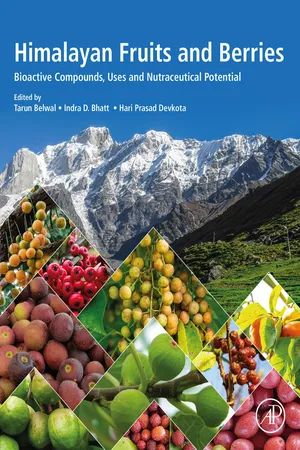
eBook - ePub
Himalayan Fruits and Berries
Bioactive Compounds, Uses and Nutraceutical Potential
- 538 pages
- English
- ePUB (mobile friendly)
- Available on iOS & Android
eBook - ePub
Himalayan Fruits and Berries
Bioactive Compounds, Uses and Nutraceutical Potential
About this book
Himalayan Fruits and Berries: Bioactive Compounds, Uses and Nutraceutical Potential presents nutraceutical fruits and berries from the Himalayan region and highlights their potential use in nutraceutical products.
Beginning with the introduction of the Himalayan region and its wild fruits, this book explores various kinds of wild fruits and berries. It includes coverage of traditional, ethnomedicinal, and local uses of potential nutraceutical fruits and analyzes their distribution, availability, and cultivation methods. The book also provides a detailed summary of clinical studies and presents "from field to industry" case studies.
Wild fruits and berries play an important role in mitigating hunger in the developing world, and these fruits are consumed either in whole or extracted for use in nutraceutical production.
Nutrition researchers, food scientists, food chemists, plant scientists, pharmacologists, as well as students or researchers working in pharmaceutical and nutraceutical industries exploring the use of Himalayan wild berries and fruits as new components and sources in nutraceuticals will benefit from this book.
- Includes coverage of the traditional, ethnomedicinal, and local uses of potential nutraceutical fruits and berries
- Presents bioactive chemical constituents and nutraceutical properties of Himalayan fruits and berries
- Addresses current challenges related to sustainable utilization, mass production, and the transfer from field to the industry of potential nutraceutical fruits and berries
Information
Table of contents
- Himalayan Fruits and Berries
- Cover
- Front Matter
- Title Page
- Copyright
- Table of Contents
- Dedication
- Contents
- Contributors
- Chapter 1 Introduction to Himalayan region and wild edible diversity
- Chapter 2 Aegle marmelos (L.) Correa
- Chapter 3 Artocarpus lacucha Buch. -Ham
- Chapter 4 Baccaurea ramiflora Lour.
- Chapter 5 Bischofia javanica Blume
- Chapter 6 Carissa carandas L.
- Chapter 7 Choerospondias axillaris (Roxb.) B.L.Burtt & A.W.Hill
- Chapter 8 Citrus medica L.
- Chapter 9 Crataegus rhipidophylla Gand.
- Chapter 10 Cydonia oblonga Mill
- Chapter 11 Cyphomandra betacea (Cav.) Sendtn.
- Chapter 12 Dillenia indica L
- Chapter 13 Diospyros spp. (Diospyros kaki L.f., Diospyros lotus L., Diospyros tomentosa Roxb.)
- Chapter 14 Diploknema butyracea (Roxburgh) H. J. Lam
- Chapter 15 Elaeagnus spp. (Elaeagnus latifolia L., Elaeagnus umbellata Thunb.)
- Chapter 16 Entada phaseoloides (Linn.) Merr.
- Chapter 17 Eriolobus indica (Wall.) Decne
- Chapter 18 Ficus species (Ficus auriculata Lour., Ficus benghalensis L., Ficus carica L., Ficus religiosa L., Ficus semicordata Buch.Ham. ex Sm).
- Chapter 19 Fragaria spp. (Fragaria indica, Fragaria nubicola)
- Chapter 20 Garcinia cowa Roxb. ex Choisy
- Chapter 21 Traditional uses, phytochemical and pharmacological properties of Grewia sps (Grewia asiatica and Grewia serrulata)
- Chapter 22 Gynocordia odorata R. Br.
- Chapter 23 Lycium spp. (Lycium barbarum L., Lycium chinense Mill.)
- Chapter 24 Machilus edulis: An underutilized wild edible fruit species of North-eastern Himalaya, India
- Chapter 25 Mahonia species (M. jaunsarensis Ahrendt, M. nepalensis DC, M. aquifolium Nutt, M. acanthifolia Don, M. borealis Takeda, M. oiwakensis Hayata and M. leschenaultii Takeda)
- Chapter 26 Morus alba L.
- Chapter 27 Murraya koenigii (L.) Spreng.
- Chapter 28 Myrica esculenta
- Chapter 29 Opuntia dillenii (Ker Gawl.) Haw
- Chapter 30 Phoenix spp. (Phoenix acaulis, Phoenix sylvestris)
- Chapter 31 Pyracantha crenulata (Roxb. ex D.Don) M.Roem
- Chapter 32 Pyrus spp. (Pyrus pashia Buch.-Ham. ex D.Don, Pyrus pyrifolia (Burm.f) Nakai)
- Chapter 33 Rhus chinensis Mill.
- Chapter 34 Ribes nigrum
- Chapter 35 Rosa spp. (Rosa canina L., R. macrophylla Lindl., R. moschata Herrm., R. multiflora Thunb.)
- Chapter 36 Rubus spp. (Rubus armeniacus, Rubus ellipticus, Rubus fruticosus, Rubus nepalensis, Rubus niveus, Rubus occidentalis)
- Chapter 37 Spondias pinnata (L.f.) Kurz.
- Chapter 38 Syzygium cumini (L.) Skeels.
- Chapter 39 Taxus baccata subsp. wallichiana (Zucc.) Pilg.
- Chapter 40 Terminalia chebula Retz.
- Chapter 41 Terminalia bellirica (Gaertn.) Roxb.
- Chapter 42 Viburnum spp. (Viburnum erubescens Wall., Viburnum mullaha Buch.-Ham. ex D. Don)
- Chapter 43 Vitis spp. (Vitis elongata (Roxb.) Wall. ex M.A. Lawson, Vitis flexuosa Thunb, Vitis heyneana Roem. & Schult, Vitis himalayana [Royle] Brandis, Vitis repanda (Vahl) Wight & Arn, Vitis vinifera L.)
- Chapter 44 Zanthoxylum armatum DC.
- Chapter 45 Ziziphus spp. (Ziziphus jujuba Mill., Ziziphus mauritiana Lam.)
- Chapter 46 Nutraceuticals from Himalayan fruits and berries: opportunities and challenges
- Index
Trusted by 375,005 students
Access to over 1.5 million titles for a fair monthly price.
Study more efficiently using our study tools.
Frequently asked questions
Yes, you can cancel anytime from the Subscription tab in your account settings on the Perlego website. Your subscription will stay active until the end of your current billing period. Learn how to cancel your subscription
No, books cannot be downloaded as external files, such as PDFs, for use outside of Perlego. However, you can download books within the Perlego app for offline reading on mobile or tablet. Learn how to download books offline
Perlego offers two plans: Essential and Complete
- Essential is ideal for learners and professionals who enjoy exploring a wide range of subjects. Access the Essential Library with 800,000+ trusted titles and best-sellers across business, personal growth, and the humanities. Includes unlimited reading time and Standard Read Aloud voice.
- Complete: Perfect for advanced learners and researchers needing full, unrestricted access. Unlock 1.5M+ books across hundreds of subjects, including academic and specialized titles. The Complete Plan also includes advanced features like Premium Read Aloud and Research Assistant.
We are an online textbook subscription service, where you can get access to an entire online library for less than the price of a single book per month. With over 1.5 million books across 990+ topics, we’ve got you covered! Learn about our mission
Look out for the read-aloud symbol on your next book to see if you can listen to it. The read-aloud tool reads text aloud for you, highlighting the text as it is being read. You can pause it, speed it up and slow it down. Learn more about Read Aloud
Yes! You can use the Perlego app on both iOS and Android devices to read anytime, anywhere — even offline. Perfect for commutes or when you’re on the go.
Please note we cannot support devices running on iOS 13 and Android 7 or earlier. Learn more about using the app
Please note we cannot support devices running on iOS 13 and Android 7 or earlier. Learn more about using the app
Yes, you can access Himalayan Fruits and Berries by Tarun Belwal,Indra D. Bhatt,Hari Prasad Devkota in PDF and/or ePUB format, as well as other popular books in Technology & Engineering & Nutrition, Dietics & Bariatrics. We have over 1.5 million books available in our catalogue for you to explore.