eBook - ePub
Plant Stress Mitigators
Types, Techniques and Functions
- 540 pages
- English
- ePUB (mobile friendly)
- Available on iOS & Android
eBook - ePub
Plant Stress Mitigators
Types, Techniques and Functions
About this book
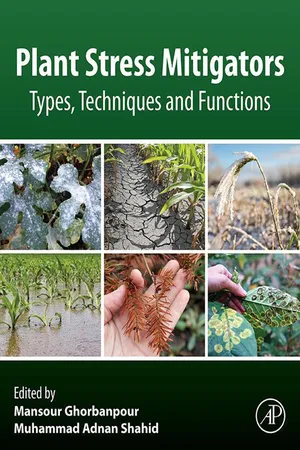
Plant Stress Mitigators: Types, Techniques and Functions presents a detailed contextual discussion of various stressors on plant health and yield, with accompanying insights into options for limiting impacts using chemical elicitors, bio-stimulants, breeding techniques and agronomical techniques such as seed priming, cold plasma treatment, and nanotechnology, amongst others. The book explores the various action mechanisms for enhancing plant growth and stress tolerance capacity, including nutrient solubilizing and mobilizing, biocontrol activity against plant pathogens, phytohormone production, soil conditioners, and many more unrevealed mechanisms.
This book combines research, methods, opinion, perspectives and reviews, dissecting the stress alleviation action of different plant stress mitigators on crops grown under optimal and sub-optimal growing conditions (abiotic and biotic stresses).
- Explores the various action mechanisms of mitigators
- Highlights the relationship between mitigator and nutrient efficiency, product quality and microbial population
- Includes both biotic and abiotic stressors and their mitigation options
Information
Table of contents
- Plant Stress Mitigators
- Cover
- Title page
- Copyright
- Table of Contents
- Dedication
- List of Contributors
- Chapter 1 Approaches in stress mitigation of plants
- Chapter 2 Biocontrol: a novel eco-friendly mitigation strategy to manage plant diseases
- Chapter 3 Salicylic acid induced abiotic stress tolerance in plants
- Chapter 4 Salicylic acid mediated postharvest chilling and disease stress tolerance in horticultural crops
- Chapter 5 Germination and seedling establishment of useful tropical trees for ecological restoration: implications for conservation: The ecology of tropical tree seedling
- Chapter 6 Soil health and plant stress mitigation
- Chapter 7 Salicylic acid and ascorbic acid as mitigators of chilling stress in plants
- Chapter 8 Role of glycine betaine in the protection of plants against environmental stresses
- Chapter 9 Effects of plant growth regulators on physiological and phytochemical parameters in medicinal plants under stress conditions
- Chapter 10 Proline and soluble carbohydrates biosynthesis and their roles in plants under abiotic stresses
- Chapter 11 Switching role of hydrogen sulfide in amelioration of metal stress in plant
- Chapter 12 PGPR reduces the adverse effects of abiotic stresses by modulating morphological and biochemical properties in plants
- Chapter 13 Role of polyamines in plants under abiotic stresses: regulation of biochemical interactions
- Chapter 14 Prime-omics approaches to mitigate stress response in plants
- Chapter 15 Perspectives of using plant growth-promoting rhizobacteria under salinity stress for sustainable crop production
- Chapter 16 Biosaline agriculture and efficient management strategies for sustainable agriculture on salt affected Vertisols
- Chapter 17 Chemical elicitors- a mitigation strategy for maximize crop yields under abiotic stress
- Chapter 18 Role of sulfhydryl bioregulator thiourea in mitigating drought stress in crops
- Chapter 19 Rhizobacterial-mediated tolerance to plants upon abiotic stresses
- Chapter 20 Changes in plant secondary metabolite profiles in response to environmental stresses
- Chapter 21 Soil microbial inocula: an eco-friendly and sustainable solution for mitigating salinity stress in plants
- Chapter 22 How does silicon help alleviate biotic and abiotic stresses in plants? Mechanisms and future prospects
- Chapter 23 Editing genomes to modify plant response to abiotic stress
- Chapter 24 Organic compounds as antistress stimulants in plants: responses and mechanisms
- Chapter 25 The influence of climate change on interactions between environmental stresses and plants
- Chapter 26 Biological control of Fusarium wilt in legumes
- Chapter 27 Oxidative stress in plants and the biochemical response mechanisms
- Chapter 28 Nanoparticles treatment ameliorate the side effects of stresses in plants
- Chapter 29 Soil moisture–mediated changes in microorganism biomass and bioavailability of nutrients in paddy soil
- Chapter 30 Trichomes plasticity of plants in response to environmental stresses
- Chapter 31 An overview of bacterial bio-fertilizers function on soil fertility under abiotic stresses
- Index
- Index - Continued
Trusted by 375,005 students
Access to over 1.5 million titles for a fair monthly price.
Study more efficiently using our study tools.
Frequently asked questions
Yes, you can cancel anytime from the Subscription tab in your account settings on the Perlego website. Your subscription will stay active until the end of your current billing period. Learn how to cancel your subscription
No, books cannot be downloaded as external files, such as PDFs, for use outside of Perlego. However, you can download books within the Perlego app for offline reading on mobile or tablet. Learn how to download books offline
Perlego offers two plans: Essential and Complete
- Essential is ideal for learners and professionals who enjoy exploring a wide range of subjects. Access the Essential Library with 800,000+ trusted titles and best-sellers across business, personal growth, and the humanities. Includes unlimited reading time and Standard Read Aloud voice.
- Complete: Perfect for advanced learners and researchers needing full, unrestricted access. Unlock 1.5M+ books across hundreds of subjects, including academic and specialized titles. The Complete Plan also includes advanced features like Premium Read Aloud and Research Assistant.
We are an online textbook subscription service, where you can get access to an entire online library for less than the price of a single book per month. With over 1.5 million books across 990+ topics, we’ve got you covered! Learn about our mission
Look out for the read-aloud symbol on your next book to see if you can listen to it. The read-aloud tool reads text aloud for you, highlighting the text as it is being read. You can pause it, speed it up and slow it down. Learn more about Read Aloud
Yes! You can use the Perlego app on both iOS and Android devices to read anytime, anywhere — even offline. Perfect for commutes or when you’re on the go.
Please note we cannot support devices running on iOS 13 and Android 7 or earlier. Learn more about using the app
Please note we cannot support devices running on iOS 13 and Android 7 or earlier. Learn more about using the app
Yes, you can access Plant Stress Mitigators by Mansour Ghorbanpour,Muhammad Adnan Shahid,Muhammad Adnan Adnan Shahid in PDF and/or ePUB format, as well as other popular books in Biological Sciences & Biochemistry. We have over 1.5 million books available in our catalogue for you to explore.