eBook - ePub
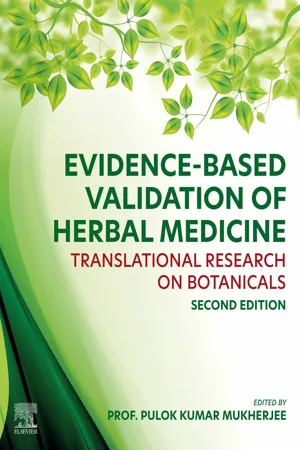
Evidence-Based Validation of Herbal Medicine
Translational Research on Botanicals
- 836 pages
- English
- ePUB (mobile friendly)
- Available on iOS & Android
eBook - ePub
About this book
Evidence-Based Validation of Herbal Medicines: Translational Research on Botanicals brings together current thinking and practice in the characterization and validation of natural products. The book describes different approaches and techniques for evaluating the quality, safety and efficacy of herbal medicine, particularly methods to assess their activity and understand compounds responsible and their probable underlying mechanisms of action. This book brings together the views, expertise and experiences of scientific experts in the field of medicinal plant research, hence it will be useful for researcher who want to know more about the natural lead with their validation and also useful to exploit traditional medicines.
- Includes state-of-the-art methods for detecting, isolating and performing structure elucidation by degradation and spectroscopic techniques
- Highlights the trends in validation and value addition of herbal medicine with different scientific approaches used in therapeutics
- Contains several all-new chapters on topics such as traditional-medicine-inspired drug development to treat emerging viral diseases, medicinal plants in antimicrobial resistance, TLC bio profiling, botanicals as medicinal foods, bioprospecting and bioassay-guided isolation of medicinal plants, immunomodulators from medicinal plants, and more
Information
Topic
MedicineSubtopic
OperationsTable of contents
- Title of Book
- Cover image
- Title page
- Table of Contents
- Copyright
- Contributors
- Foreword
- Preface
- Acknowledgments
- Chapter 1 Evidence-based validation of herbal medicine: Translational approach
- Chapter 2 New perspectives on value chains of herbal medicines—Ethnopharmacological and analytical challenges in a globalizing world
- Chapter 3 Ultrasound in identification of ADR in herbal medicine
- Chapter 4 Phospholipid complexation: A versatile technique for delivery of phytomedicine
- Chapter 5 Traditional herbal medicine, pharmacognosy, and pharmacopoeial standards: A discussion at the crossroads in the age of COVID
- Chapter 6 Taxonomy—An irreplaceable tool for validation of herbal medicine revisited
- Chapter 7 Bioactive leads for skin aging—Current scenario and future perspectives
- Chapter 8 DNA barcoding and metabarcoding for quality control of botanicals and derived herbal products
- Chapter 9 Pharmacovigilance of herbal medicines: The vigilance of tomorrow
- Chapter 10 Validation of antiviral potential of herbal ethnomedicine
- Chapter 11 Harmonization of regulatory requirements in Europe to ensure quality, safety and efficacy of herbal medicinal products
- Chapter 12 Medicinal plants in antimicrobial resistance—Perspectives towards drug development
- Chapter 13 Good quality and clinical practices for the future development of herbal medicines
- Chapter 14 Evaluation of bioactive compounds as AChE inhibitors from medicinal plants
- Chapter 15 Validation of anti-malarial leads from natural products and traditional medicine for treatment of malaria
- Chapter 16 TLC bioprofiling—A tool for quality evaluation of medicinal plants
- Chapter 17 Obesity and lifestyle-related disorders beyond the stethoscope: Role of botanicals
- Chapter 18 Advances in applications of high-performance liquid chromatography in the analysis of herbal products
- Chapter 19 Ayurveda—Translational approaches towards validation as sustainable healthcare practices
- Chapter 20 Evaluation of immunomodulatory potential of medicinal plants—Present scenario
- Chapter 21 Synergy and network pharmacology—Establishing the efficacy of herbal medicine
- Chapter 22 Bioprospecting and bioassay-guided isolation of medicinal plants—A tool for drug discovery
- Chapter 23 Discovery and development of lead compounds from natural sources using computational approaches
- Chapter 24 African traditional herbal medicine: Addressing standardization and quality control challenges for product development
- Chapter 25 Analytical platforms and methodologies in herbal metabolomics
- Chapter 26 Infrared and near-infrared spectroscopic techniques for the quality control of herbal medicines
- Chapter 27 Cyberecoethnopharmacolomics—An integrated approach to traditional medicine quality control
- Chapter 28 Ethnopharmacological and therapeutic potential of Terminalia arjuna and Camellia sinensis against cardiovascular diseases: Evidence and experimental studies
- Chapter 29 Exploring medicinal plants for the development of natural enzyme inhibitors
- Chapter 30 Validation of Thai traditional medicine: Current scenario
- Chapter 31 Application of NIR and Raman spectroscopy for quality evaluation and gradation of medicinal plants: Possibilities and challenges
- Chapter 32 Evaluation of anti-biofilm formation and quorum sensing attenuation of herbal medicines
- Chapter 33 Clinical research on herbal/ASU/traditional drugs in India
- Chapter 34 Biotransformation of natural products and its significance in drug development
- Chapter 35 Methods of extraction of medicinal plants
- Chapter 36 Essential oils and their components as sensitizers of multidrug resistant bacteria
- Chapter 37 Hyphenated analytical techniques for validation of herbal medicine
- Index
Trusted by 375,005 students
Access to over 1.5 million titles for a fair monthly price.
Study more efficiently using our study tools.
Frequently asked questions
Yes, you can cancel anytime from the Subscription tab in your account settings on the Perlego website. Your subscription will stay active until the end of your current billing period. Learn how to cancel your subscription
No, books cannot be downloaded as external files, such as PDFs, for use outside of Perlego. However, you can download books within the Perlego app for offline reading on mobile or tablet. Learn how to download books offline
Perlego offers two plans: Essential and Complete
- Essential is ideal for learners and professionals who enjoy exploring a wide range of subjects. Access the Essential Library with 800,000+ trusted titles and best-sellers across business, personal growth, and the humanities. Includes unlimited reading time and Standard Read Aloud voice.
- Complete: Perfect for advanced learners and researchers needing full, unrestricted access. Unlock 1.5M+ books across hundreds of subjects, including academic and specialized titles. The Complete Plan also includes advanced features like Premium Read Aloud and Research Assistant.
We are an online textbook subscription service, where you can get access to an entire online library for less than the price of a single book per month. With over 1.5 million books across 990+ topics, we’ve got you covered! Learn about our mission
Look out for the read-aloud symbol on your next book to see if you can listen to it. The read-aloud tool reads text aloud for you, highlighting the text as it is being read. You can pause it, speed it up and slow it down. Learn more about Read Aloud
Yes! You can use the Perlego app on both iOS and Android devices to read anytime, anywhere — even offline. Perfect for commutes or when you’re on the go.
Please note we cannot support devices running on iOS 13 and Android 7 or earlier. Learn more about using the app
Please note we cannot support devices running on iOS 13 and Android 7 or earlier. Learn more about using the app
Yes, you can access Evidence-Based Validation of Herbal Medicine by Pulok K. Mukherjee in PDF and/or ePUB format, as well as other popular books in Medicine & Operations. We have over 1.5 million books available in our catalogue for you to explore.