eBook - ePub
Fate of Biological Contaminants During Recycling of Organic Wastes
- 386 pages
- English
- ePUB (mobile friendly)
- Available on iOS & Android
eBook - ePub
Fate of Biological Contaminants During Recycling of Organic Wastes
About this book
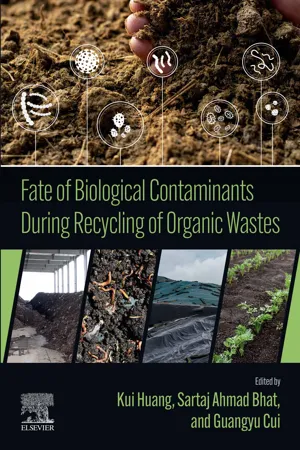
Fate of Biological Contaminants During Recycling of Organic Wastes covers the fate of viruses, HPBs, and ARGs in organic wastes, and their eliminating methods, including composting, vermicomposting and anaerobic digestion. In addition, this work describes the environmental risks associated with the application of excess sludge, livestock and other bio-wastes in soils Fate of Biological Contaminants During Recycling of Organic Wastes will benefit environmental and soil scientists engaged in the latest research regarding risk assessment and remediation techniques in wastewater, and solid wastes, and agricultural wastes.
- Covers the fate of viruses, HPBs, and ARGs in wastes as well as their environmental risk to the ecosystem
- Includes applications of earthworm remediation techniques, composting, and anaerobic digestion for organic wastes
- Introduce the key relationship between viruses, HPBs, ARGs and the microbial community during biological treatment of excess sludge and livestock manure
Information
Topic
Scienze biologicheSubtopic
Teoria economicaTable of contents
- Title of Book
- Cover image
- Title page
- Table of Contents
- Copyright
- Contributors
- Chapter One Occurrence, fate, and behavior of antibiotic resistance genes in organic wastes during biological treatments and current elimination strategies
- Chapter Two Human pathogenic microorganism in sludge
- Chapter Three Potential of entomocomposting toward soil pathogen suppression
- Chapter Four Valorization of fish wastes for circular bioeconomy: A concern toward antibiotic resistance genes (ARGs) contaminants for environmental safety
- Chapter Five Dynamics of biological contaminants along with microbial community during vermicomposting
- Chapter Six Treatment approaches for bio-contaminants in organic wastes
- Chapter Seven Fate of bio-contaminants in organic wastes during composting and vermicomposting processes
- Chapter Eight Metagenomic analysis revealing the dual microbial community features in three common vermicomposts
- Chapter Nine Solid waste management during the COVID-19 pandemic
- Chapter Ten Effects of bio-contaminants in organic waste products on the soil environment
- Chapter Eleven Fate of bio-contaminants in soil systems and available remediation methods
- Chapter Twelve Antibiotics and antibiotics resistance genes in poultry and animals’ manure and their effects on environment and human health
- Chapter Thirteen Vermicomposting as a means of removing antibiotic resistance genes (ARGs) from soil and water
- Chapter Fourteen Insight on the prevalence of pathogens present in the municipal solid waste of sanitary landfills, dumpsites, and leachate
- Chapter Fifteen Bioconversion of hazardous organic wastes using invertebrates
- Chapter Sixteen Effects of plants’ density on the reduction of antibiotic resistance genes in vermi-wetland for recycling excess sludge
- Index
Trusted by 375,005 students
Access to over 1.5 million titles for a fair monthly price.
Study more efficiently using our study tools.
Frequently asked questions
Yes, you can cancel anytime from the Subscription tab in your account settings on the Perlego website. Your subscription will stay active until the end of your current billing period. Learn how to cancel your subscription
No, books cannot be downloaded as external files, such as PDFs, for use outside of Perlego. However, you can download books within the Perlego app for offline reading on mobile or tablet. Learn how to download books offline
We are an online textbook subscription service, where you can get access to an entire online library for less than the price of a single book per month. With over 1.5 million books across 990+ topics, we’ve got you covered! Learn about our mission
Look out for the read-aloud symbol on your next book to see if you can listen to it. The read-aloud tool reads text aloud for you, highlighting the text as it is being read. You can pause it, speed it up and slow it down. Learn more about Read Aloud
Yes! You can use the Perlego app on both iOS and Android devices to read anytime, anywhere — even offline. Perfect for commutes or when you’re on the go.
Please note we cannot support devices running on iOS 13 and Android 7 or earlier. Learn more about using the app
Please note we cannot support devices running on iOS 13 and Android 7 or earlier. Learn more about using the app
Yes, you can access Fate of Biological Contaminants During Recycling of Organic Wastes by Kui Huang,Sartaj Ahmad Bhat,Guangyu Cui in PDF and/or ePUB format, as well as other popular books in Scienze biologiche & Teoria economica. We have over 1.5 million books available in our catalogue for you to explore.