eBook - ePub
Diagnosis and Treatment of Spinal Cord Injury
- 626 pages
- English
- ePUB (mobile friendly)
- Available on iOS & Android
eBook - ePub
Diagnosis and Treatment of Spinal Cord Injury
About this book
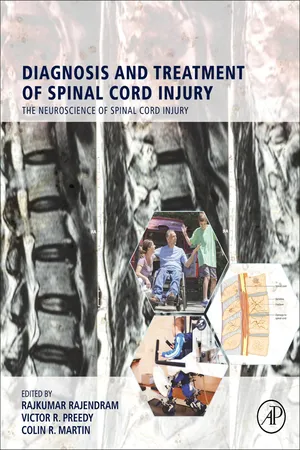
Diagnosis and Treatment of Spinal Cord Injury will enhance readers' understanding of the complexities of the diagnosis and management of spinal cord injuries. Featuring chapters on drug delivery, exercise, and rehabilitation, this volume discusses in detail the impact of the clinical features, diagnosis, management, and long-term prognosis of spinal cord injuries on the lives of those affected. The book has applicability for neuroscientists, neurologists, clinicians, and anyone working to better understand spinal cord injuries.
- Covers both the diagnosis and treatment of spinal cord injury
- Contains chapter abstracts, key facts, dictionary, and summary points to aid in understanding
- Features chapters on epidemiology and pain
- Includes MRI usage, biomarkers, and stem cell and gene therapy for management of spinal cord injury
- Discusses pain reduction, drug delivery, and rehabilitation
Information
Topic
Scienze biologicheSubtopic
FisiologiaTable of contents
- Diagnosis and Treatment of Spinal Cord Injury
- Chapter 1 Traumatic spinal cord injury and outcomes in low-resource settings
- Chapter 2 Biomechanics and patterns of spine injuries associated with spinal cord injury
- Chapter 3 Body, action, and space representations in people affected by spinal cord injuries
- Chapter 4 Methods for treating pain and painful syndromes in spinal cord injury: Medications, therapies, interventions, and neuromodulation
- Chapter 5 Factors contributing to pressure injuries in traumatic spinal cord injury
- Chapter 6 Venous thromboembolism in spinal cord injury—Prophylaxis, diagnosis and treatment
- Chapter 7 Osteoporosis-related fractures: What they are and how they occur following spinal cord injury
- Chapter 8 Understanding the effects of prolonged cervical spinal cord compression on the brain. Current knowledge and future challenges
- Chapter 9 Spasticity in spinal cord injury
- Chapter 10 Fall circumstances, consequences, assessments, and interventions to manage fall risk among individuals living with spinal cord injury
- Chapter 11 Infections and spinal cord injury: Covid-19 and beyond
- Chapter 12 Sleep problems in spinal cord injury
- Chapter 13 Biomarkers in spinal cord injury: A highlight on prognostic insights
- Chapter 14 Quality of life tools for spinal cord–injured people
- Chapter 15 S100b in spinal cord injury
- Chapter 16 Assessment of postural control after spinal cord injury or disease: A narrative review
- Chapter 17 Surgical management of acute spinal cord injury in emergency setting
- Chapter 18 Spinal cord epidural stimulation for autonomic nervous system control: A focus on improving bladder, bowel, and cardiovascular function
- Chapter 19 Treating spinal cord injury with implanted spinal cord stimulators
- Chapter 20 Bowel dysfunction in spinal cord injury
- Chapter 21 Management of neurogenic lower urinary tract dysfunction due to spinal cord injury
- Chapter 22 Bed support surfaces for preventing pressure injuries after spinal cord injury
- Chapter 23 Nerve and tendon transfers in tetraplegia: A new narrative
- Chapter 24 GEMINI-supported spinal cord transplantation for the treatment of chronic spinal paralysis: Overview and initial clinical translation
- Chapter 25 Chondroitinase ABC I as a novel candidate for reducing damage in spinal cord injury
- Chapter 26 Phenol neurolysis for spasticity management in people with spinal cord injury
- Chapter 27 Anti-repulsive guidance molecule: An antibody treatment in spinal cord injury
- Chapter 28 Mitochondrial biogenesis for the treatment of spinal cord injury
- Chapter 29 Exploring the exogenous and endogenous effects of melatonin on spinal cord injury
- Chapter 30 High-intensity interval training in individuals with spinal cord injury
- Chapter 31 Stem cells and chronic spinal cord injury: Overview
- Chapter 32 Viral vector gene therapy approaches for regeneration and repair in spinal cord injury
- Chapter 33 Curcumin usage for inflammation and spinal cord injury
- Chapter 34 Use of (−)-epigallocatechin-3-gallate on spinal cord injury
- Chapter 35 Vitamin D and spinal cord injury
- Chapter 36 Corticospinal tract regeneration after spinal cord injury: Implications for treatment and recovery
- Chapter 37 Trophic factors in patients with spinal cord injury
- Chapter 38 Spinal cord injury: Multiple family group (MFG) education and support
- Chapter 39 Spinal cord injury rehabilitation: Linking service delivery and community integration
- Chapter 40 Rehabilitation in spinal cord injury: Exercise and testing for cardiorespiratory endurance and musculoskeletal fitness
- Chapter 41 Community-based activity-based therapy for spinal cord injuries rehabilitation
- Chapter 42 Mobile health apps and self-management for spinal cord injury rehabilitation
- Chapter 43 Biomaterials, spinal cord injury, and rehabilitation: A new narrative
- Chapter 44 Support in spinal cord injury: A focus on robotics
- Chapter 45 Recommended resources and sites for the neuroscience of spinal cord injury
- Index
Trusted by 375,005 students
Access to over 1.5 million titles for a fair monthly price.
Study more efficiently using our study tools.
Frequently asked questions
Yes, you can cancel anytime from the Subscription tab in your account settings on the Perlego website. Your subscription will stay active until the end of your current billing period. Learn how to cancel your subscription
No, books cannot be downloaded as external files, such as PDFs, for use outside of Perlego. However, you can download books within the Perlego app for offline reading on mobile or tablet. Learn how to download books offline
Perlego offers two plans: Essential and Complete
- Essential is ideal for learners and professionals who enjoy exploring a wide range of subjects. Access the Essential Library with 800,000+ trusted titles and best-sellers across business, personal growth, and the humanities. Includes unlimited reading time and Standard Read Aloud voice.
- Complete: Perfect for advanced learners and researchers needing full, unrestricted access. Unlock 1.5M+ books across hundreds of subjects, including academic and specialized titles. The Complete Plan also includes advanced features like Premium Read Aloud and Research Assistant.
We are an online textbook subscription service, where you can get access to an entire online library for less than the price of a single book per month. With over 1.5 million books across 990+ topics, we’ve got you covered! Learn about our mission
Look out for the read-aloud symbol on your next book to see if you can listen to it. The read-aloud tool reads text aloud for you, highlighting the text as it is being read. You can pause it, speed it up and slow it down. Learn more about Read Aloud
Yes! You can use the Perlego app on both iOS and Android devices to read anytime, anywhere — even offline. Perfect for commutes or when you’re on the go.
Please note we cannot support devices running on iOS 13 and Android 7 or earlier. Learn more about using the app
Please note we cannot support devices running on iOS 13 and Android 7 or earlier. Learn more about using the app
Yes, you can access Diagnosis and Treatment of Spinal Cord Injury by Rajkumar Rajendram,Victor R Preedy,Colin R Martin,Colin R. R Martin,Colin R. Martin,Victor R. Preedy in PDF and/or ePUB format, as well as other popular books in Scienze biologiche & Fisiologia. We have over 1.5 million books available in our catalogue for you to explore.