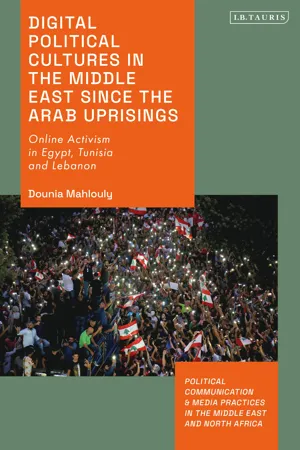
eBook - ePub
Digital Political Cultures in the Middle East since the Arab Uprisings
Online Activism in Egypt, Tunisia and Lebanon
- 208 pages
- English
- ePUB (mobile friendly)
- Available on iOS & Android
eBook - ePub
Digital Political Cultures in the Middle East since the Arab Uprisings
Online Activism in Egypt, Tunisia and Lebanon
About this book
This book offers a ten-year perspective on ongoing and evolving practices of digital activism across the Middle East and North Africa, drawing on interviews and ethnographic evidence collected between 2012 and 2022. It examines the shifting narrative around digital activism in the region, from the wake of the 2011 uprisings to the 2019 series of protests coined 'the second wave of the Arab Spring'. It considers how media activists navigate the transition from the emergent to the mainstream in a climate of contentious politics, following the civil mobilisations of the pro-revolutionary youths in Tunisia, Egypt, and Lebanon. It outlines the particularities of these three different political contexts and media environments, featuring case studies of the Tunisian blogosphere, online campaigning in the Egyptian elections and interviews with social media activists. In light of this empirical evidence, the book offers a critique of the increasing prevalence of a security perspective through which online activism has been viewed and its deleterious effect on digital political engagement in the region.
Information
Table of contents
- Cover
- Halftitle Page
- Title Page
- Contents
- List of figures
- Acknowledgements
- 1 Introduction
- 2 From utopia to dystopia
- 3 From the emergent to the mainstream: The cycle of discursive power
- 4 Emergent media in post-revolutionary Tunisia and Egypt: A study of the blogosphere
- 5 Mass media campaigning on Twitter: Egypt and the 2012 presidential election
- 6 Making sense of the revolution: Debating online over the 2012 Egyptian constitution
- 7 Looking back at the revolution: Gathering impressions from the field after the 2013 military coup
- 8 The agenda of global security and its implication for independent media
- 9 Lebanon: Before, during and after the 2019 revolution
- 10 Conclusion: The media as a bridge between the political theory and political praxis of the revolution
- Appendices
- Notes
- Bibliography
- Index
- Imprint
Trusted by 375,005 students
Access to over 1.5 million titles for a fair monthly price.
Study more efficiently using our study tools.
Frequently asked questions
Yes, you can cancel anytime from the Subscription tab in your account settings on the Perlego website. Your subscription will stay active until the end of your current billing period. Learn how to cancel your subscription
No, books cannot be downloaded as external files, such as PDFs, for use outside of Perlego. However, you can download books within the Perlego app for offline reading on mobile or tablet. Learn how to download books offline
Perlego offers two plans: Essential and Complete
- Essential is ideal for learners and professionals who enjoy exploring a wide range of subjects. Access the Essential Library with 800,000+ trusted titles and best-sellers across business, personal growth, and the humanities. Includes unlimited reading time and Standard Read Aloud voice.
- Complete: Perfect for advanced learners and researchers needing full, unrestricted access. Unlock 1.5M+ books across hundreds of subjects, including academic and specialized titles. The Complete Plan also includes advanced features like Premium Read Aloud and Research Assistant.
We are an online textbook subscription service, where you can get access to an entire online library for less than the price of a single book per month. With over 1.5 million books across 990+ topics, we’ve got you covered! Learn about our mission
Look out for the read-aloud symbol on your next book to see if you can listen to it. The read-aloud tool reads text aloud for you, highlighting the text as it is being read. You can pause it, speed it up and slow it down. Learn more about Read Aloud
Yes! You can use the Perlego app on both iOS and Android devices to read anytime, anywhere — even offline. Perfect for commutes or when you’re on the go.
Please note we cannot support devices running on iOS 13 and Android 7 or earlier. Learn more about using the app
Please note we cannot support devices running on iOS 13 and Android 7 or earlier. Learn more about using the app
Yes, you can access Digital Political Cultures in the Middle East since the Arab Uprisings by Dounia Mahlouly in PDF and/or ePUB format, as well as other popular books in History & Middle Eastern History. We have over 1.5 million books available in our catalogue for you to explore.