- 212 pages
- English
- ePUB (mobile friendly)
- Available on iOS & Android
eBook - ePub
Postwar South Korea and Japanese Popular Culture
About this book
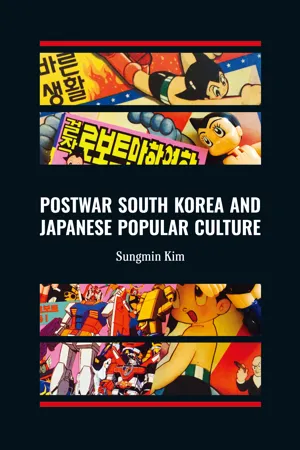
After World War II, Japanese popular culture was "banned" in Korea. However, despite the official ban, Japanese popular culture was introduced and circulated through hidden or unofficial channels. In fact, the author, born in Seoul in 1976, grew up watching the animated TV series
Astro Boy with its theme song in Korean. He recalls that it was not until the 1990s that he learned that
Astro Boy was produced in Japan. Why was Japanese popular culture banned? How did Japanese popular culture spread in Korea despite the ban and the changing political situation? This book analyzes the history of how Japanese culture has been accepted into Korean society, citing numerous animated and visual works as examples. Japan-Korea relations have undergone dramatic changes, and although Japan and Korea are increasingly linked in terms of politics, economics, and cultural production, the relationship remains fragile due to the colonial history of the two countries. This book is a unique attempt to rethink postwar Japan-Korea relations from the perspective of transnational cultural space.
Information
Table of contents
- Cover
- Title Page
- Copyright
- Contents
- List of Images
- List of Tables
- Preface to the English Edition
- Introduction
- Part One: Historical Conditions of the Korean Ban on Japanese Popular Culture
- Part Two: The Era of the Ban on Japanese Popular Culture
- Part Three: Dismantling the Ban on Japanese Popular Culture
- Conclusion: Can the “Mechanism of Prohibition” be Surmounted?
- Bibliography
- Newspapers, Magazines, Websites and other Primary Sources
- Appendix: Table of Titles
- Index
Trusted by 375,005 students
Access to over 1.5 million titles for a fair monthly price.
Study more efficiently using our study tools.
Frequently asked questions
Yes, you can cancel anytime from the Subscription tab in your account settings on the Perlego website. Your subscription will stay active until the end of your current billing period. Learn how to cancel your subscription
No, books cannot be downloaded as external files, such as PDFs, for use outside of Perlego. However, you can download books within the Perlego app for offline reading on mobile or tablet. Learn how to download books offline
Perlego offers two plans: Essential and Complete
- Essential is ideal for learners and professionals who enjoy exploring a wide range of subjects. Access the Essential Library with 800,000+ trusted titles and best-sellers across business, personal growth, and the humanities. Includes unlimited reading time and Standard Read Aloud voice.
- Complete: Perfect for advanced learners and researchers needing full, unrestricted access. Unlock 1.5M+ books across hundreds of subjects, including academic and specialized titles. The Complete Plan also includes advanced features like Premium Read Aloud and Research Assistant.
We are an online textbook subscription service, where you can get access to an entire online library for less than the price of a single book per month. With over 1.5 million books across 990+ topics, we’ve got you covered! Learn about our mission
Look out for the read-aloud symbol on your next book to see if you can listen to it. The read-aloud tool reads text aloud for you, highlighting the text as it is being read. You can pause it, speed it up and slow it down. Learn more about Read Aloud
Yes! You can use the Perlego app on both iOS and Android devices to read anytime, anywhere — even offline. Perfect for commutes or when you’re on the go.
Please note we cannot support devices running on iOS 13 and Android 7 or earlier. Learn more about using the app
Please note we cannot support devices running on iOS 13 and Android 7 or earlier. Learn more about using the app
Yes, you can access Postwar South Korea and Japanese Popular Culture by Sungmin Kim in PDF and/or ePUB format, as well as other popular books in History & Korean History. We have over 1.5 million books available in our catalogue for you to explore.