SHORTLISTED, 2024 MSA FIRST BOOK PRIZE
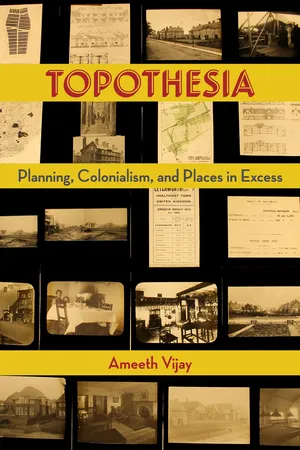
Topothesia reads urban planning as a mode of speculative fiction, one inextricably linked to histories of British colonialism and liberalism through a particular understanding of place. The book focuses on town planning from the late nineteenth century to the present day, showing how the contemporary geography of Britain—sharply unequal and marked by racial division—continues ideologies of place established in colonial contexts. Specifically, planning allows for the speculative construction of future places that are both utopian in their ability to resolve political disagreement and at the same tantalizingly realizable, able to be produced in concrete reality. This speculative imaginary, I argue, is only possible within the ideological framework of colonialism and the history of empire within which it developed.
Topothesia refers to a rhetorical device employing the vivid depiction of an often-imaginary place. This device, Vijay shows, helps us understand urban planning as a narrative genre, one that, even in its most mundane documents, is compelled to produce elaborate fantasies of future places. The book examines specific planning movements over time to understand the form and the stakes of their speculative worlds. In building these worlds, the book shows, planners continually coopted literary critiques of the present and reveries of the future, retaining literature's aesthetics while eschewing its politics. At the same time, Vijay shows, writers and artists have dwelled within and against these colonial imaginaries to seek other means of representing place.
- 272 pages
- English
- ePUB (mobile friendly)
- Available on iOS & Android
eBook - ePub
About this book
Information
Publisher
Fordham University PressYear
2023Print ISBN
9781531503185
9781531503178
Edition
1eBook ISBN
9781531503192
Table of contents
- Cover
- Title Page
- Copyright
- Contents
- Introduction
- Part I: Improving Places: Liberal Colonialism and the Speculative Imaginary of Early Planning
- Part II: Diminishing Horizons: The Ambivalent Temporalities of Development
- Coda
- Acknowledgments
- Notes
- Bibliography
- Index
- About the Author
Trusted by 375,005 students
Access to over 1.5 million titles for a fair monthly price.
Study more efficiently using our study tools.
Frequently asked questions
Yes, you can cancel anytime from the Subscription tab in your account settings on the Perlego website. Your subscription will stay active until the end of your current billing period. Learn how to cancel your subscription
No, books cannot be downloaded as external files, such as PDFs, for use outside of Perlego. However, you can download books within the Perlego app for offline reading on mobile or tablet. Learn how to download books offline
We are an online textbook subscription service, where you can get access to an entire online library for less than the price of a single book per month. With over 1.5 million books across 990+ topics, we’ve got you covered! Learn about our mission
Look out for the read-aloud symbol on your next book to see if you can listen to it. The read-aloud tool reads text aloud for you, highlighting the text as it is being read. You can pause it, speed it up and slow it down. Learn more about Read Aloud
Yes! You can use the Perlego app on both iOS and Android devices to read anytime, anywhere — even offline. Perfect for commutes or when you’re on the go.
Please note we cannot support devices running on iOS 13 and Android 7 or earlier. Learn more about using the app
Please note we cannot support devices running on iOS 13 and Android 7 or earlier. Learn more about using the app
Yes, you can access Topothesia by Ameeth Vijay in PDF and/or ePUB format, as well as other popular books in Literature & Urban Planning & Landscaping. We have over 1.5 million books available in our catalogue for you to explore.