The rural-urban dichotomy is one of the most influential figures of thought in history, laying the foundation for academic disciplines such as rural and urban sociology. The dichotomy rests on the assumption that rural and urban areas differ fundamentally. By the mid-twentieth century, scholars had observed that many rural areas displayed a blend of rural and urban features. Since then, counter urbanisation, urban sprawl and ever-increasing flows of people, goods and ideas between rural and urban areas have blurred the distinctions even further. Attempts to create new rural-urban classification systems, whether based on factors such as population size, density or distances, have largely failed. Clearly, new classification systems must use the meaning of observed changes in rural-urban systems as their point of departure rather than simple measurements of these changes. These meanings can, despite the interdependencies of our global world, be explored only in their political, cultural and economic settings.
eBook - PDF
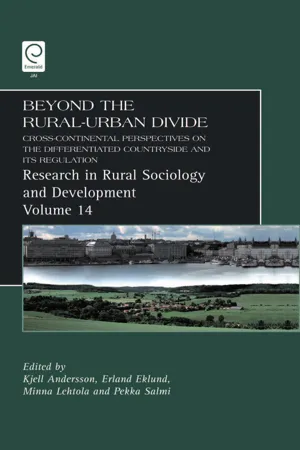
Beyond the Rural-Urban Divide
Cross-Continental Perspectives on the Differentiated Countryside and Its Regulation
- 361 pages
- English
- PDF
- Available on iOS & Android
eBook - PDF
Beyond the Rural-Urban Divide
Cross-Continental Perspectives on the Differentiated Countryside and Its Regulation
About this book
Information
Publisher
Emerald Group Publishing LimitedYear
2009Print ISBN
9781781901557
9781848551381
eBook ISBN
9781848551398
Table of contents
- Beyond the Rural-Urban Divide: Cross-Continental Perspectives on the Differentiated Countryside and its Regulation
- Copyright page
- Contents
- List of contributors
- Introduction: Beyond the rural-urban divide
- Part I. Differentiation processes: Deep rural areas, periurban areas, post-socialist countrysides
- Part II. Governing differentiation
Trusted by 375,005 students
Access to over 1.5 million titles for a fair monthly price.
Study more efficiently using our study tools.
Frequently asked questions
Yes, you can cancel anytime from the Subscription tab in your account settings on the Perlego website. Your subscription will stay active until the end of your current billing period. Learn how to cancel your subscription
No, books cannot be downloaded as external files, such as PDFs, for use outside of Perlego. However, you can download books within the Perlego app for offline reading on mobile or tablet. Learn how to download books offline
Perlego offers two plans: Essential and Complete
- Essential is ideal for learners and professionals who enjoy exploring a wide range of subjects. Access the Essential Library with 800,000+ trusted titles and best-sellers across business, personal growth, and the humanities. Includes unlimited reading time and Standard Read Aloud voice.
- Complete: Perfect for advanced learners and researchers needing full, unrestricted access. Unlock 1.5M+ books across hundreds of subjects, including academic and specialized titles. The Complete Plan also includes advanced features like Premium Read Aloud and Research Assistant.
We are an online textbook subscription service, where you can get access to an entire online library for less than the price of a single book per month. With over 1.5 million books across 990+ topics, we’ve got you covered! Learn about our mission
Look out for the read-aloud symbol on your next book to see if you can listen to it. The read-aloud tool reads text aloud for you, highlighting the text as it is being read. You can pause it, speed it up and slow it down. Learn more about Read Aloud
Yes! You can use the Perlego app on both iOS and Android devices to read anytime, anywhere — even offline. Perfect for commutes or when you’re on the go.
Please note we cannot support devices running on iOS 13 and Android 7 or earlier. Learn more about using the app
Please note we cannot support devices running on iOS 13 and Android 7 or earlier. Learn more about using the app
Yes, you can access Beyond the Rural-Urban Divide by Kjell Andersson, Erland Eklund, Minna Lehtola, Kjell Andersson,Erland Eklund,Minna Lehtola, Terry Marsden in PDF and/or ePUB format, as well as other popular books in Politics & International Relations & Local & Regional Planning Public Policy. We have over 1.5 million books available in our catalogue for you to explore.