A bold account of property reform during the French Revolution, arguing that the lofty democratic ideals enshrined by revolutionary leaders were rarely secured in practice—with lasting consequences.
Property reform was at the heart of the French Revolution. As lawmakers proclaimed at the time, and as historians have long echoed, the Revolution created modern property rights. Under the new regime, property was redefined as an individual right to which all citizens were entitled. Yet as the state seized assets and prepared them for sale, administrators quickly found that realizing the dream of democratic property rights was far more complicated than simply rewriting laws.
H. B. Callaway sifts through records on Parisian émigrés who fled the country during the Revolution, leaving behind property that the state tried to confiscate. Immediately, officials faced difficult questions about what constituted property, how to prove ownership, and how to navigate the complexities of credit arrangements and family lineage. Mothers fought to protect the inheritances of their children, tenants angled to avoid rent payments, and creditors sought their dues. In attempting to execute policy, administrators regularly exercised their own judgment on the validity of claims. Their records reveal far more continuity between the Old Regime and revolutionary practices than the law proclaimed. Property ownership continued to depend on webs of connections beyond the citizen-state relationship, reinforced by customary law and inheritance traditions. The resulting property system was a product of contingent, on-the-ground negotiations as much as revolutionary law.
The House in the Rue Saint-Fiacre takes stock of the contradictions on which modern property rights were founded. As Callaway shows, the property confiscations of Parisian émigrés are a powerful, clarifying lens on the idea of ownership even as it exists today.
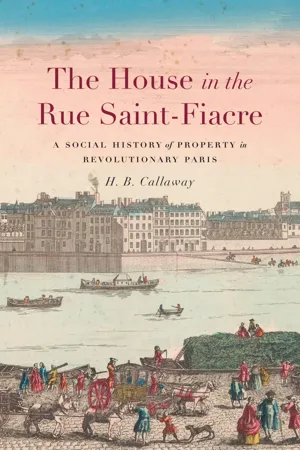
eBook - ePub
The House in the Rue Saint-Fiacre
A Social History of Property in Revolutionary Paris
- 297 pages
- English
- ePUB (mobile friendly)
- Available on iOS & Android
eBook - ePub
About this book
Information
Table of contents
- Cover
- Series Page
- Title Page
- Copyright
- Contents
- Map
- Introduction
- 1. Property Law in Revolutionary Society
- 2. The Émigrés and the Politics of Property
- 3. The Hands of the Nation
- 4. Césarine’s Inheritance
- 5. Property, Family, and Patrimony
- 6. By Iron or Nail
- Conclusion
- Notes
- Acknowledgments
- Index
Trusted by 375,005 students
Access to over 1.5 million titles for a fair monthly price.
Study more efficiently using our study tools.
Frequently asked questions
Yes, you can cancel anytime from the Subscription tab in your account settings on the Perlego website. Your subscription will stay active until the end of your current billing period. Learn how to cancel your subscription
No, books cannot be downloaded as external files, such as PDFs, for use outside of Perlego. However, you can download books within the Perlego app for offline reading on mobile or tablet. Learn how to download books offline
Perlego offers two plans: Essential and Complete
- Essential is ideal for learners and professionals who enjoy exploring a wide range of subjects. Access the Essential Library with 800,000+ trusted titles and best-sellers across business, personal growth, and the humanities. Includes unlimited reading time and Standard Read Aloud voice.
- Complete: Perfect for advanced learners and researchers needing full, unrestricted access. Unlock 1.5M+ books across hundreds of subjects, including academic and specialized titles. The Complete Plan also includes advanced features like Premium Read Aloud and Research Assistant.
We are an online textbook subscription service, where you can get access to an entire online library for less than the price of a single book per month. With over 1.5 million books across 990+ topics, we’ve got you covered! Learn about our mission
Look out for the read-aloud symbol on your next book to see if you can listen to it. The read-aloud tool reads text aloud for you, highlighting the text as it is being read. You can pause it, speed it up and slow it down. Learn more about Read Aloud
Yes! You can use the Perlego app on both iOS and Android devices to read anytime, anywhere — even offline. Perfect for commutes or when you’re on the go.
Please note we cannot support devices running on iOS 13 and Android 7 or earlier. Learn more about using the app
Please note we cannot support devices running on iOS 13 and Android 7 or earlier. Learn more about using the app
Yes, you can access The House in the Rue Saint-Fiacre by H. B. Callaway in PDF and/or ePUB format, as well as other popular books in History & Early Modern History. We have over 1.5 million books available in our catalogue for you to explore.