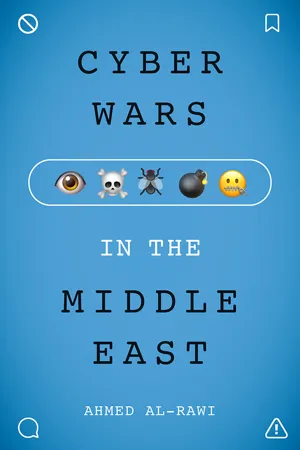
Cyberwars in the Middle East argues that hacking is a form of online political disruption whose influence flows vertically in two directions (top-bottom or bottom-up) or horizontally. These hacking activities are performed along three political dimensions: international, regional, and local. Author Ahmed Al-Rawi argues that political hacking is an aggressive and militant form of public communication employed by tech-savvy individuals, regardless of their affiliations, in order to influence politics and policies. Kenneth Waltz's structural realism theory is linked to this argument as it provides a relevant framework to explain why nation-states employ cyber tools against each other.
On the one hand, nation-states as well as their affiliated hacking groups like cyber warriors employ hacking as offensive and defensive tools in connection to the cyber activity or inactivity of other nation-states, such as the role of Russian Trolls disseminating disinformation on social media during the US 2016 presidential election. This is regarded as a horizontal flow of political disruption. Sometimes, nation-states, like the UAE, Saudi Arabia, and Bahrain, use hacking and surveillance tactics as a vertical flow (top-bottom) form of online political disruption by targeting their own citizens due to their oppositional or activists' political views. On the other hand, regular hackers who are often politically independent practice a form of bottom-top political disruption to address issues related to the internal politics of their respective nation-states such as the case of a number of Iraqi, Saudi, and Algerian hackers. In some cases, other hackers target ordinary citizens to express opposition to their political or ideological views which is regarded as a horizontal form of online political disruption. This book is the first of its kind to shine a light on many ways that governments and hackers are perpetrating cyber attacks in the Middle East and beyond, and to show the ripple effect of these attacks.
- 194 pages
- English
- ePUB (mobile friendly)
- Available on iOS & Android
eBook - ePub
Cyberwars in the Middle East
About this book
Information
Publisher
Rutgers University PressYear
2021Print ISBN
9781978810105
9781978810112
eBook ISBN
9781978810129
Table of contents
- Cover
- Series Page
- Title Page
- Copyright
- Dedication
- Contents
- Preface
- Introduction
- 1. Toward a Theoretical Framework of Cyberwars
- 2. Cyberwars and International Politics
- 3. U.S. Cyberoperations in the Middle East
- 4. Russian Trolls, Islam, and the Middle East
- 5. Cyberwars and Regional Politics
- 6. Arab Hackers and Electronic Armies
- Conclusion
- Appendix: Selected List of Arab Hacking Groups
- Notes
- References
- Index
- About the Author
Trusted by 375,005 students
Access to over 1.5 million titles for a fair monthly price.
Study more efficiently using our study tools.
Frequently asked questions
Yes, you can cancel anytime from the Subscription tab in your account settings on the Perlego website. Your subscription will stay active until the end of your current billing period. Learn how to cancel your subscription
No, books cannot be downloaded as external files, such as PDFs, for use outside of Perlego. However, you can download books within the Perlego app for offline reading on mobile or tablet. Learn how to download books offline
We are an online textbook subscription service, where you can get access to an entire online library for less than the price of a single book per month. With over 1.5 million books across 990+ topics, we’ve got you covered! Learn about our mission
Look out for the read-aloud symbol on your next book to see if you can listen to it. The read-aloud tool reads text aloud for you, highlighting the text as it is being read. You can pause it, speed it up and slow it down. Learn more about Read Aloud
Yes! You can use the Perlego app on both iOS and Android devices to read anytime, anywhere — even offline. Perfect for commutes or when you’re on the go.
Please note we cannot support devices running on iOS 13 and Android 7 or earlier. Learn more about using the app
Please note we cannot support devices running on iOS 13 and Android 7 or earlier. Learn more about using the app
Yes, you can access Cyberwars in the Middle East by Ahmed Al-Rawi in PDF and/or ePUB format, as well as other popular books in History & Computer Science General. We have over 1.5 million books available in our catalogue for you to explore.