On 3 September 1978, a Russian-supplied heat-seeking missile shot down an Air Rhodesia Viscount civilian airliner shortly after it took off from the lakeside holiday resort of Kariba in the Zambezi Valley. Miraculously, 18 people, including small children, survived the crash only for most of them to be gunned down in cold blood shortly after the crash by terrorists loyal to the Zimbabwe African People's Union (ZAPU) leader Joshua Nkomo. Just days before the plane was shot down, the Rhodesian leader, Ian Smith, had met secretly with Nkomo for discussions, brokered by Britain, Zambia and Nigeria. However, this event dramatically changed the political landscape and wrecked a plan by the British government to mold an alliance between Smith and the Ndebele leader Nkomo, and smoothed the path for the Shona leader Robert Mugabe to become the first leader of Zimbabwe. In this fascinating two-part account, Ian Pringle (author ofDingo Firestorm), describes the Viscount tragedy and the military response. He uses exclusive interviews with two survivors of the crash and the massacre, and with the first person to arrive at the horrendous crash scene (commanding officer of the Rhodesian SAS Regiment), as well as accounts from other key witnesses, to recreate the tragic event. He describes the white-hot anger felt by the small white community in Rhodesia, who howled for revenge and demanded martial law and total war. The Rhodesian military responded with Operation Gatling, a risky three-phased revenge attack on Nkomo's guerilla bases and infrastructure in Zambia. The prime target was Nkomo's military headquarters on the outskirts of Lusaka, the Zambian capital. The author uses a cockpit voice recording from the lead Canberra bomber, and exclusive interviews with the lead navigator and pilots involved in the raid to tell a fascinating, authentic and gripping story of the audacious attack, which became known as the Green Leader Raid. On the same day as Green Leader, two more bases in Zambia were attacked using air power and elite paratroops and helitroops in a well-honed tactic known as vertical envelopment. Pringle uses his own experience as a jet and helicopter pilot, and skydiver, as well as top-secret documents and interviews with key personnel involved in Operation Gatling to recreate a gripping account of Rhodesia's first large-scale attacks on Zambia. He describes the aftermath, another tragedy and a reprisal attack in Angola, which brought southern Africa to the very brink of a full-scale regional war. Green Leader is an exciting recreation of a calamitous time in southern African history.
eBook - ePub
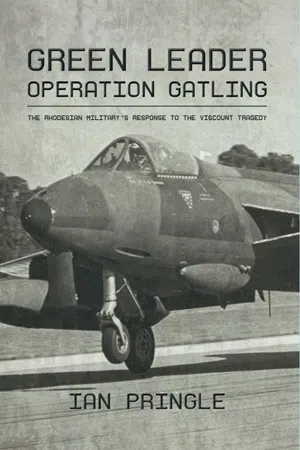
Green Leader
Operation Gatling, the Rhodesian Military's Response To The Viscount Tragedy
- 242 pages
- English
- ePUB (mobile friendly)
- Available on iOS & Android
eBook - ePub
Green Leader
Operation Gatling, the Rhodesian Military's Response To The Viscount Tragedy
About this book
Trusted by 375,005 students
Access to over 1.5 million titles for a fair monthly price.
Study more efficiently using our study tools.
Information
Subtopic
Modern HistoryIndex
HistoryPart 1
The Viscount tragedy
1
Britain takes sides
I came to the conclusion that he [Robert Mugabe] would not make a good leader.
– Dr David Owen, British Foreign Secretary, 1977–79
After 12 years of fruitlessly searching for a political settlement in Rhodesia, in 1978 Britain decided to choose sides. At the time, Rhodesia was sandwiched between Chinese-backed insurgents to the east, based in Mozambique and loyal to Robert Mugabe, and Soviet-backed insurgents to the west, based in Zambia and loyal to Joshua Nkomo. Britain decided to back Nkomo.
Attempts to reach a settlement had come and gone, but in 1976, US Secretary of State Henry Kissinger forced the issue by using what Americans call ‘meat-axe diplomacy’ to compel Ian Smith, the Rhodesian prime minister, to accept majority rule. Kissinger promised the South African prime minister, John Vorster, that if he helped to impose a black, non-communist government on Rhodesia (and Namibia), then the US administration would take the political heat off South Africa and allow the country to sort out its apartheid problems on its own terms. Yet, although Kissinger successfully forced Smith’s hand, this did not lead to compromise from the other side. If anything, the Kissinger deal hardened the attitude of the insurgent leaders because they sensed that Smith had lost control of events. When the parties gathered in Geneva at the end of 1976 to debate the Kissinger plan, the nationalists, particularly Robert Mugabe, demanded many more compromises. A furious Smith felt hoodwinked by the whole process and refused to compromise any further.
At the same time as the doomed Geneva conference, Kissinger’s boss, President Gerald Ford, lost the presidential election to Democrat Jimmy Carter, who took office as the 39th president of the United States in January 1977. The new president and his administration had a dramatic impact on events in Southern Africa. Carter was openly hostile towards any form of white rule in southern Africa, which put him at odds with Kissinger’s plan, especially the idea of shielding South Africa from political heat. Carter’s vice president, Walter Mondale, openly criticised the South African political system and tried to intimidate John Vorster. These tactics served only to harden South Africa’s attitude and Carter turned to oil-rich Nigeria as his principal ally in Africa. He managed to persuade Nigerian leader General Olusegun Obasanjo to get involved in reaching a settlement in Rhodesia – and the Nigerians certainly did get involved.
In early 1977, Cyrus Vance replaced Kissinger as secretary of state and soon contacted his opposite number in Britain, Foreign Secretary Dr David Owen – also a newcomer. By September that year, a new Anglo–American peace plan was formulated, known as the Owen–Vance plan. This arrangement required Smith to compromise even further and, like Kissinger’s plan, it relied on South Africa putting pressure on Rhodesia. But without their political heat shield, the South Africans were far less inclined to play ball and they refused to endorse the new plan. Unsurprisingly, Smith also rejected the plan.
Ian Smith had conceded a lot of ground to Henry Kissinger for little, if any, return. Despairing at the many failed international settlement attempts, the Rhodesian leader vigorously applied himself to negotiating a deal internally with Bishop Abel Muzorewa and other Rhodesian non-Marxist black nationalists. A deal was reached in March 1978, known as the March agreement, which saw the creation of Rhodesia’s first multiracial government – in which one white and one black minister shared each ministerial position – as a prelude to majority-rule elections later that year.
Although most of the world ignored the March agreement, Owen shrewdly saw it as a means to an end. Despite Vance’s misgivings, Owen tried to expand Smith’s internal settlement to include Joshua Nkomo in a powerful coalition that would almost certainly have excluded Robert Mugabe. At the time, Nkomo and Mugabe were the joint leaders of an external coalition called the Patriotic Front – a partnership they had been cornered into by the black presidents of various southern African states, who had become exasperated with the bickering and rivalry between them. However, the black presidents could not change the fact that these two men were bitter rivals who differed tribally and politically. Nkomo was a Matabele man who believed in a mild form of African socialism, whereas Mugabe was from the majority Shona group and a committed Marxist–Maoist. Their political organisations, Nkomo’s Zimbabwe African People’s Union (ZAPU) and Mugabe’s Zimbabwe African National Union (ZANU), and their armies, the Zimbabwe People’s Revolutionary Army (ZIPRA) and the Zimbabwe African National Liberation Army (ZANLA), respectively, were kept distinctly apart and often came within a hair’s breadth of attacking each other instead of fighting the Rhodesians.
During an interview on BBC Radio 4, 33 years later, in August 2011, David Owen shed light on this time in Zimbabwe’s history. Interviewer Mike Thompson asked Owen if it was true that he had tried to ensure that Joshua Nkomo, and not Robert Mugabe, would become the first black president of Zimbabwe. Owen answered: ‘Well, to some extent I am rather embarrassed by this because in the spring of ’78, I came to the conclusion that there was something wrong with Mugabe: that this man – who was both a Jesuit, or Catholic, and espousing Maoism – was hugely internally conflicted.’
Owen related that no one in the foreign office had believed that Mugabe regularly went to church, so he ordered MI6 agents to tail Mugabe in Maputo. They soon confirmed that Mugabe was indeed a regular attendee of mass in the Mozambique capital.
‘I came to the conclusion that he [Mugabe] would not make a good leader, the first democratic leader,’ said Owen. ‘That was also the conclusion of President Kaunda, very strongly … [and] the Nigerians, who were playing a very active role. Anyhow, an African solution began to emerge, which was really to meet with Ian Smith in Lusaka at State House. I was involved behind the scenes – I openly admit this. The idea was that Nkomo would go back into the country and be accepted by General Walls, and everybody, as prime minister, and that UN forces and other countries would go in and monitor, and there would be a year’s period, and then an election.’
It was an ambitious plan and had it come off, Mugabe would have had to fall in line or face off with the Rhodesian forces, Nkomo’s army and the UN peacekeeping forces.
Smith and Nkomo meet
A plan was hatched for Smith and Nkomo to meet secretly at President Kenneth Kaunda’s personal camp in the Luangwa Game Reserve, in Eastern Zambia. However, just before the intended meeting, Kaunda had to dash off to Rome for the funeral of Pope Paul VI. The meeting was postponed by a week and the venue moved to State House, in the heart of the Zambian capital, Lusaka. To ensure the secrecy of Smith’s visit, the Rhodesian premier was flown into Lusaka Airport after dark in an executive jet laid on by British company Lonrho on Monday 14 August 1978. The plan was for the meetings to take place during the night so that Smith could leave before first light the following morning.
This was Smith’s second visit to the Zambian capital: he had been smuggled into Zambia 10 months earlier to meet Kaunda, a trip facilitated by the chief executive of Lonrho, Tiny Rowland. Although the talks had not amounted to much, it is likely that David Owen had been involved behind the scenes. It was no coincidence that shortly after that secret trip, Smith had authorised Operation Dingo: a massive external strike into Mozambique, where Rhodesian forces had annihilated Robert Mugabe’s military headquarters complex near Chimoio and another base in Mozambique at Tembue, wiping out approximately a fifth of Mugabe’s forces.
After the raid, Mugabe had been furious with David Owen for not condemning the strike. Instead Owen had remarked that the attack had shown the world that the Rhodesian security forces were still a force to be reckoned with. That was not what Mugabe had wanted to hear.
‘It was a long drive from the airport, about forty minutes,’ recalled Smith in his memoirs, remembering that night in August. ‘We [Smith and two officials] were taken into a big lounge where Nkomo came forward and greeted me, and introduced me to Brigadier Garba from Nigeria.’
Joseph Garba, a Sandhurst-trained officer, had previously been the foreign minister of Nigeria. Kaunda stepped in, greeted Smith affably and opened the proceedings. He then left the parties to discuss the nitty gritty. ‘We talked until after midnight,’ recalled Smith, ‘and produced a plan which I thought was workable.’
The plan was as Owen had described it: Nkomo would return to Rhodesia as chairman of a new transitional government. Mugabe would also be invited to join and declare a ceasefire, although it was thought that he would not accept a plan that would result in him being subordinate to his rival Nkomo. The likely outcome would be that Mugabe would isolate himself.
Contextually, Smith and Nkomo’s meeting took place during the Cold War and in the wake of Portugal’s abrupt withdrawal from Angola and Mozambique in 1976, when the new Lisbon government, which had replaced the previous authoritarian regime, handed over their colonies to the insurgents they had been fighting. Consequently, Soviet-backed Marxist governments came to power in Mozambique and Angola. The startled West had no desire to see another Marxist-led government rise to power in Rhodesia – a situation that would have created a red saddle across Southern Africa from the Atlantic to the Indian Ocean. The Cold War was at its height.
Owen’s master plan would, however, go up in smoke in a tragedy that traumatised white Rhodesians and exposed Nkomo’s weak strategic thinking – and ultimately achieved an outcome directly opposed to Owen’s intention. Mugabe would rule for decades and Nkomo would be a political lame duck for the rest of his life.
2
Unholy grail
In 1966, when insurgents began to penetrate Rhodesia from neighbouring countries, air superiority proved to be a key strength in the Rhodesian security force’s armoury. In particular, the Alouette helicopter was used very effectively to carry infantry rapidly to envelop and destroy insurgents on the ground. In the early 1970s, a combination of an Alouette gunship, armed with a 20 mm cannon, known as a K-car, and three or four troop-carrying Alouettes, called G-cars, produced a formidable and highly mobile counterinsurgency weapon and was known as a Fireforce. Attached to each Fireforce was a fixed-wing aircraft armed with rockets, napalm or bombs, and machine guns. Later in the war, a vintage Dakota aircraft was added to the Fireforce and served to reinforce the infantry by dropping paratroops near the scene of a contact.
The Fireforce swung the advantage in favour of the Rhodesian forces and the insurgents took a severe battering. They needed something more than their AK automatic rifles and RPD light machine guns to counter Rhodesian air power; they needed a light and portable weapon specifically designed to bring down aircraft.
The answer lay in a guided missile that would pick up the heat from an aircraft’s exhaust system, home in on it and explode on impact. The American military had developed such a tail-chasing weapon, known as the Redeye. The Soviets copied this infrared, heat-seeking missile and developed their own version, commonly known as the SAM 7 (Surface to Air Missile Mk 7), but also called the Grail or Strela.
The Strela launcher was light and easily portable, and the shoulder-mounted weapon could be fired by one man alone. The Strela made its debut in Egypt in 1969, bringing down an Israeli Air Force Skyhawk. The weapon was used extensively during the Yom Kippur War and also by the North Vietnamese forces against American aircraft. It was just a matter of time before the Strela showed up in sub-Saharan Africa.
And it soon did. In March 1973, anti-Portuguese forces in the West African Portuguese colony of Guinea brought down two Portuguese Air Force Fiat jets on the same day using the Strela, which sent shock waves through southern Africa. There was little doubt that the Strela would soon show up in the hands of insurgents in Angola, Mozambique, Zambia and Rhodesia.
It wasn’t, however, until 1977 that the Soviets eventually supplied Joshua Nkomo’s ZIPRA insurgents with some of these weapons, specifically an improved version known as the Strela 2M, which was faster and had a better range than the earlier version. The first one showed up at the Victoria Falls.
The mighty Zambezi
Crystal clear water bubbles out of the ground into a small pond cradled by tree roots in the savannah woodland of Zambia’s far north-west, where a finger of Zambian land pokes into the Congo. This is the source of the mighty Zambezi River that ends its 2 500 km journey into the Indian Ocean.
This was not the original course of the river, it is thought that it originally flowed across the...
Table of contents
- Cover
- Title Page
- Copyright
- Contents
- List of photographs
- List of maps
- Picture acknowledgements
- Glossary and abbreviations
- Author’s note
- Acknowledgements
- Preface: The sun sets somewhere
- Part 1: The Viscount tragedy
- Part 2: Operation Gatling
- Epilogue
- Appendix: Documents
- Bibliography
Frequently asked questions
Yes, you can cancel anytime from the Subscription tab in your account settings on the Perlego website. Your subscription will stay active until the end of your current billing period. Learn how to cancel your subscription
No, books cannot be downloaded as external files, such as PDFs, for use outside of Perlego. However, you can download books within the Perlego app for offline reading on mobile or tablet. Learn how to download books offline
Perlego offers two plans: Essential and Complete
- Essential is ideal for learners and professionals who enjoy exploring a wide range of subjects. Access the Essential Library with 800,000+ trusted titles and best-sellers across business, personal growth, and the humanities. Includes unlimited reading time and Standard Read Aloud voice.
- Complete: Perfect for advanced learners and researchers needing full, unrestricted access. Unlock 1.5M+ books across hundreds of subjects, including academic and specialized titles. The Complete Plan also includes advanced features like Premium Read Aloud and Research Assistant.
We are an online textbook subscription service, where you can get access to an entire online library for less than the price of a single book per month. With over 1.5 million books across 990+ topics, we’ve got you covered! Learn about our mission
Look out for the read-aloud symbol on your next book to see if you can listen to it. The read-aloud tool reads text aloud for you, highlighting the text as it is being read. You can pause it, speed it up and slow it down. Learn more about Read Aloud
Yes! You can use the Perlego app on both iOS and Android devices to read anytime, anywhere — even offline. Perfect for commutes or when you’re on the go.
Please note we cannot support devices running on iOS 13 and Android 7 or earlier. Learn more about using the app
Please note we cannot support devices running on iOS 13 and Android 7 or earlier. Learn more about using the app
Yes, you can access Green Leader by Ian Pringle in PDF and/or ePUB format, as well as other popular books in History & Modern History. We have over 1.5 million books available in our catalogue for you to explore.