eBook - ePub
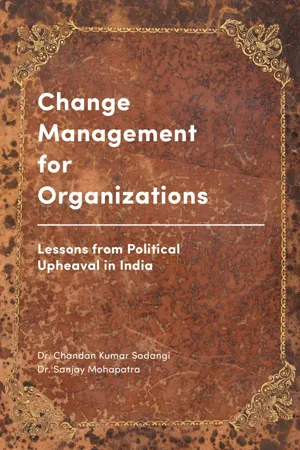
Change Management for Organizations
Lessons from Political Upheaval in India
- 184 pages
- English
- ePUB (mobile friendly)
- Available on iOS & Android
eBook - ePub
Change Management for Organizations
Lessons from Political Upheaval in India
About this book
Change management is a better or smarter approach to initiate a change via behavioral aspects. As it is the power to innovate which is a unique strength for companies, the need for strategies to tackle change management within the firm is evident. This work demonstrates how a firm can learn change management from political upheavals, thus providing benefits to the entire value chain. Through examples and case studies from such unrest throughout India's diverse history, Mohapatra and Sadangi combine their academic and industry experience to show the need for business alignment with change management strategy.
Information
CHAPTER
1
Nilgiri: Its Location, Geography and Dynastic History
Orissa encompassed two main divisions. One was less fertile, with wider mountainous areas and forest tracts, and parcelled out and occupied by a number of military chieftains. This area contained several forts or castles locally known as garhs or killas. It came to be known as the Garjat area. The second division was a fertile and productive coastal region that formed the area of the principal ruling dynasties of Orissa and from which the earlier Hindu sovereigns and their successors, the Afghans, the Mughals, the Marathas and finally the British, derived their principal revenue. Since Akbar’s conquest of Orissa this region (second division), which remained under the direct administration of the sovereign, came to be known as the Mughalbandi.
Nilgiri, the Land and Its People
The Nilgiri state was located between 21°17 and 21°37 north latitude and 86°25 and 86°25 east longitude with an area of 278 square miles. The headquarters of the state was named Raj Nilgiri and was located between 21°29 North and 86°48 East. The state was bordered on the North by the Mayurbhanj state, on the West by the Kaptipada zamindar in the Mayurbhanj state and on the South and East by the district of Balasore, which was administered directly by the British.1 Out of the total area of 284 square miles, 147 square miles comprised forests, hills and scrub jungles, leaving the rest cultivated or otherwise occupied.2 The whole range of hills, which was known as the Nilgiri hills, consisted of metamorphic rocks of various kinds, the most extensive being the black magnesia rock. This black granite stone was locally known as the mugni stone.3
The forests in the state contained valuable timber trees; but there were no high forests in the state mainly due to the presence of laterite stones below the surface.4
No big river passed through this state; the only river worthy of the name was Sona, a small tributary of the river Burhabalang. The other two small waterways, Tangana and Ghagra, were mere rivulets; for the greater part of the year they remained sand beds except in the rainy season.
As for the nature of the soil, there was every variety of admixture from poor stony soil to pure clacy leam; heavy soils and clay leams were most abundant in the state. The soil received an annual deposit of silt from the washing of the hills and forests. Due to swelling of the surface, the silt found ready access to the low lands and for which those lands were more fertile than the higher tract.5 The state was divided into eight chaklas or circles and contained 313 villages. These chaklas were formed for the purpose of revenue administration and continued for a very long time. The chaklas were Athkunta, Banasima, Benagadia, Dantore, Jukjhuri, Kaspa, Khadpur and Panchagarh. Panchagarh was the largest in area while Banasima was the smallest. From a population point of view, Kaspa was the most densely populated chakla and Banasima was scarcely inhabited.6
The first available statistics on the population of the state date back to 1870 AD. But, they were not very accurate as the calculations were made using guesswork rather than careful enumeration. The superintendent of the tributary Mahals estimated 21,000 people in Nilgiri in 1870 AD. However, the Raja’s return the same year showed 27,665 inhabitants in his state.7 The first census of the population of the Orissa states were taken in 1872 AD. According to this census report, 33,944 people lived in Nilgiri in 6,319 houses. The aboriginal tribes and the semi-Hinduised aborigines comprised 18.3 per cent of the total population. People of Hindu origin formed the majority with 81.7 per cent; the most numerous castes were Khandait, Chasa, Brahmins and Gouras.8 A small community of native Christians was established at village Mitrapur; they belonged to the American Free Baptist Mission, which was started in 1854–1855.9
Early History of Nilgiri
The origin and the past history of Nilgiri, like those of most other Orissa states, is cloaked in obscurity. In many cases, facts have been mixed with fiction and myth. The history of Nilgiri follows the usual pattern found behind the creation of most Orissan principalities, i.e. a strong man connected in one way or the other with the foremost ruling race of Orissa (the Gajapatis) and was rewarded with certain territorial possessions for his fidelity or distinguished services to the sovereign. This common narrative includes a significant phase of Indian history. There was a period of Aryan colonisation of the tribal and hilly regions of Orissa, which contained almost all the feudatory states. This area might be regarded as the backwaters of colonisation by the Hindu settlers and probably was among the last areas in India to be colonised by advanced Hindu settlers.10 It was originally occupied by the aborigines, who lived there undisturbed in the seclusion of hills and jungles. But changing circumstances in Northern and Central India had its usual impact on the future of these tribal people and their places. The Mohammedan incursions in the 12th century AD brought about great changes in upper India. Several established ruling houses were shaken and kingdoms underwent changes. A number of soldiers of fortune and princes without thrones, who happened to visit Puri on pilgrimage, found that these areas were easy to acquire and hold. The primitive tribes who inhabited and ruled over these areas were either driven off or conquered by these strong men who carved out kingdoms for themselves.11
This historical path led the way to the foundation of the state of Nilgiri. This state, as maintained by tradition, was originally inhabited by the tribes, the most important tribes of which were the Bhuyans and Kurmis.12 The last tribal patriarch of this state was Nila Sardar, who ruled over those Bhuyans and Kurmis. In 1125 AD, a Rajput prince of the Naga family of Chota Nagpur, named Bhanukaran, came over to Mayurbhanj and established himself at Bamanghati. This daring and innovative Rajput soldier shook off his subordinate position in Mayurbhanj and stepped into the neighbouring territory, Nilgiri. He killed the ruling tribal chief Nila Sardar and laid the foundation of his dynasty and kingdom in Nilgiri.13 The word ‘Nilgiri’ is probably derived from the name of the tribal ruler – ‘Nila’. The earlier name of Nilgiri was Nilagada, which meant ‘the fort of Nila’. Gobinda Das, who accompanied Sri Chaitanya on his journey from Bengal to Orissa early in the 16th century, had mentioned the state as Nilagada.14
Bhanukaran named and styled himself as Birata Bhujanga Mandhata Bhanukaran and as an old courageous black snake because he hailed from the Nagabansi family and thus identified with the character of the cobra (naga). The ruling house of Nilgiri was locally known as the Bhuchunga family.15 The word ‘bhuchung’ is a corrupt variation of the Sanskrit term ‘bhuchung’, which means snake.16
From the ancestors’ records some of the names of rulers of Nilgiri are available with an approximate chronology; however, the account given of the rise and development of the state does not appear to be fully authentic. The rulers listed in Table 1 were recorded to have ruled over the state ...
Table of contents
- Cover
- Title Page
- Chapter 1 Nilgiri: Its Location, Geography and Dynastic History
- Chapter 2 Feudal Economy: The Genesis of Socio-Economic Problems
- Chapter 3 Tribal and Political Movements in the 19th Century
- Chapter 4 Political Movements (1930–1942)
- Chapter 5 Tribal Upheaval and Merger of Nilgiri after Quit India Movement (1942–1947)
- Chapter 6 Conclusion
- Appendix
- Glossary of Terms
- Bibliography
- Maps
- Index
Trusted by 375,005 students
Access to over 1.5 million titles for a fair monthly price.
Study more efficiently using our study tools.
Frequently asked questions
Yes, you can cancel anytime from the Subscription tab in your account settings on the Perlego website. Your subscription will stay active until the end of your current billing period. Learn how to cancel your subscription
No, books cannot be downloaded as external files, such as PDFs, for use outside of Perlego. However, you can download books within the Perlego app for offline reading on mobile or tablet. Learn how to download books offline
Perlego offers two plans: Essential and Complete
- Essential is ideal for learners and professionals who enjoy exploring a wide range of subjects. Access the Essential Library with 800,000+ trusted titles and best-sellers across business, personal growth, and the humanities. Includes unlimited reading time and Standard Read Aloud voice.
- Complete: Perfect for advanced learners and researchers needing full, unrestricted access. Unlock 1.5M+ books across hundreds of subjects, including academic and specialized titles. The Complete Plan also includes advanced features like Premium Read Aloud and Research Assistant.
We are an online textbook subscription service, where you can get access to an entire online library for less than the price of a single book per month. With over 1.5 million books across 990+ topics, we’ve got you covered! Learn about our mission
Look out for the read-aloud symbol on your next book to see if you can listen to it. The read-aloud tool reads text aloud for you, highlighting the text as it is being read. You can pause it, speed it up and slow it down. Learn more about Read Aloud
Yes! You can use the Perlego app on both iOS and Android devices to read anytime, anywhere — even offline. Perfect for commutes or when you’re on the go.
Please note we cannot support devices running on iOS 13 and Android 7 or earlier. Learn more about using the app
Please note we cannot support devices running on iOS 13 and Android 7 or earlier. Learn more about using the app
Yes, you can access Change Management for Organizations by Chandan Kumar Sadangi,Sanjay Mohapatra in PDF and/or ePUB format, as well as other popular books in Business & Management. We have over 1.5 million books available in our catalogue for you to explore.