This book uses narrative to examine the complexities of teaching and learning. The authors of the chapters, as well as the editors, use innovative approaches to narrative methodology for research on teaching and teacher education in areas of education critical to teachers' lives. Particularly through this book, they continue to advance the work of researchers to display narratives of educator lives and ways of knowing while opening the space for a community of narrative scholars.
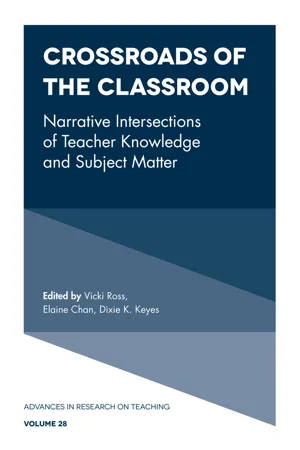
eBook - ePub
Crossroads of the Classroom
Narrative Intersections of Teacher Knowledge and Subject Matter
- 320 pages
- English
- ePUB (mobile friendly)
- Available on iOS & Android
eBook - ePub
Crossroads of the Classroom
Narrative Intersections of Teacher Knowledge and Subject Matter
About this book
This book aims to explore and make visible the intersection of subject matter knowledge and teacher knowledge in the narratives of teachers. This complicated interaction between these two bodies of knowledge is often studied and little understood.
Information
Topic
EducationSubtopic
Inclusive EducationINDIGENOUS EDUCATION, RELATIONAL PEDAGOGY, AND AUTOBIOGRAPHICAL NARRATIVE INQUIRY: A REFLECTIVE JOURNEY OF TEACHING TEACHERS
ABSTRACT
In this chapter, we explore our experiences of co-teaching an undergraduate elementary teacher education class titled, “Teaching Language Arts in FNMI (First Nations, Métis and Inuit) Contexts.” In our curriculum-making for the course, we drew on Narrative Inquiry as pedagogy, as well as on Indigenous storybooks, novels, and scholarship. We chose to work in these ways so that we might attempt to complicate and enrich both our experiences as teacher educators, and the possibilities of what it means to engage in Language Arts alongside Indigenous children, youth, and families in Kindergarten through Grade 12 classrooms. Thus, central to this chapter will be reflection on our efforts to co-create curriculum alongside of students – considered in their multiplicity also as pre-service teachers, mothers, fathers, brothers, sisters, daughters, sons, etc. – in ways that honored all of our knowing and experience. The relational practices inherent to Narrative Inquiry and Indigenous approaches to education, such as the creation and sharing of personal annals/timelines and narratives, along with small and large group conversations and talking circles are pedagogies we hoped would invite safe, reflective, and communal spaces for conversation. While certainly not a tension-free process, all of the pedagogical choices we made as teacher educators provide us the opportunity to attend to the relational and ontological commitments of Narrative Inquiry, to the students in their processes of becoming, to Indigenous worldviews, and to the responsibilities of the Alberta Language Arts curriculum.
Keywords: Narrative Inquiry; Indigenous education; Indigenous contexts; relational pedagogy; teacher identity; teacher education
INTRODUCTION
We – Trudy and Sulya – came together to teach EDEL 412, “Teaching Language Arts in First Nations, Métis and Inuit (FNMI) Contexts” at the University of Alberta for the first time in the winter of 2015. We approached the opportunity from our shared, yet individual, perspectives as daughters, sisters, mothers, and teacher educators, and our distinct perspectives as a Kokom (grandmother), a Cree-Métis professor and scholar, and as a Canadian-born doctoral student of Jewish and American heritage. The desire we both had was to co-create, with each other and with students (whom we will also refer to as our “classmates”), a story of teacher education that allowed all of us to begin with our lived and familial curriculum experiences (Chung, 2009; Lessard, 2015; Swanson, 2014); with our defining stories, experiences, and relationships.
We did not wish to position ourselves as experts who deliver a previously decided upon and finalized curriculum. As such, our ways of being in a classroom community push against some of the dominant institutional narratives of post-secondary education. Our classmates reflected to us that it was rare in their undergraduate university experience for a class to begin with all the lives and living of a classroom and then bridge this to subject matter in a co-creative process of curriculum-making. We found, though, that our relational, reflective, and storied starting point enabled us to truly attend to the more specific institutional, and broader social, responsibilities of the course. Our process helped us to honor EDEL 412’s intentions and objectives as regards literacy in Indigenous contexts.
For Trudy, specifically, this way of living/being in a classroom allows her to begin from the Indigenous worldview with which she has been raised. She does not leave the complexities, tensions, humility, humor, and wonders of who she is at the door and come in to teach abstractly the concepts of a course. She begins with her stories. Among many other pieces of her identity, she begins with who she is as a Cree/Métis Kokom and scholar and as our classmates come to know these stories, they are compelled to consider not only the potential subject matter knowledge Trudy carries with her into a classroom, but also how she has come to know what she is sharing.
This attention to processes of learning – and that each life offers so many different ways to learn in terms of languages, contexts, family stories, and traditions, etc. – becomes its own way to contextualize Indigenous approaches to education where the how of education is often positioned differently than it is in mainstream Kindergarten through Grade 12 (K-12) schooling. For her part, Sulya shares with classmates how she was educated at home by her parents and how this has shaped her relationship to curriculum and schooling. She also shares how most of her particular teaching experiences have allowed her to be in intergenerational spaces with as many parents/grandparents/caregivers in a room as there were children. The presentation of these aspects of Sulya’s journey and experience invite still more recognition that education happens in many different ways; that it can honor many different relationships and dynamics.
It is through this personal sharing, this intentional nurturance of an environment where a multiplicity of stories and openness are the foundation of all subsequent course learning, that we begin the co-composition of the course curriculum. We carve out and nurture space for students to come into awareness of how their history, living, and relationships informs them as teachers, and we work to weave these ways-of-being with the subject matter of the course in as organic a way as we can. Willie Ermine (1995) helps us to see how these personal, reflective, and storied ways of living in classrooms are deeply woven throughout Indigenous epistemologies:
Aboriginal epistemology is grounded in the self, the spirit, the unknown. Understanding of the universe must be grounded in the spirit. Knowledge must be sought through the stream of the inner space in unison with all instruments of knowing and conditions that make individuals receptive to knowing. Ultimately it was in the self that Aboriginal people discovered great resources for coming to grips with life’s mysteries. It was in the self that the richest source of information could be found by delving into the metaphysical and the nature and origin of knowledge. Aboriginal epistemology speaks of pondering great mysteries that lie not further than the self. (p. 108)
We also feel that the challenging, hard work of coming to know ourselves – and the great mysteries that reside within, and through, us – is part of how “young people prepare to participate fully in the spiritual, cultural, physical, and emotional life of […] society” (Schissel & Wotherspoon, 2003, p. 63) and that, despite the pressures to give marks, “In an educational context like this, the concepts of ‘failure’ and ‘pass’ are irrelevant” (p. 63).
As an experience, EDEL 412 calls us to attend to just such, and many congruent perspectives on, Indigenous approaches to living, learning, and education (Goulet & Goulet, 2014; Hanohano, 1999; Lambe, 2003; McNally, 2004). Additionally, we – Trudy and Sulya – met through our mutual connection to the field and practice of Narrative Inquiry (Clandinin, 2013; Clandinin & Connelly, 2000). Thus, with both Narrative and Indigenous approaches to living and learning firmly in our minds and hearts, we endeavored to co-create curriculum in ways that would honor what we see as a pedagogy built upon deep relationality.
Indigenous approaches to education invite relationality as a series of connections that transcend the human sphere to include animals, plants, the air, the mountains, the directions, etc. All of Creation is viewed as interwoven and interdependent (Ermine, 1995, 2007; Wilson, 2001). For its part, Narrative Inquiry invites relationality because it asks of us to begin with who we are and how we are situated. It calls us to attend to the three-dimensional Narrative Inquiry space composed of an awareness of how experience is situated in “place,” in time (“temporality”), and in connection with others (“sociality”) (Connelly & Clandinin, 2006, p. 479). Narrative Inquiry situates all conversation, research, and teaching in the expression and sharing of experience (Dewey, 1938). With these Indigenous and Narrative foundations, relational pedagogy becomes, for us, a self-reflective, embodied form of pedagogy (Dixon & Senior, 2011). It privileges the co-construction of knowledge and meaning in collaborative environments of mutual respect, attentiveness, reciprocity, and humility. It is also awake to intergenerational connections as well as connections with – and responsibilities to – the broader living world.
It was our hope, and responsibility, to nurture a relational pedagogical practice in EDEL 412 that would be a lived and shared expression of practices that we view as being valuable to the teaching of literacy in K-12 schooling, especially alongside Indigenous children, youth, and families. Put in a more colloquial way: we hoped that students would see, and feel, us walking our talk. We wished for classmates to first value the invitation to a course founded in relational pedagogy informed by narrative and Indigenous worldviews and, second, to carry the value of that relationality – along with practices that they might adopt and adapt – forward with them into their future classroom communities as teachers. We wished to enable them, in as many ways as we could, to see the rich, complex wholeness of lives that exists in all classrooms.
This complexity, in part, is shaped by understanding that all of the stories are always in the midst (Clandinin & Connelly, 2000). Each story, whether personal, social, institutional, cultural, familial, or linguistic, is alive, unfinished, and always in the making; stories continue to be composed with and without our presence. Another complexity that emerges when thinking narratively about pedagogy is that doing so entails the asking of hard questions about what is educative (Dewey, 1938) in the composing of lives. (Huber, Caine, Huber, & Steeves, 2013, p. 227)
In the sections that follow, and our ongoing wonders and thinking about “what is educative in the composing of lives” (Huber et al., 2013, p. 227), we will first continue our conversation of relational pedagogy as it is expressed through Narrative Inquiry and Indigenous approaches to education (see section “Guiding Framework for Our Thinking, Living, Teaching, and this Chapter”). We will then share some information about EDEL 412, its sections, delivery methods, the broader political climate that touches our work, and given we orient ourselves relationally, we will also share some personal factors which further inform our conceptualization of the course (see section “Instructional Context: Multiple Considerations”). Following this, we will speak more specifically to the ways in which narrative pedagogies came to inform our work in EDEL 412 and how the narrative work in which we engage is relationally woven with subject matter and with its own application and methods (see section “Narrative Applications Related to Subject Matter: Complicating the Conversation”). Finally, we will offer a layered unpacking and juxtaposition of these pieces (see section “Analysis: More Threads to Weave”) and some concluding thoughts that point toward our current and future research directions at the intersection of relational pedagogies, Indigenous education, teacher education, and K-12 literacy instruction (see section “Looking Back and Looking Forward”).
GUIDING FRAMEWORK FOR OUR THINKING, LIVING, TEACHING, AND THIS CHAPTER
From the very beginning of our co-composing of curriculum for the EDEL 412 course, we – Trudy and Sulya – worked to imagine a more ethical way of engaging in pre-service teacher education, a way that honors who we are, who each classmate/student is, and the relational ways we try to live in the world. We felt that a pedagogy founded in relationality, as described in the introduction above, would allow us to meet our classmates/students with loving perception (Lugones, 1987). It was also our intent that together, as we engaged in literacy activities and inquired into texts chosen to help us deepen our understanding of Indigenous context that we, teacher educators and pre-service teachers alike, might become part of the movement away from the trend in research on Aboriginal youth, families and communities that is as Tuck (2009) calls it “damage-centered” while still allowing for the recognition of the need to continue to “document the effects of oppression on … communities” and consider the “long-term repercussions of continuing to think of [Aboriginal youth and families] as broken” (p. 409). By focusing on the story of the statistics (Statistics Canada, 2003, 2006, 2008, 2011) and research that prioritizes the barriers and hardship experiences, we miss the potential to see the lives of Aboriginal youth and families as “not yet” (Greene, 1993, p. 26) and filled with possibility; we miss the opportunity to see lives, living, and learning as processes of becoming. We cease to see each human journey and person in his/her/its wholeness.
With this in mind, we offer that the guiding framework for this chapter is – as the title of this section suggests – also that with which we attempt to frame our thinking, our living, and our teaching. In other words, it is shaped by our relational sense of epistemology, ontology, and pedagogy. This sense is itself nurtured, as described in the introduction, by our work with both Narrative Inquiry and Indigenous approaches to living, learning, and education. Particularly, through attention to our ongoing process of Autobiographical Narrative Inquiry (Saleh, Menon, & Clandinin, 2014) in our research, and our invitation of Autobiographical Narrative Inquiry practices as a form of pedagogy in EDEL 412 (Huber et al., 2013; Huber, Li, Murphy, Nelson, & Young, 2014), we follow the lead of Indigenous scholars such as Bruno (2010), Lessard (2010, 2014), Swanson (2013), and Young (2003) who “concluded [that] narrative inquiry is how Aboriginal people learn and gain knowledge” (p. 25) and drew on the work of Battiste and Henderson (2000) who stated that, “Stories are enfolding lessons. Not only do they transmit validated experiences; they also renew, awaken, and honor spiritual forces. Hence, almost every ancient story does not explain; instead it focuses on process of knowing” (p. 77).
This emphasis on knowing as process (as something that becomes) rather than on knowing as a result of explanation honored our wish to work from relational places. We have often seen how “explanation” as a way of teaching can undermine our ability and motivation to generate meaning and understanding for ourselves and with each other (Ranciére, 1991, p. 8). Knowing considered as a process, a becoming, inspired us to invite relationality as a pedagogical commitment to communal and collaborative meaning and sense making. It became a way to honor the Indigenous epistemologies and ontologies that live at the heart of EDEL 412.
As a research methodology, and a relational pedagogy, Narrative Inquiry takes “the sphere of immediate human experiences as the first and foremost fundamental reality we have” (Clandinin & Rosiek, 2007, p. 44). With respect to this, we framed the course, and subsequently this chapter, with a “conception of knowledge … of human experience that remains within the stream of human lives” (p. 44). We nurtured, and seek here to articulate and share, an experience of a teacher education course which invited all of us involved – professor, teaching assistant, and classmates/students – to come to know ourselves and then each other more deeply; to locate and then unpack assumptions; and to live our subject matter together as an embodied experience and not just as an accumulation of subject matter knowledge. We – Trudy and Sulya – knew how important it was to attend to the lives of our classmates/students and, in particular, to how they imagined who they are, and are be...
Table of contents
- Cover
- Title Page
- Teachers’ Stories of Navigating the Intersection of Subject Matter and Teacher Knowledge
- Section I: Entering the Crossroads through Stories at the Elementary Level
- Variegated Stories of Professional Development: Striking a/n Im/Balance between Science and Mathematics Content Knowledge and Teacher Knowledge
- Stories and Statistics: A Mixed Picture of Gender Equity in Mathematics
- A Glimpse into the Future: Practice Teaching in FIFTH-GRADE Math
- Choosing the Best Alternative: The Branching Pathways of Consequences in Social Studies Curriculum Choice-Making
- Section II: Entering the Crossroads through Stories from the Secondary Level
- Sing it Over: Meditations on “Best-Loved Self” and Sustaining in Secondary English Language Arts
- Teaching That “Promotes Diversity”: The Potential of Disruptive Narratives
- Stories of an English Language Arts Teacher in a HIGH NEED Secondary School: A Narrative Inquiry into Her Best-Loved Self
- Health, Physical Education Content, and Teacher Knowledge/Identity
- Section III: Entering the Crossroads through Stories from Teacher Preparation
- A Narrative Inquiry of Other in Special Education: Tensions of Subject Matter Knowledge in Relation to Teacher Knowledge
- Interweaving Narratives of Personal and Professional Selves of a Beginning Teacher in India
- “Traditional Teaching Method Still Holds Water”: Narrative Inquiry of Student Teachers’ Professional Identities at the Intersection of Teacher Knowledge and Subject Matter Knowledge
- Indigenous Education, Relational Pedagogy, and Autobiographical Narrative Inquiry: A Reflective Journey of Teaching Teachers
- Narrative Resonance among Stories: Crossroads of the Classroom, Curriculum-Makers, and Complexities of Deliberation
- About the Authors
- Index
Trusted by 375,005 students
Access to over 1.5 million titles for a fair monthly price.
Study more efficiently using our study tools.
Frequently asked questions
Yes, you can cancel anytime from the Subscription tab in your account settings on the Perlego website. Your subscription will stay active until the end of your current billing period. Learn how to cancel your subscription
No, books cannot be downloaded as external files, such as PDFs, for use outside of Perlego. However, you can download books within the Perlego app for offline reading on mobile or tablet. Learn how to download books offline
Perlego offers two plans: Essential and Complete
- Essential is ideal for learners and professionals who enjoy exploring a wide range of subjects. Access the Essential Library with 800,000+ trusted titles and best-sellers across business, personal growth, and the humanities. Includes unlimited reading time and Standard Read Aloud voice.
- Complete: Perfect for advanced learners and researchers needing full, unrestricted access. Unlock 1.5M+ books across hundreds of subjects, including academic and specialized titles. The Complete Plan also includes advanced features like Premium Read Aloud and Research Assistant.
We are an online textbook subscription service, where you can get access to an entire online library for less than the price of a single book per month. With over 1.5 million books across 990+ topics, we’ve got you covered! Learn about our mission
Look out for the read-aloud symbol on your next book to see if you can listen to it. The read-aloud tool reads text aloud for you, highlighting the text as it is being read. You can pause it, speed it up and slow it down. Learn more about Read Aloud
Yes! You can use the Perlego app on both iOS and Android devices to read anytime, anywhere — even offline. Perfect for commutes or when you’re on the go.
Please note we cannot support devices running on iOS 13 and Android 7 or earlier. Learn more about using the app
Please note we cannot support devices running on iOS 13 and Android 7 or earlier. Learn more about using the app
Yes, you can access Crossroads of the Classroom by Vicki Ross, Elaine Chan, Dixie K. Keyes, Vicki Ross,Elaine Chan,Dixie K. Keyes in PDF and/or ePUB format, as well as other popular books in Education & Inclusive Education. We have over 1.5 million books available in our catalogue for you to explore.