- 488 pages
- English
- ePUB (mobile friendly)
- Available on iOS & Android
eBook - ePub
About this book
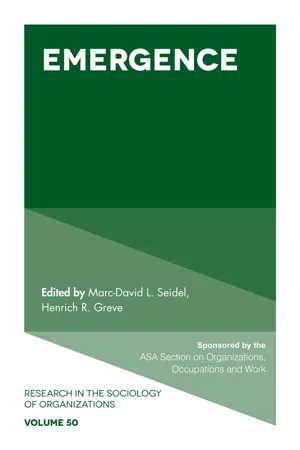
The recent growth in research on the topic of evolutionary novelties inspired this volume of Research in the Sociology of Organizations. While previous sociological work has done an admirable job of understanding selection and differentiation processes, it has widely ignored the origin of novelty and how it grows to form initial structures and practices. Emergence is an easy to understand intuitive concept, as it simply means that an object comes into existence or appearance, but it needs further unpacking as a description of a widespread social process. In this book, emergence is seen as a process that involves 1) the creation of novelty, 2) its growth to a salient size, and 3) its formation into a recognizable social object, process, or structure. Each step should be understood through theory and empirical work. Yet the theory of each step can differ from, though it may be related to, the theory of the other two. As a consequence, emergence is a much more complex research topic than is suggested by a single word and it is these complexities that are examined in this book.
Information
NOVELTY
DIFFERENT SHADES OF GREEN: ENVIRONMENT UNCERTAINTY AND THE STRATEGIES OF HYBRID ORGANIZATIONS
ABSTRACT
How does environmental uncertainty affect the process of starting new hybrid organizations? Our comparative analysis of the formation of two “green” banks – with hybrid goals linked to banking and environmental logics – reveals that shifts in their strategic orientations resulted from attempts to align uncertain and changing resource environments with the composition and goals of the organizations’ top leadership. While the initial idea and goals of the founders were similar, the organizations they established ended up with divergent strategic orientations and senior leadership groups.
Keywords: Institutional uncertainty; hybrid organizations; complexity; strategic orientation; institutional logics, resource acquisition
INTRODUCTION
How are the strategies of new organizations shaped by the institutional environments in which they emerge? Institutions grant legitimacy to organizations that follow established organizational forms, thereby facilitating access to resources needed to support their strategies (Aldrich & Fiol, 1994; Suchman, 1995). New organizations’ strategies are also shaped by local institutional logics that provide order and meaning to organizational activities (Friedland, & Alford, 1991; Thornton, Ocasio, & Lounsbury, 2012), and by other market, regulative, social, and cultural factors (Marquis & Battilana, 2009). These diverse pressures provide a new organization with templates for action, generally resulting in conformity with established organizational forms present in their institutional environments (DiMaggio & Powell, 1983).
Institutions thus benefit new organizations by facilitating their alignment with established organizational fields. However, these same institutional pressures may be antagonistic to organizations attempting to engage in innovative entrepreneurship that diverges from institutional norms. Such organizations frequently adopt innovative hybrid models of organizing that require new combinations of cultural and material resources, and thus are exposed to disparate and changing institutional pressures (Kraatz & Block, 2008). Previous research has noted that such organizations tend to operate at the fringes of stable resource niches, where access to resources is risky and unpredictable (Haveman & Rao, 2006). By pursuing strategies that require diverse resources, these organizations open themselves to multiple, variable, and discordant demands, to which established templates provide no viable response (Greenwood, Raynard, Kodeih, Micelotta, & Lounsbury, 2011).
Innovative hybrid organizations thus confront a particular type of environmental uncertainty associated with changing and competing institutional pressures. Previous research on the emergence of organizations often assumes that the local resource environment occupied by a given organization is relatively well-defined and consistent. However, environmental instability and ambiguity is an integral aspect of the organizational founding process, particularly for organizations that deviate from established organizational forms (Aldrich & Fiol, 1994; Suchman, 1995). Such organizations are prone to search across discontinuous resource environments before settling on a stable organizational strategy (Battilana & Dorado, 2010), and thus face uncertainty in the very definition and scope of the resource environment they occupy. The environmental fluidity faced by these new ventures resembles the conceptualization by entrepreneurship scholars of uncertainty as an “unknown unknown” which defies evaluation – distinct from measurable uncertainty (Knight, 1921; McMullen & Shepherd, 2006) – because the institutional environment with which the organization must contend is ambiguous ex ante. If such environmental uncertainty is an essential feature of new organizations that deviate from established forms, its consequences are important to understand, because environmental influences at the time of founding are likely to persist over time (Marquis & Tilcsik, 2013; Stinchcombe, 1965). Thus, we ask: how does uncertainty in the environment of a divergent, innovative organization influence its strategic orientation?
To address this question, we explore the co-emergent process of an organization’s strategic orientation and the internal representation of institutions among its senior leadership. Senior leaders profoundly influence the fates of organizations through their consideration and selection of organizational strategies (Finkelstein, Hambrick, & Cannella, 2009), as well as by facilitating relationships with their organizations’ external environments. Organizations typically select leaders that align with their external environments, and thereby represent external pressures in decision-making. For new, divergent organizations, however, this selection process is subject to environmental uncertainty. As new organizations emerge, ‘leaders of these organizations may thus be selected according to multiple and uncertain external pressures (Greve, 2008), which will influence those leaders’ future decisions. Since each decision of those senior leaders is influenced by preceding choices, the sequence in which different parts of the environment receive the leaders’ attention are likely to have important consequences for the organizations’ ultimate strategic orientation (David, 1994).
We examine these issues through a comparative case study of the creation of two of the first “green banks” in the United States. Both were founded in the first decade after the year 2000, one in a Western state and one in a Southern state. The goals of the founders in creating these novel organizations were both to make money and to support the well-being of the natural environment. These goals were aligned, respectively, with standards and practices taken from the banking sector and also from the field of “green” environmental sustainability organizations. Both green banks were thus founded as hybrid organizations, influenced simultaneously by multiple resource environments that imposed conflicting standards of legitimacy and behavior (Battilana & Lee, 2014; Besharov & Smith, 2014; Jay, 2013; Thornton et al., 2012). At the time of their founding, green banks were a nascent type of organization affected by uncertainty in its essential goals and activities and thus in the definition of the relevant resource environment. The two green banks we studied thus provided a suitable setting to explore the implications of environmental uncertainty for innovative hybrid organizations.
The geographical locations of the two banks we studied varied significantly in their resource environments. This feature enabled us to observe variation in how the banks’ strategies responded to differing environmental changes. Establishing the new organization was difficult in both locations, but the resource environment was especially challenging in the Southern state. For the purposes of our study, the banking sector also has the attractive feature the process of starting new banks follows a clear, well-established sequence of events whereby specific parts of the environment (investors, regulators, customers, etc.) become especially relevant (Almandoz, 2012). This feature enabled the comparison between cases at similar stages in each bank’s development. The time period examined, from 2005 to 2012 (extending beyond the founding period), offered a good opportunity to observe the implications of uncertainty stemming from the 2008 economic crisis, some of which affected industries with which the banks were directly involved. Our analysis focused on the process and mechanisms by which a strategy was defined over time to achieve those goals.
This study contributes to the literature on institutions and entrepreneurship by explicitly theorizing the process by which innovative hybrid organizations define their strategic orientations in the face of uncertainty in their local resource environments. First, our findings suggest that uncertainty plays a key and nuanced role in entrepreneurial founding as entrepreneurs search for resources and adapt their strategic orientation to the local availability of suitable resources. Second, we contribute to research on internal representation of institutional logics within hybrid organizations (Pache & Santos, 2010) by exploring how new organizations in complex environments (Kraatz & Block, 2008) incorporate multiple field-level logics in the composition of their strategic decision-making teams. Our findings suggest that, especially among innovative hybrid organizations, the internal representation of competing logics may not be an “a priori” factor driving the process of organizational creation but may be endogenous to this process and consequential to its outcome.
THEORETICAL CONTEXT
Institutional Uncertainty and Entrepreneurship
Abundant previous research has addressed how institutional influences in local environments affect organizational forms and practices (DiMaggio & Powell, 1983; Meyer & Rowan, 1977; see also Marquis & Battilana, 2009). The presence of strong institutional norms can enable new enterprises to establish their legitimacy by conforming to established conventions and thus to acquire resources. By contrast, failure to conform to established conventions can result in an “illegitimacy discount” (Zuckerman, 1999) that complicates the acquisition of resources, thereby aggravating the legitimacy struggles that all new organizations face (Stinchcombe, 1965). Alignment with institutional expectations is thus critically important for the viability of new organizations.
Given the importance of institutional environments, uncertainty would be expected to weigh heavily upon entrepreneurial outcomes. Yet to the degree that researchers have explored changing environments over time (Thornton, 2004), studies have focused on drawing linkages between gradual changes in the institutional environment and population-level founding rates. An advantage of this approach is that in such settings, the link between institutional change and entrepreneurial opportunities can be more easily established (see Tolbert, David, & Sine, 2011 for a review of the literature on how institutions shape entrepreneurial choices). However, research has yet to fully explore how entrepreneurial organizations develop their strategic directions contemporaneously with the unfolding of their institutional environments in real time, and the results of these processes for these organizations’ strategic orientations. Uncertainty is likely to be a critical factor for new hybrid organizations that are outside of established or conventional forms.
Previous research has conceptualized multiple types of uncertainty in organizational environments. For instance, Milliken (1987) subdivided the concept of environment uncertainty into three types: uncertainty about the state of the environment – addressing for instance the likelihood of experiencing a crisis or a drop in demand (Adner, 2002); uncertainty about the degree to which environment changes will have an effect on the organization (for instance a crisis drying up resource pools for the organization) (Duncan, 1972; Lawrence & Lorsch, 1967; Tushman & Anderson, 1986); and, finally, uncertainty about organizational response options and about the likely consequences of those options (Conrath, 1967; Duncan, 1972; Taylor, 1984).
Innovative hybrid organizations are likely to experience each of these types of uncertainty to varying degrees. Hybrid organizations that operate at the fringes of multiple institutional environments face uncertainty related to the states of those multiple environments, how they will affect the organization, and how the hybrid organization might respond. In some respects, the institutional plurality of these organizations’ environments, as the organizations are exposed to a greater diversity of sources of risk. However, hybrids may also have broader options to respond to uncertainty in one institutional domain, including shifting their strategic orientation to align with another institutional domain. In such circumstances, shifting the strategic orientation of the organization may be a way to deal with environmental uncertainty.
Previous research has argued that institutional change – for instance, the historical transition of the banking industry from a community to an efficiency logic – can increase environmental uncertainty and thus affect the strategies of entrepreneurs. Marquis and Lounsbury (2007) found that as larger banks acquired community banks – imposing an efficiency logic in the local banking sector – banking entrepreneurs found support to start new banks that embraced a community logic. Institutional changes can give rise to new organizational forms by making resources available to entrepreneurs who are skillful at the art of institutional bricolage, defined as, “importing and exporting cultural symbols and practices from one institutional order to another” (Thornton & Ocasio, 2008, p. 115), or at mobilizing actors invested in the success of a particular institutionalization project (DiMaggio, 1991).
One of the most central ways that emerging organizations manage uncertainty is through the composition of their founding board of directors or strategic decision-making team (Boyd, 1990). For exam...
Table of contents
- Cover
- Title Page
- Emergence: How Novelty, Growth, and Formation Shape Organizations and Their Ecosystems
- Part I Novelty
- Part II Growth
- Part III Formation
- About the Authors
- Index
Trusted by 375,005 students
Access to over 1.5 million titles for a fair monthly price.
Study more efficiently using our study tools.
Frequently asked questions
Yes, you can cancel anytime from the Subscription tab in your account settings on the Perlego website. Your subscription will stay active until the end of your current billing period. Learn how to cancel your subscription
No, books cannot be downloaded as external files, such as PDFs, for use outside of Perlego. However, you can download books within the Perlego app for offline reading on mobile or tablet. Learn how to download books offline
Perlego offers two plans: Essential and Complete
- Essential is ideal for learners and professionals who enjoy exploring a wide range of subjects. Access the Essential Library with 800,000+ trusted titles and best-sellers across business, personal growth, and the humanities. Includes unlimited reading time and Standard Read Aloud voice.
- Complete: Perfect for advanced learners and researchers needing full, unrestricted access. Unlock 1.5M+ books across hundreds of subjects, including academic and specialized titles. The Complete Plan also includes advanced features like Premium Read Aloud and Research Assistant.
We are an online textbook subscription service, where you can get access to an entire online library for less than the price of a single book per month. With over 1.5 million books across 990+ topics, we’ve got you covered! Learn about our mission
Look out for the read-aloud symbol on your next book to see if you can listen to it. The read-aloud tool reads text aloud for you, highlighting the text as it is being read. You can pause it, speed it up and slow it down. Learn more about Read Aloud
Yes! You can use the Perlego app on both iOS and Android devices to read anytime, anywhere — even offline. Perfect for commutes or when you’re on the go.
Please note we cannot support devices running on iOS 13 and Android 7 or earlier. Learn more about using the app
Please note we cannot support devices running on iOS 13 and Android 7 or earlier. Learn more about using the app
Yes, you can access Emergence by Marc-David L. Seidel, Henrich R. Greve, Marc-David L. Seidel,Henrich R. Greve in PDF and/or ePUB format, as well as other popular books in Business & Comportamento organizzativo. We have over 1.5 million books available in our catalogue for you to explore.