eBook - ePub
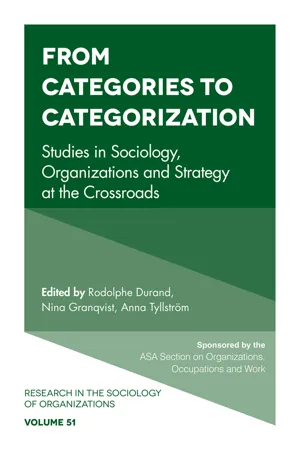
From Categories to Categorization
Studies in Sociology, Organizations and Strategy at the Crossroads
- 416 pages
- English
- ePUB (mobile friendly)
- Available on iOS & Android
eBook - ePub
From Categories to Categorization
Studies in Sociology, Organizations and Strategy at the Crossroads
About this book
Categorization pervades economic life; products, services, firms and industries are continuously being classified by rivals, clients, experts and critics. A stream of research highlighting the importance of market and product categories for organizations and individuals has grown in importance during the past 40 years. This volume contains ten essays on categorization authored by some of the world's leading scholars within sociology of markets, organization theory, and strategy research. It opens with revisiting the influential theory of "the categorical imperative", and moves on to present various accounts of the social processes that form part of categorization and elaboration of their consequences. Together, the different chapters effectively show that categorization is a process, tightly connected to actors involved and their specific acts, the characteristics of the entity being categorized, and the context and timing informing these activities. As such, it complements the earlier cognitive perspectives by discussing the evaluative, social, and political manifestations of categorization.
Information
Publisher
Emerald Publishing LimitedYear
2017Print ISBN
9781800430204
9781787142398
eBook ISBN
9781787143395
CATEGORIZATION AS POLITICS AND STRATEGY
STRATEGIC CATEGORIZATION
ABSTRACT
This article suggests that both producers and analysts are strategic about categorization. Producers use categorization to maintain a balance of differentiation and legitimacy, whereas analysts seek to influence categorization and clarify boundaries. Ideas are explored for software producers and Gartner, the preeminent high-technology analyst. Findings show evidence of strategic categorization. Producers move to proximate market categories in response to competition. Gartner reports on large categories and those that receive investment and stops reporting on categories that have fuzzy boundaries. Compared to analysts, producers may be more influential in category creation than previous research has acknowledged.
Keywords: Categories; markets; producers; analysts; technology
All market actors navigate categories. Producers need to define their market category before answering basic questions such as what their market share is. For example, in 2015, whether Apple is one of the top three “personal computer” companies depends on whether “tablets” are included in the “personal computer” market. Customers learn categories to help them compare products and make purchasing decisions. Analysts facilitate this by describing market categories. Investors try to pick category winners.
Categories are important, but defining a category can be slippery. Early research identified markets based on technological attributes or by using demand-based statistics, such as cross-elasticity (Scherer, 1980). More recently, scholars question whether these methods lead to meaningful groupings. Drawing on cognitive science, they model markets as systems of socially defined categories (Day, Shocker, & Srivastava, 1979; Hannan, Pólos, & Carroll, 2007; Porac & Thomas, 1990; Sujan, 1985).
Research on market categorization typically assumes that people use categories for informational purposes. Cognitively, the reason for categorization is to organize and interpret information (Murphy, 2002). Building on these foundations, researchers suggest that market actors use categories primarily for communication (Hannan et al., 2007). Scholars typically cast middlemen like analysts and critics as neutral third parties that maintain category boundaries. Categories defined by intermediaries are seen as an exogenous structure imposed on organizations. As Zuckerman (1999) states, “categories that comprise market structure” are a “social screen, not designed by the actor but external to her” (p. 1404). In this narrative, actors that navigate categories (producers) are not the ones who create them (analysts or critics) (Pollock & Williams, 2011). An actor may try to strategically position himself within categories, but category definitions are not strategic.
Previous studies do recognize strategic categorization in early stages of category formation. This is most comprehensively studied in the literature on framing processes in social movements (Benford & Snow, 2000; King & Pearce, 2010; Snow, Rochford, Worden, & Benford, 1986). Activists also shape boundaries of emerging cultural and market categories (DiMaggio, 1991; Khaire, 2014; Powell & Sandholtz, 2012; Rosa, Porac, Runser-Spanjol, & Saxon, 1999), and entrepreneurs use categories to frame their activities, which influences category emergence (Bingham & Kahl, 2013; Carroll & Swaminathan, 2000; Granqvist, Grodal, & Woolley, 2013; Khaire & Wadhwani, 2010; Navis & Glynn, 2010; Pontikes, 2016; Santos & Eisenhardt, 2009; Weber, Heinze, & DeSoucey, 2008). Researchers acknowledge that there is at least a limited strategic behavior among producers navigating mature categories (Durand, 2006; Porac, Thomas, Wilson, Paton, & Kanfer, 1995; Rao, Monin, & Durand, 2003). But producers are rarely viewed as influencing category definitions – especially for mature categories (but see Granqvist et al., 2013; Pontikes & Hannan, 2014). Once categories are established, intermediaries like analysts and critics are considered to reflect a consensus view. Many studies use categories defined by middlemen as the categorical structure in a domain (Hsu, 2006b; Hsu, Hannan, & Koçak, 2009; Kovács & Hannan, 2010; Negro, Hannan, & Rao, 2011; Paolella & Durand, 2016; Rao et al., 2003; Ruef & Patterson, 2009; Zuckerman, 1999).
We argue that strategic categorization is much more widespread than what has been acknowledged in previous research, and that it is not limited to early-stage categories. We propose that many types of market actors are strategic when they categorize. Specifically, any act of categorization aims to:
- (1) convey information about the producer and/or the market and
- (2) promote a categorical system that is favorable to the organization or person.
These two objectives are not contradictory. Because market categorization contains ambiguity, the potential to change meanings, and the possibility of creating a new category, shrewd market actors can use categories in a way that is both informative and favorable. We call this strategic categorization.
Every person who categorizes engages with the first objective; that is, conveying information. There is a range as to how much people engage in the second objective. At one end of the spectrum is an observer who uses market categorization simply to understand his environment. We suggest that this passive bystander is rare. Even someone who reacts to her friend’s restaurant suggestion with “That’s not Italian!” participates in strategic categorization; she is trying to shape how others perceive the “Italian” category in a way she favors. A more extreme example is the producer who tries to redefine a market category around his organization; for example, when chef Rick Bayless sets out to change people’s perception of Mexican cuisine being of high quality, contemporary food with a depth of flavor.1 Or, consider when an analyst proclaims a category “dead” in order to generate demand for new reports. Because market categories are socially constructed, market actors have leeway in how they categorize. This creates space for strategic objectives.
We focus on strategic categorization for producers and analysts. We propose that producers use categories both to communicate information and to position themselves favorably with respect to competitors. Analysts want to be viewed as the “expert” in a domain. We test our hypotheses using data from software producers’ self-categorization and from reports on market categories issued by Gartner, the premier technology analyst organization. Results provide evidence of strategic categorization by both producers and analysts. They suggest that producer-based categorization may be as or more reliable than categorization defined by intermediaries.
STRATEGIC CATEGORIZATION
Market categorization is a lens through which products and organizations are viewed. How objects are positioned within categories affects how they are evaluated (Goldberg, Hannan, & Kovács, 2016; Hsu et al., 2009; Leung & Sharkey, 2014; Negro, Hannan, & Rao, 2010; Smith, 2011). Research in cognitive science sheds light on why social definitions of market categories are important. Categories map onto mental concepts that simplify the world (Lakoff, 1997; Murphy, 2002). Though socially defined, categories affect perceptions of similarity and difference. This is highlighted in experimental studies where people learn nonsense categories in a short period of time, and these categories have effects. Assigning objects to the same category label increases their perceived similarity, decreases their perceived variability, and facilitates category learning (Goldstone, 1994; Lara, Hahn, Yu, & Yamauchi, 2012; Lupyan, Rakison, & McClelland, 2007; Park & Hastie, 1987; Sloutsky, Lo, & Fisher, 2001).
In markets, people learn category definitions through social interactions (DiMaggio, 1997; Koçak, Hannan, & Hsu, 2014; Grodal & Kahl, 2017). Whether a market category becomes established depends on whether a consensus develops that a set of products represents a distinct “type” (Hannan et al., 2007). This consensus results from negotiation among many audiences (DiMaggio, 1987; Khaire & Wadhwani, 2010; Rosa et al., 1999). The consensus about a market category can be long lasting but does not need to be (Rosa & Porac, 2002). Market categories frequently change (Pontikes & Hannan, 2014). For example, the “phone” evolved from an object with a rotary dial and an attached receiver to a small computer that can also make calls.
Given that market categories are socially constructed – that producers and analysts can, and do, influence their realization – combined with the fact that categories affect how customers value a product, it should not come as a surprise that strategic categorization is widespread. Yet, in most research, market categorization is cast as only strategic during early stages of category emergence (Carroll & Swaminathan, 2000; Khaire, 2014; King & Pearce, 2010; Rao, 2009). In research on mature markets, categories are assumed to be exogenous structures that are imposed on actors (Zuckerman, 1999). Studies consider analysts, critics, or other middlemen to be disinterested observers, creating and maintaining categories that determine consensus views. This may be because of a tendency for researchers to assume that strategic behavior must also be deceptive. Under this presumption, it is necessary to assume that creators of stable social categories are not strategic.
We think that strategic behavior is not rooted in deception. Rather, it employs framing techniques where people present their product, or define a category, in a plausible and targeted way (Goffman, 1974; Pontikes & Barnett, 2015; Porac et al., 1995). Rick Bayless’s initiative to change the perception of “Mexican cuisine” is an example. There is nothing deceptive in asserting that Mexican cuisine is contemporary and upscale. But this was a change in the category’s taken-for-granted definition. The fact that market categories are not simply a reflection of objective distinctions, but result from social negotiation, allows for such a framing. We suggest that it is the typical case for actors to use categories both to convey information and to manipulate categorization to their advantage.
We build on previous studies that support the idea of strategic categorization. Much research in this vein considers strategic behavior among producers. For example, producers purposefully define reference groups of rivals (Durand, 2006; Porac & Thomas, 1990; Porac et al., 1995), and there are strategic considerations to timing an entry into an emerging category (Suarez, Grodal, & Gotsopoulos, 2015). Studies find variance in how much producers conform to “typical” expectations of their categories, and this affects how critics react to the producer or product ...
Table of contents
- Cover
- Title Page
- Section I: Introduction
- Section II: Categorization as Politics and Strategy
- Section III: Categorizing the Unknown
- Section IV: Times and Places of Categorization
- About the Authors
- Index
Trusted by 375,005 students
Access to over 1.5 million titles for a fair monthly price.
Study more efficiently using our study tools.
Frequently asked questions
Yes, you can cancel anytime from the Subscription tab in your account settings on the Perlego website. Your subscription will stay active until the end of your current billing period. Learn how to cancel your subscription
No, books cannot be downloaded as external files, such as PDFs, for use outside of Perlego. However, you can download books within the Perlego app for offline reading on mobile or tablet. Learn how to download books offline
Perlego offers two plans: Essential and Complete
- Essential is ideal for learners and professionals who enjoy exploring a wide range of subjects. Access the Essential Library with 800,000+ trusted titles and best-sellers across business, personal growth, and the humanities. Includes unlimited reading time and Standard Read Aloud voice.
- Complete: Perfect for advanced learners and researchers needing full, unrestricted access. Unlock 1.5M+ books across hundreds of subjects, including academic and specialized titles. The Complete Plan also includes advanced features like Premium Read Aloud and Research Assistant.
We are an online textbook subscription service, where you can get access to an entire online library for less than the price of a single book per month. With over 1.5 million books across 990+ topics, we’ve got you covered! Learn about our mission
Look out for the read-aloud symbol on your next book to see if you can listen to it. The read-aloud tool reads text aloud for you, highlighting the text as it is being read. You can pause it, speed it up and slow it down. Learn more about Read Aloud
Yes! You can use the Perlego app on both iOS and Android devices to read anytime, anywhere — even offline. Perfect for commutes or when you’re on the go.
Please note we cannot support devices running on iOS 13 and Android 7 or earlier. Learn more about using the app
Please note we cannot support devices running on iOS 13 and Android 7 or earlier. Learn more about using the app
Yes, you can access From Categories to Categorization by Rodolphe Durrand, Nina Granqvist, Anna Tyllström, Rodolphe Durrand,Nina Granqvist,Anna Tyllström in PDF and/or ePUB format, as well as other popular books in Business & Organisational Behaviour. We have over 1.5 million books available in our catalogue for you to explore.