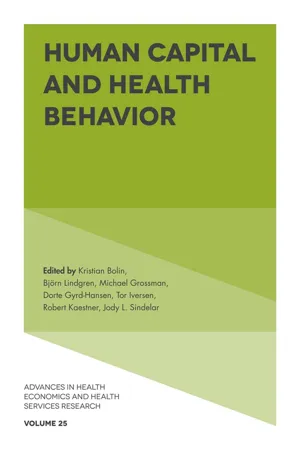
Human capital is embodied in human beings. It embraces the individual's capacity to perform and enjoy activities that provide money and/or psychic income. Health behaviour affects human capital and is itself affected by the individual's human capital. This volume consists of original theoretical and empirical contributions to our knowledge of the interdependence between Human Capital and Health Behaviour.
PART I PRENATAL INVESTMENTS AND HUMAN CAPITAL DEVELOPMENT
BIRTH SPACING AND EDUCATIONAL OUTCOMES
Elaine L. Hill and David J. G. Slusky
ABSTRACT
Virtually all parents want their children to succeed academically. How to achieve this goal, though, is far from clear. Specifically, the temporal spacing between adjacent births has been shown to affect educational outcomes. While many of these studies have produced substantial and statistically significant results, these results have been relatively narrow in their application due to data limitations. Using Colorado birth certificates matched to schooling outcomes, we investigate the relationship between birth spacing and educational attainment. We instrument birth spacing with a previous pregnancy that did not result in a live birth. We find no overall effect of spacing on either the first or second children’s grade 3–10 test scores. Stratifying by the sexes of the children, we find that when the first child is a boy and the second a girl, an extra year of spacing increases the first child’s math, reading, and writing test scores by 0.07–0.08 SD, while there is no impact on the second child. This is the first study to do such an analysis using matched large-scale birth and elementary to high school administrative data, and to leverage a very large dataset to stratify our results by the sexes of the children.
Keywords: Human capital; educational attainment; birth spacing; pregnancy loss; miscarriage
INTRODUCTION
Virtually all parents want their children to succeed academically. How to achieve this goal, though, is far from clear. Specifically, a child’s environment in utero (Almond & Currie, 2011), weight at birth (Figlio, Guryan, Karbownik, & Roth, 2014), birth order (Hotz & Pantano, 2013), and the temporal spacing between adjacent births (Buckles & Munnich, 2012) all have been shown to affect educational outcomes. While many of these studies have produced substantial and statistically significant results, these results have been relatively narrow in their application due to data limitations.
In this chapter, we surmount many of these limitations using a newly matched dataset: administrative records on Colorado birth certificates matched to schooling outcomes. As far as we know this is the first study to do such an analysis using matched large-scale birth and elementary to high school administrative data.1
BACKGROUND
Birth spacing can be viewed as a proxy for the quantity of resources available for parental investment in children (Buckles & Munnich, 2012). It can have long lasting effects both on a child’s cognitive and overall human capital development (Black, Devereux, & Salvanes, 2007; Buckles & Munnich, 2012).
Our work also follows a long line of literature stemming from the work of Rosenzweig (1986) and Rosenzweig and Wolpin (1988), both of which examine the relationship between optimal child spacing and investment in the human capital of those children. Whereas these studies use a very small sample size (in the hundreds), and the work by Buckles and Munnich (2012) uses survey data with a medium sample size (in the thousands), here we are able to use administrative data with hundreds of thousands of observations. This will allow us to be more restrictive in our overall sample to increase the robustness of our empirical setup, and also delve into stratifications of the data.
Previous research has found that larger spacing between births has a positive effect on K-12 educational attainment, with an extra year increasing test scores by 0.17 standard deviations for the older siblings but no impact on the younger ones (Black, Devereux, & Salvanes, 2005; Buckles & Munnich, 2012). Newer research has suggested that a larger space between births increases the probability of the mother re-entering the labor market between births and results in increased labor income and long-run wages for mothers with larger spaces between their children’s births (Karimi, 2014). Additionally, research suggests that short birth intervals may cause adverse birth outcomes for younger siblings due to maternal nutritional depletion (Conde-Agudelo, Rosas-Bermúdez, & Kafury-Goeta, 2006).
Given this literature, we ask two previously unanswered questions: (1) Does the effect of birth spacing on educational attainment persist through high school, using a previous pregnancy that did not result in a live birth as an instrument? and (2) Does this relationship change depending on the sexes of the children?
CONCEPTUAL FRAMEWORK
Consider parents faced with the choice of how many resources to invest in the human capital development of their offspring, given a fixed endowment of time. Having a second child can be seen as a particular investment decision, that is, increasing the time spent investing in the human capital of the second child from zero to a positive number.
This situation can be parameterized as follows. Each child i in a family (i = 1 or 2) has a human capital stock
at time t. This stock is an aggregation of a function of all of the investments, I, previously made by the child’s parents:
F is the production function of human capital, where F′>0 and F″<0, and δ is some discount function.
appears in the production function since the marginal product of investment in human capital is also affected by the stock of human capital at the time of investment.
The parents’ utility is a function of the human capital stocks of their children:
where G1 > 0, G2 > 0, G11 < 0, and G22 < 0.
Finally, the parents are subject to a budget constraint, such that
where T is the time endowment of the parents.
From this model, the following optimal investment strategy emerges: (1) Invest everything in the first child in the first period. (2) Choose to have a second kid whenever the marginal utility of putting some of the investment into the second child exceeds the marginal cost of no longer being able to invest it in the first child. (3) Split the investment between the two children to maximize the next period’s utility. This will start out with the majority of the investment in the second child (due to the greater initial marginal utility) but will eventually converge to a split such that the marginal utilities are equal.
What now happens if this family is unable to have their children optimally spaced and instead has a longer space (e.g., due to a previous pregnancy that did not result in a live birth)? In the short term, the first child is better off as he or she receives the entire endowment as an investment. In the medium term, though, if the marginal product of investment declines as the stock of human capital rises, the first child may become worse off. This is because the ratio of the marginal utility of investing in that child versus in the first is large and so the first child will receive a lower investment in the first years of the second child’s life. The second child, on the other hand, may receive greater overall investment due to the larger investment in the early years from this high marginal product. This effect, though, may be very small, as parents may ultimately attempt to equalize the stocks of the two children. It also depends on the particular functional forms for the model above.
This illustrative model shows the challenge in pinning down a one-sided hypothesis for the empirical analysis below. Having an unexpected extra year could result in a persistent human capital rise for the first child. Or it could result in a persistent human capital loss as even more resources are diverted to the new child. The second child likewise could see better or worse outcomes. It is also possible that any suboptimal birth spacing (e.g., one affected by a previous pregnancy that did not result in a live birth) results in worse overall outcomes for both children as it diverges from the utility maximizing path. Finally, it is possible that the parents will adjust the investments between the two children such that the human capital of each eventually reaches the previous optimum, albeit under a different path, and so there is no overall resulting change. The analysis below will provide quantitative results for these hypotheses. At the moment though, it is reasonable from the model to test both as two-sided.
METHODOLOGY
Our estimations below use the following empirical structure
The unit of observation is individual i, born in time t to mother m, and tested in grade g. Education refers to the individual’s standardized test scores in the matched education data in a particular grade. Birthspacing is a measure of parental investment in the individual (i.e., birth spacing). ρ values are year-of-birth and month-of-birth fixed effects. X denotes demographic controls for the mother at the time of the birth, including maternal age, education, race, ethnicity, marital status, the sex of the child, and the ultimate number of children born to that mother. Finally, robust standard err...
Table of contents
Cover
Title Page
Part I Prenatal Investments and Human Capital Development
Part II Education and Health
Part III Human Capital and Risky Health Behavior
Part IV Information and Health Behavior
Part V Insurance and Health Behavior
Biographies
Index
Trusted by 375,005 students
Access to over 1.5 million titles for a fair monthly price.
Study more efficiently using our study tools.
Frequently asked questions
Yes, you can cancel anytime from the Subscription tab in your account settings on the Perlego website. Your subscription will stay active until the end of your current billing period. Learn how to cancel your subscription
No, books cannot be downloaded as external files, such as PDFs, for use outside of Perlego. However, you can download books within the Perlego app for offline reading on mobile or tablet. Learn how to download books offline
Perlego offers two plans: Essential and Complete
Essential is ideal for learners and professionals who enjoy exploring a wide range of subjects. Access the Essential Library with 800,000+ trusted titles and best-sellers across business, personal growth, and the humanities. Includes unlimited reading time and Standard Read Aloud voice.
Complete: Perfect for advanced learners and researchers needing full, unrestricted access. Unlock 1.5M+ books across hundreds of subjects, including academic and specialized titles. The Complete Plan also includes advanced features like Premium Read Aloud and Research Assistant.
Both plans are available with monthly, semester, or annual billing cycles.
We are an online textbook subscription service, where you can get access to an entire online library for less than the price of a single book per month. With over 1.5 million books across 990+ topics, we’ve got you covered! Learn about our mission
Look out for the read-aloud symbol on your next book to see if you can listen to it. The read-aloud tool reads text aloud for you, highlighting the text as it is being read. You can pause it, speed it up and slow it down. Learn more about Read Aloud
Yes! You can use the Perlego app on both iOS and Android devices to read anytime, anywhere — even offline. Perfect for commutes or when you’re on the go. Please note we cannot support devices running on iOS 13 and Android 7 or earlier. Learn more about using the app
Yes, you can access Human Capital and Health Behavior by Kristian Bolin, Björn Lindgren, Michael Grossman, Dorte Gyrd-Hansen, Tor Iversen, Robert Kaestner, Jody Sindelar, Kristian Bolin,Björn Lindgren,Michael Grossman,Dorte Gyrd-Hansen,Tor Iversen,Robert Kaestner,Jody Sindelar in PDF and/or ePUB format, as well as other popular books in Medicina & Finanzas públicas. We have over 1.5 million books available in our catalogue for you to explore.