
eBook - ePub
Internationalization of Firms
The Role of Institutional Distance on Location and Entry Mode
- 256 pages
- English
- ePUB (mobile friendly)
- Available on iOS & Android
eBook - ePub
Internationalization of Firms
The Role of Institutional Distance on Location and Entry Mode
About this book
Parietti addresses one of the most important topic scrutinized by the scholars of International Business. Distance between two countries is a multidimensional concept, including not only a geographical dimension but also other dimensions related to the culture, the administrative, political and economic aspects as shown by Ghemawat (2001) and its "CAGE" framework, as well as by Berry et al. (2010) and their nine dimensions of cross-national distance. In the last decade, van Tulder (2010) notes that the research tends to be oriented towards the institutional and governance distance between countries. Many scholars have emphasized the role of institutions in the internationalization process of firms (Cantwell et al., 2010; Dunning and Lundan, 2008; Van Hoorn and Maseland, 2016). Institutional distance has been used primarily to explain the location and entry mode choices based on the concept of "liability of foreignness" introduced by Zaheer (1995). Nevertheless, previous studies show contradictory results due to differences in terms of conceptualization and measurement of institutional distance.
Information
CHAPTER
1
Institutional Distance: Conceptualization and Measurements
This chapter is dedicated to the concept of “institutional distance” (ID). ID – defined as “the similarity or dissimilarity between two countries in terms of institutions” (Kostova, 1996) – has been used very often in IB studies, primarily with the purpose to understand different strategic firms’ behaviors and choices in their foreign direct investments (see Table 1.1). The first central issue is to define institutions. Different conceptualizations exist: from North (1990) distinguishing formal and informal institutions to Ghemawat (2001) and his “CAGE” (cultural, administrative, geographic, economic) framework. Section 1.1 reviews the multitude of “institutions” conceptualizations. The second issue to address is the operationalization of ID. In Section 1.2, a review of the data samples as well as the measures used as ID proxies is proposed. This highlights the diversity in the measurements and the requirements to compare their properties. Section 1.3 replicates the measurement methods of ID and proposes a detailed analysis of their statistical properties. Moreover, it considers the special case of Switzerland as a home country and illustrates the informal and formal ID between Switzerland and other countries.
1.1 Conceptualization: A Review
The first formal definition of institutional distance comes from Kostova (1999). Kostova (1999) defines institutional distance as “the difference between the institutional profiles of two countries” (Kostova, 1999, p. 316). According to her conception, each institutional profile is composed of three dimensions: regulatory, cognitive, and normative. This categorization of institutions is proposed by Scott (1995, 2008). According to Scott (2008), institutions are composed of three types of pillars: regulatory, cognitive, and normative. The regulatory pillar consists of all rules and laws of a society, which are made and enforced by the government. It also embraces all the “unwritten codes of conduct that underlie and supplement formal rules” (Scott, 2008, p. 52). The cognitive pillar represents all cognitive structures of a society: the mode of thinking, the symbols and meanings given to objects and behaviors. And finally the normative pillar refers to all social values of a society (norms, habits, customs). The cognitive and normative elements are mental constructions developed through education and socialization processes. Table 1.1 gives an overview of the different dimensions and their specific features. As shown in the table, institutions are like a coin with two tails. On one hand, the apparent and explicit regulatory part of institutions can be easily interpreted by foreigners. On the other hand, the implicit and most invisible normative and cognitive parts of institutions are anchored in a society and difficult to capture and interpret by foreigners, causing legitimacy.1 problems. Most of the IB studies2 use Scott’s definition to conceptualize institutions and the related concept of institutional distance.
Table 1.1: Scott’s Conceptualization of Institutions.
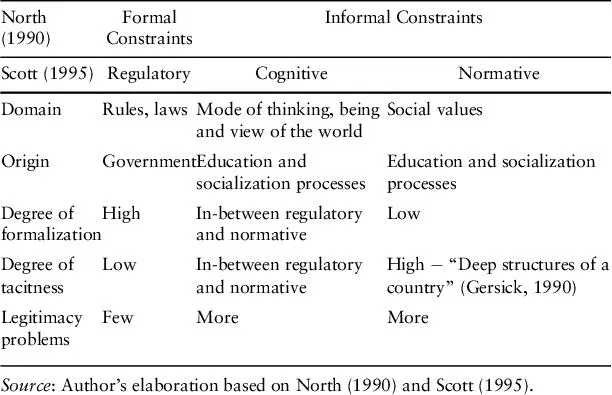
Nevertheless, the boundaries between cognitive and normative pillars are not well defined and result in overlaps (Magnusson, Wilson, Zdravkovic, Zhou, & Westjohn, 2008). Thence, some studies3 use North’s classification to avoid overlapping. The concept of institutions was defined by North (1990) as “the rules of the game in a society or, more formally, the human devised constraints that shape human interaction” (North, 1990, p. 3). North (1990) distinguishes two types of institutions, the formal and the informal ones. The formal institutions are defined as all the rules setting by a society, whereas the informal institutions refer to codes of conduct, norms, and conventions (North, 1990, pp. 36 and 47). Hodgson (2006) criticizes the distinction between “formal” and “informal” institutions. He notes that “these terms have been used misleadingly and in different ways. Does the term formal mean legal, written, explicit, codifiable, or something else? The ambiguities surrounding these terms mean that they cannot be taken for granted. One is required to specify more clearly what is meant in each case or use more transparent terms such as legal, nonlegal, and explicit instead.” (Hodgson, 2006, p. 18). Hodgson (2006) defines institutions as “systems of established and embedded social rules that structure social interactions” (p. 18). He adds that “rules in this context are understood as socially transmitted and customary normative injunctions or immanently normative dispositions, that in circumstances X do Y” (p. 18). Malik (2013) bases his definition of institutions on Hodgson (2006) and identifies six institutional dimensions: language, education, industrial development, political systems, social systems, and religions.
Three papers consider the CAGE distance framework developed by Ghemawat (2001) to define institutional distance. The analysis of the different dimensions underlines the similarity between the cultural distance and the informal distance developed by North, as well as the similarity between the administrative distance and the formal distance. Based on Ghemawat (2001), Wu (2009), and Van Den Waeyenberg and Hens (2012), institutional distance is defined as composed of the cultural, administrative, and economic dimensions. Alternatively, Maseland and Van Hoorn (2013) determine that institutional distance solely incorporates the cultural and administrative dimensions. These two dimensions can be assimilated to the formal and informal institutional aspects suggested by North (1990).
Some authors use their own conceptualization of institutions and institutional distance. For example, Parkhe (2003) decomposes “institutional diversity” (assimilated to institutional distance) into two parts: external diversity and internal ones. The external diversity refers to the partner’s cultural background and to the national context in which he evolves (e.g., industry structure, institutions, and government laws and regulations). The internal diversity refers to firm corporate culture and operational-level variables. Corporate culture is defined by Parkhe as “those ideologies and values that characterize particular organizations (Beyer, 1981)” (Parkhe, 2003, p. 309). Operational-level differences comprise “differences in the style of management (participatory or authoritarian), delegation of responsibility (high or low), decision making (centralized or decentralized) or reliance on formal planning and control (high or low)” (Parkhe, 2003, p. 310).
Alternatively, Jansson et al. (2009) and Hilmersson and Jansson (2012) introduce the notion of perception in the ID definition. Jansson et al. (2009) defines ID as “the distance between institutions as perceived by one actor in relation to other actors in market networks and in relation to the institutional environments of the market networks” (Jansson et al., 2009, p. 5). They suggest that the institutional environment is composed of three levels of institutions: the micro institutions (e.g., firms), the meso institutions (e.g., organizational fields), and the macro institutions (e.g., societal sectors). They decompose the perceived institutional distance in the internationalization process into three constructs: norms, thought styles, and enforcement mechanisms and derive five important indicators from primary data (distrust, reliability, sanctions, patience, and rationality).
More generally, integrating three institutional approaches, Berry et al. (2010) developed a new theoretical framework to conceptualize cross-national distance. The first approach is based on Whitley (1992) and emphasizes the concept of “national business systems.” According to Whitley (1992), “national business systems” are defined as “particular arrangements of hierarchy-market relations becoming institutionalized and relatively successful in particular context” (Whitley, 1992, p. 10). National business systems can be distinguished by demographic, geographic, cultural, and political institutions. The second approach is based on the concept of “national governance systems” defined as the “set of incentives, safeguards, and dispute-resolution processes used to order the activities of various corporate stakeholders” (Kester, 1996, p. 109). This concept refers to administrative and political dimensions of institutions. The last approach integrated in their framework is based on the concept of “national innovation systems” (Nelson & Rosenberg, 1993). As noted by Berry et al. (2010), “national innovation systems refer to configurations of institutions that foster the development of technology and innovation” (Berry et al., 2010, p. 1464). Their framework includes nin...
Table of contents
- Cover
- Internationalization of Firms: The Role of Institutional Distance on Location and Entry mode
- Chapter 1 Institutional Distance: Conceptualization and Measurements
- Chapter 2 Institutional Distance, Location, and Entry Mode Choice: Theoretical Foundations
- Chapter 3 Institutional Distance and Location Choice of Swiss FDI: A Country-Level Analysis
- Chapter 4 Institutional Distance, Location, and Entry Mode Choice of Swiss FDI: A Firm-Level Analysis
- Conclusion
- Appendix A Country-Level Analysis: Results
- Appendix B Firm-Level Analysis: Results
- Appendix C KOF Questionnaire on Internationalization of Swiss Firms, 2014
- Bibliography
- Index
Trusted by 375,005 students
Access to over 1.5 million titles for a fair monthly price.
Study more efficiently using our study tools.
Frequently asked questions
Yes, you can cancel anytime from the Subscription tab in your account settings on the Perlego website. Your subscription will stay active until the end of your current billing period. Learn how to cancel your subscription
No, books cannot be downloaded as external files, such as PDFs, for use outside of Perlego. However, you can download books within the Perlego app for offline reading on mobile or tablet. Learn how to download books offline
Perlego offers two plans: Essential and Complete
- Essential is ideal for learners and professionals who enjoy exploring a wide range of subjects. Access the Essential Library with 800,000+ trusted titles and best-sellers across business, personal growth, and the humanities. Includes unlimited reading time and Standard Read Aloud voice.
- Complete: Perfect for advanced learners and researchers needing full, unrestricted access. Unlock 1.5M+ books across hundreds of subjects, including academic and specialized titles. The Complete Plan also includes advanced features like Premium Read Aloud and Research Assistant.
We are an online textbook subscription service, where you can get access to an entire online library for less than the price of a single book per month. With over 1.5 million books across 990+ topics, we’ve got you covered! Learn about our mission
Look out for the read-aloud symbol on your next book to see if you can listen to it. The read-aloud tool reads text aloud for you, highlighting the text as it is being read. You can pause it, speed it up and slow it down. Learn more about Read Aloud
Yes! You can use the Perlego app on both iOS and Android devices to read anytime, anywhere — even offline. Perfect for commutes or when you’re on the go.
Please note we cannot support devices running on iOS 13 and Android 7 or earlier. Learn more about using the app
Please note we cannot support devices running on iOS 13 and Android 7 or earlier. Learn more about using the app
Yes, you can access Internationalization of Firms by Laura Vanoli Parietti in PDF and/or ePUB format, as well as other popular books in Business & International Marketing. We have over 1.5 million books available in our catalogue for you to explore.