eBook - ePub
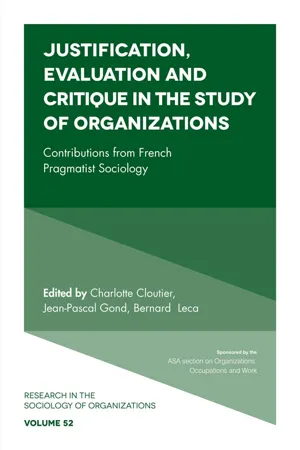
Justification, Evaluation and Critique in the Study of Organizations
Contributions from French Pragmatist Sociology
- 416 pages
- English
- ePUB (mobile friendly)
- Available on iOS & Android
eBook - ePub
Justification, Evaluation and Critique in the Study of Organizations
Contributions from French Pragmatist Sociology
About this book
The papers included in the volume explore how mobilizing Boltanski and Thévenot's EW framework helps address questions regarding the premises and dynamics of agreement and disagreement in coordinated action, both within and across organizations, and by so doing, help advance our understanding of organizational processes more generally. The book is organized into four sections, each with contributions that address one of the four core theoretical objectives around which the volume is structured (1) to clarify how individuals manage the contradictions and compromises inherent to organizational pluralism; (2) to look at organizations critically by unpacking the roles of rhetoric and justification in the practice of critique; (3) to reconsider valuation and evaluation in organizations; and (4) to push the boundaries of the EW framework. These four objectives provide a scaffolding that helps further embed the framework in our contemporary thinking about organizations.
Information
SECTION V – PUSHING THE BOUNDARIES OF PRAGMATIC SOCIOLOGY’S THEORETICAL AGENDA
Articles in this section push the boundaries of French Pragmatic Sociology theorizing, by exploring certain core concepts of the theory more deeply.
AN ECOLOGICAL JUSTIFICATION? CONFLICTS IN THE DEVELOPMENT OF NATURE*
ABSTRACT
There are a number of conflicts today involving groups and individuals as regards nature in its various forms. The aim of this article is to examine how these give rise to changes in the forms of critique and justification that underpin them. Based on various points of disagreement as to how nature should be developed, three possibilities of change have been put forward for examination according to the importance of the transformations required: (a) integration of the model into existing orders of justification, (b) development of a new order based on the same model, (c) serious adjustment of the underlying common matrix of orders and the basis it offers for appreciating injustice.
Keywords: Ecological justification; Green order of worth; Conflicts related to nature
We have studied the permafrost, fur-bearing animals, the Manitounuk sound, the region’s peatland, the Arctic char, the caribou, the beluga, spawning beds, the eider duck, the tundra, the sea water, lichens, and humans. No hydroelectric project ever incorporated environmental knowledge so extensively.1
*Readers can find further developments based on this piece initially published in 1993 in two subsequent texts: Thévenot, Moody, and Lafaye (2000), Moody and Thévenot (2000).
THE INVOCATION OF NATURE
Matters of nature, and the cause of nature, are increasingly invoked in relations between humans. What consequences does referring to these natural beings have on the dealings of human beings in society? Is there not behind it a new front masking well-established interests: hunters defending their hunting grounds, on the pretext of ‘maintaining the balance of an ecosystem’; fishermen ensuring that their hobby can continue by loudly claiming ‘that a right to the environment should be recognised as a basic human right’? It is possible to detect the interests of broader social groups, or institutional actors, with the resources of nature being at the centre of the struggles that oppose them. The social sciences are particularly inclined to this type of interpretation, since they are very suspicious of any explanation referring to natural phenomena. As a result it is important to examine the social processes of naturalisation, taking care to use language that is stripped of references to a mythical environment.
The first part of this article looks at this confrontation between actors under the cover of nature. However relevant the prospect of strategic action may be, it cannot account for the way the invocation of nature offers a transition from the specific to the general. The sociology of social movements has clearly noted the possibility of building a collective movement on critical positions that make reference to nature, and ecologically centred political mobilisation has been analysed from the same perspective. But what, in fact, are the collective forms constructed in this way? Are they identical to those created by feelings of solidarity concerning social rights? How can common projects go beyond personal interests and give substance to the collective interests of actors?
To shed some light on these questions, close scrutiny is needed of the way references to the environment facilitate a transition from the personal to the common, the specific to the general. To this end, we draw on the conflicts provoked by the development of nature (i.e. human projects involving installations or rearrangements), considering the opposing arguments put forward in such cases. We propose to put these very diverse arguments in order, successively considering three possibilities of varying compatibility with tried-and-tested forms of the collective. They are presented in order of the scale of the development project concerned, as well as the argument frameworks that refer to a common good and thus constitute political rhetorics. First, we consider the possibility that nature is aligned with a number of tried-and-tested, legitimate orders of justification. This movement shows the pervasiveness of these orders as well as their dynamic openness, since new resources are absorbed at the cost of classifying the environment in long-established forms of the common good (Boltanski & Thévenot, 1991). However, certain arguments and types of proof and tests suggest a different movement, in which the enhancement of nature focuses on the creation of a new order of worth, an ecological worth meeting the same demands as the previous types of worth. Interest in the forms of invocation of nature is sharpened further by a third type of elaboration containing an inherent radical challenge to the political and moral grammar common to different forms of justification previously studied.
THE COVER OF NATURE AND CONFRONTATION BETWEEN ACTORS
The implementation of major development projects brings actors of three different types face to face: a centralised State and its extensions in the form of regional and local authorities, or a public sector enterprise, which decides that work should be undertaken to develop an infrastructure (a motorway, tunnel, high-speed train line, dam, etc.); local elected officers keen to defend the interests of the local community (farmers, winegrowers, local businesses and hotels), especially the interests of an elite of notable personalities, and who are dependent on electoral deadlines; and associations which, to consolidate their social basis, strive to criticise the project in the name of the environment. Whatever references any party makes to nature, is it not the case that every development project launch leads to the same confrontation between actors with divergent interests?
Actors with Many Voices
While it may be effective to summarise conflicts based on a map of actors with their own logics, such an approach involves a simplification that is detrimental to any explanation of the environment’s status in these conflicts and the specific turn that can result. Proof of this can be found by paying attention to the diversity of voices that can be heard from each actor-type.
Protean Defence Associations
The diversity of voices is particularly clear in the case of environmental defence associations. Their actions can cover at least three different directions reflected not only in the reasons stated in their arguments, but also in the type of resources used.
The first direction, militant and critical, was the hallmark of the ecological cause in the 1970s, with protests against an industrial logic and technocratic power that prevented information from reaching the public and thus being included in the democratic debate (Simmonet, 1979). The model of the anti-nuclear movement is an excellent embodiment of this militant, critical direction (Nelkin & Pollak, 1981; Touraine, Dubet, Hegedus, & Wieviorka, 1980). As Alain Touraine and his co-authors clearly demonstrate, the campaign against nuclear power is rooted in a rejection of industrial values and challenges to the idea of progress, denouncing an authoritarian, repressive State and attempting to go beyond unproductive debate and establish itself as an alternative political force channelling democratic demands. Yet it was not until the late 1980s, and in part separately from the anti-nuclear movement, that this direction became rooted in the French political arena through the electoral influence of political parties representing the environment.2
Although it can be fed by the same type of civic justification, a second mode of action often replaces the first just described, when the association engages in action to ensure compliance with laws and regulations (Alphandéry, Bitoun, & Dupont, 1992, p. 83). In a setting with a smaller central government whose involvement has been lessened by decentralisation, associations tend to act as substitutes for the state: they closely monitor decision-making processes in town and regional councils and act as an administrative police force, identifying breaches of the law and taking legal action (Lascoumes, 1992). Associations engaging in this type of ‘managerial ecology’ approach often criticise the government for not doing its job of making sure that the law is respected, and thus burdening them with too much work.
Finally, in a third direction, the association is involved in decision-making circuits, occupying a position as an expert advisor and issuing opinions based on scientific measurements. This direction is characterised by a capacity for expert assessment and independence, with a focus on the production of absolutely scientific information.
There are doubtless associations routinely engaged in just one of these modes of intervention, and individual actors who always take the same approach in all circumstances. Extreme cases exist of associations entirely taken up with a managerial logic because like an in-house union, they have been put together from scratch by a government and local authorities that want to deal with a ‘responsible’ representative (Lascoumes, 1992). But frequently, that very actor – institutional or otherwise – changes the direction of his action, suggesting that we should take the specific logic of each of these directions seriously, without reducing it to a mere front for an underlying interest.
The Many Languages of Government
Another important actor, the government, can also make several voices heard. Its dispersed nature is a well-known phenomenon today, particularly as a large number of government department’s work on any given project or on policy implementation. Some research has emphasised public sector agents’ capacities to come to arrangements and make accommodations for the external parties they deal with (Dupuy & Thoenig, 1985); others have concentrated instead on the existence of corporate logics at work in French government (Jobert & Muller, 1987; Muller, 1990; Thoenig, 1987).
This article is more directly interested in a third approach, focusing on the study of systems of thought and action, and the analysis of the main languages, essentially conveyed by government, that arise from policies that concern the development of the natural environment (Barouch, 1989). The first language identified is regulatory language, which is often considered synonymous with government (Chevallier & Loschak, 1982). In the illustrative case of the development of the river Cisse in France’s Centre region, this language is objectified in an ordinance of 1834 by France’s King Louis-Philippe which proposed the detailed regulation for how the river can and should be developed, a policy which remained in force until the early 1980s. The second language identified, essentially used by County Agricultural Departments (DDAs3) and County Amenities Departments (DDEs4), is technical language. This language concerns engineers, and takes a single view of the river – as a channel of flowing water – that ignores its other social functions (fishing, leisure). It is expressed through formulas appropriate for calculating the river’s flow rates, sections and gradients with a view to recalibrating the river bed. The third and final identified language comes more from industry and agriculture than from government: it is economic language, which considers the river as a resource whose use must be optimised. To improve water flow and prevent the river from overflowing, walls were constructed and diverted courses dug. The government is increasingly sensitive to this language in matters of natural resource management and environmental management (Godard, 1980). This is particularly true in the case of a public company like the French electricity operator EDF, which justifies its nuclear programme on the grounds of market necessity (Wieviorka & Trinh, 1989).
The Generalisation of Interests
Paying attention to the diversity of voices heard from each institutional actor involved in developing the environment means taking into consideration the constraints affecting each argument put forward and the acceptability of proposed modes of action. The association of action and interests defended on the basis of a particular form of the common good is a key issue in conflicts concerning the environment.
A contrario, this is clear in the name ‘lobby’ given to a group of actors: a lobby of market gardeners or winegrowers wanting to divert a proposed motorway r...
Table of contents
- Cover
- Title Page
- Section I – Introduction
- Section II – Managing Organizational Pluralism: How Individuals Navigate Moral Contradictions and Compromise
- Section III – Looking at Organizations Critically: Rhetoric, Justification and Criticism-as-Practice
- Section IV – Reconsidering Valuation and Evaluation in Organizations
- Section V – Pushing the Boundaries of Pragmatic Sociology’s Theoretical Agenda
- Index
Trusted by 375,005 students
Access to over 1.5 million titles for a fair monthly price.
Study more efficiently using our study tools.
Frequently asked questions
Yes, you can cancel anytime from the Subscription tab in your account settings on the Perlego website. Your subscription will stay active until the end of your current billing period. Learn how to cancel your subscription
No, books cannot be downloaded as external files, such as PDFs, for use outside of Perlego. However, you can download books within the Perlego app for offline reading on mobile or tablet. Learn how to download books offline
Perlego offers two plans: Essential and Complete
- Essential is ideal for learners and professionals who enjoy exploring a wide range of subjects. Access the Essential Library with 800,000+ trusted titles and best-sellers across business, personal growth, and the humanities. Includes unlimited reading time and Standard Read Aloud voice.
- Complete: Perfect for advanced learners and researchers needing full, unrestricted access. Unlock 1.5M+ books across hundreds of subjects, including academic and specialized titles. The Complete Plan also includes advanced features like Premium Read Aloud and Research Assistant.
We are an online textbook subscription service, where you can get access to an entire online library for less than the price of a single book per month. With over 1.5 million books across 990+ topics, we’ve got you covered! Learn about our mission
Look out for the read-aloud symbol on your next book to see if you can listen to it. The read-aloud tool reads text aloud for you, highlighting the text as it is being read. You can pause it, speed it up and slow it down. Learn more about Read Aloud
Yes! You can use the Perlego app on both iOS and Android devices to read anytime, anywhere — even offline. Perfect for commutes or when you’re on the go.
Please note we cannot support devices running on iOS 13 and Android 7 or earlier. Learn more about using the app
Please note we cannot support devices running on iOS 13 and Android 7 or earlier. Learn more about using the app
Yes, you can access Justification, Evaluation and Critique in the Study of Organizations by Charlotte Cloutier, Jean-Pascal Gond, Bernard Leca, Charlotte Cloutier,Jean-Pascal Gond,Bernard Leca, Michael Lounsbury in PDF and/or ePUB format, as well as other popular books in Business & Business General. We have over 1.5 million books available in our catalogue for you to explore.