eBook - ePub
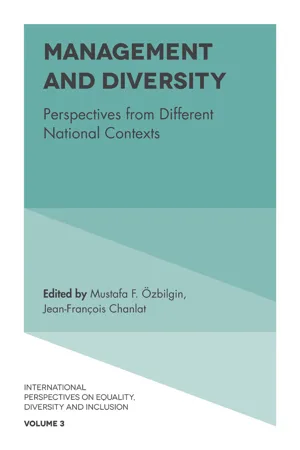
Management and Diversity
Perspectives from Different National Contexts
- 328 pages
- English
- ePUB (mobile friendly)
- Available on iOS & Android
eBook - ePub
Management and Diversity
Perspectives from Different National Contexts
About this book
International Perspectives on Equality, Diversity and Inclusion examines the complex nature of equality, diversity and inclusion in the world of work through interdisciplinary, comparative and critical perspectives. Authors are encouraged to provide cross-national and multi-dimensional insights through comparative analysis and to bring insights from across the disciplines of social sciences and humanities. The series elicits critical scholarship through its focus on structures of inequality in relations of power in exploring issues of EDI at work.
Information
MANAGING DIVERSITY IN BRAZIL
ABSTRACT
The objective of this chapter is to outline an integrating picture of the situation, representativeness, contradictions, and challenges that the treatment of diversity assumes in Brazilian society and in its organizations. The aim is to reply to the research question: “How are public policies and organizational practices constructing ways of inserting and valuing the diversity of Brazilians?” We provide a brief background of the changes in the global and Brazilian contexts over the last few decades and analyze the demographic data presented in the 2010 Census and in studies on diversity that were published in the main periodicals in the Administration area in Brazil, between 2000 and 2014 with regard to the segments most widely studied in the academic literature: Afro-descendants, homosexuals, the elderly, Indians, women, and people with a disability. The conclusion reached is that, in a short period of time, Brazil has made great strides in constructing the mechanisms and legal devices for recognizing the rights of its diverse population and that private companies are in the initial stages of introducing diversity programs.
Keywords: Brazilian diversity; public policies on diversity; organizational diversity programs and practices
INTRODUCTION
The statement that the last few decades have seen a profound transformation in all fields of human life has become commonplace, particularly in Western societies. These transformations are different from previous ones in at least three aspects, which seem to us to be most visible: (a) the speed with which they occur; (b) the interdependence and reciprocal influences between them; (c) the level of complexity they present, which demands new responses to new and old social problems involving multiple variables.
Since organizations do not operate in a vacuum, but in the societies in which they are conceptualized and set themselves up, changes in different contexts impose demands on them that are increasingly more challenging, while at the same time opening up new opportunities and conditions for more competitive, democratic, intercultural, and changeable exercises.
In the economic plan, the new millennium brought with it a more wide-reaching globalization process of capital, commodities, companies, and people, largely resulting from the formation of economic blocks between countries and international agreements that facilitated a greater diversification worldwide of investments, the circulation of goods, internationalization, and a strengthening of the economies of emerging countries. The immediate consequence of globalization has been a rise in the level of competition that influences and is influenced by scientific and technological progress, by the privatization of parts of the public sector and the development of new forms of synergy between countries and companies. Countries that were off the world economic radar have presented high average rates of growth over the last few years, while in more developed countries this performance has not been the most enviable. The 2000s began in a nebulous way, with accusations of countless financial scandals and promiscuity between governments and private sectors in various first-world countries. This situation was in turn transformed into economic crises, the climax of which occurred in 2008, but the effects of which are still punishing various economies.
The political field is becoming more and more confused with the economic field as relations between countries become more interdependent; the latter question the formulae imposed for getting out of crises, redefine alliances, create multilateral institutions and negotiation forums that they judge to be more representative and demand unprecedented legal adjustments in order to face up to the new issues. More intense migratory flows serve as justification for various societies to adopt increasingly restrictive laws regarding foreign presence, create mechanisms for protecting the labor market, and close borders, all of which drives the growth of political parties of the right and/or extreme right, especially in Europe. New democracies are installed and the power of the pressure of individuals, groups, and institutions grows, but the political factor becomes more and more subordinate to the economic factor, both locally and globally. The market economy wins in practically all countries on earth, depleting the power of proposals for alternative ways of production, which – if they survive – do not threaten the general panorama. A new global agenda is imposed and new players are enrolled as regional leaders, claiming their share of participation and influence in various organisms that are held to be multilateral.
The broad social context reflects this globalized and interactive scenario by way of a greater intensification of internal and international migratory processes for various reasons, a heated local–global debate, and a questioning of the role of State and the meaning of citizenship and of the rights and benefits associated with it. The increase in the older population and a reduction in the lower age bands place in check the social security systems, which in developed countries were designed during the social welfare period, the continuity of which must answer the question as to who will pay the bill.
Meanwhile, public and social rights policies are being partially introduced in emerging countries in a response to the demands made by these new democracies, in which people are claiming their rights as citizens more and more. The mass entry of women to the labor market and universities reawakens the debate about family, motherhood, the school and domestic chores and denounces the absence of support policies and programs that consider this new reality. Thanks to the broad access to information technology and to constant interactions with different social players, a more plural, better informed, more demanding, more mobile, and more visible society emerges, which faces up to truths, beliefs, values, established imaginary representations, and generic interpretative schemes.
The different cultures absorb the acceleration of the processes of cultural diffusion caused by the expansion and speed of means of communication, of multiple interactions and of increasingly frequent and more distant displacements. The world is becoming a smaller and more complex place and this has an impact on local cultures and traditions, on language, on family relations, on the role of religion and of authority figures, all of which provided society with its structure. New arrangements emerge between the sexes that challenge the traditional roles associated with men and women and seek to offer replies to complaints regarding the rights of people of the same sex to marry, adopt children and receive the same social, legal and organizational treatment as heterosexual couples. The concept of family changes. Work becomes a central element in structuring the lives of people and identificatory figures, which were previously associated with religious, political, or artistic names or people from a person’s own personal trajectory, start being symbolized by the geniuses of technology (Gates, Jobs, Page, Zuckerberg). Notions of time and space alter and the virtual world is seen as the real world. Professional and social relationships become more and more mediated by technology, which provides exponential contacts and frees man from the body that is his prison.
Public and private companies are confronted with new challenges in the face of their global presence and the intensity of interactions. As a response, the increase in competition demands continuous cost-cutting, professionals with greater qualifications and the increasingly more advanced and faster incorporation of technology, which transform competitiveness into survival. Companies improve new forms of synergy by way of strategies that involve mergers, acquisitions, partnerships, and joint ventures, thus generating a more heterogeneous, nomadic, and multicultural work environment. Financial, organizational, and administrative processes are internationally integrated and clock-time becomes obsolete.
Intellectual capital assumes a growing importance; innovation is a fundamental requirement; learning becomes a permanent process; cultural hybridism starts being the predictable consequence in environments that have to manage the intercultural work of people of different origins and groups, by the way of new communication and negotiation competences in organizational structures that are more and more flexible. The synthesis that emerges from these forces has many faces, one of the most obvious of them being the intensity of intercultural relations, produced by contact with diversity, the challenges of which are found in daily social life and in the world of work.
It is against this great canvas, in which global factors are allied with factors that are peculiar to each society that we pose the key question that motivates this chapter: How are public policies and organizational practices constructing ways of inserting and valuing the diversity of Brazilians? To reply this question, we have structured this study into five parts: (1) Diversity as an academic subject and a social and political value; (2) The peculiarities of the Brazilian scenario; (3) The legal and political instruments destined for specific groups; (4) Managing diversity in private companies; and (5) Conclusions.
DIVERSITY AS A SUBJECT AND AS VALUE
Diversity is a characteristic that is intrinsic to mankind, which due to its transversal nature and complexity can be studied from different perspectives. Generally speaking, but with no pretense of exhausting the possibilities, we can say that fragmented views, grounded in justice, morality, economics, the biological, human and social sciences, and the field of management. Arguments are usually based on theories of group and social identity, on the political, economic, social, and cultural effects of globalization, on the national and international legal aspects involved, on the social and legal claim for the recognition of human rights, on the historical and cultural validity of specific actions, on recognition of others and of alterity, on esthetic and moral aspects and on all their effects on organizational management. However, whatever the view, it seems obvious that different societies have become aware that diversity is a question to be dealt with in a new way and not with the same ideas that generated the problematic and unjust situations that it is intended to correct nowadays.
The interest of the Management in this topic is recent (Chanlat, Dameron, Dupuis, & de Freitas, 2013; Fleury, 2000; Nkomo & Cox, 1999; Pereira & Hanashiro, 2010; Saji, 2005; São Paulo, 2010) and has gained greater visibility over the last few decades by virtue of the necessary conditions and demands to speed up the globalization process, with its economic, social, cultural, and political consequences. We might say, however, that the Declaration of Human Rights was the founding event of the recognition of the importance of human differences and that this has materialized into culturally appropriate, social, and legal mechanisms over the last four decades, particularly in developed societies. Public administration in these countries has constructed public policies and legal instruments that have forced the private sector to take part in the insertion and inclusion of people coming from marginalized groups, in such a way as to reduce inequalities and promote greater social cohesion.
The introduction of affirmative actions occurred in various societies. The results of the treatment of inequalities within the economic, social, and political context were varied, but little by little they were incorporated into a mentality that no longer questions the right to equality of a society’s citizens. In this particular case, we are referring to diversity as a social and political value that recognizes the rights of differences in society and guides its behavior, as we shall see later when we refer to the formulation of public policies and their impacts. The most popular case of affirmative action comes from the United States that adopted specific policies in the 1960s and 1970s, seeking to face up to inequalities that related mainly to the schooling, employment, and income of its Afro-descendant population. The management of diversity was the response of companies to these actions that were defined by government and served as a model for various other societies.
The topic has been analyzed in an enormous amount of academic literature, which indicates the gains in social inclusion, carries accusations regarding the still persistent intolerance in relation to some groups, and criticizes the conversion of rights of political content for the operationalization of organizational ideology, the management of which aims to create competitive advantages and instrumental purposes. In other words, based on technocratic ideology, the treatment of social inequalities in the political arena becomes the treatment of human resources management, which masks prejudices and avoids a deeper debate in society itself (Alves & Galeão-Silva, 2004; Pereira & Hanashiro, 2010; Saraiva & Irigaray, 2009).
We know that capitalism is an extremely agile form of production and very effective in working with its contradictions, transforming them into positive points. Companies have an enormous capacity for interpreting the broader environment and they manage to turn aspects of social life that might imply risks of market disintegration or instability to their favor. It is, therefore, understandable that they seek to adjust to the new scenario, by converting difficulties into opportunities and image costs into a positive image of social responsibility, by developing instruments for correcting distortions and influencing behaviors that value what is appropriate to their objectives. However, we need to be clear that companies are no substitute for government or social institutions, nor are the inherent rights of citizenship to be confused with programs for managing the diversity of human resources in order to leverage competiveness in companies. The purpose of society is to produce itself by way of its institutions and not to produce larger profits for private companies.
Studies on the topic in the Management in Brazil are even more recent, despite the fact that we are a society that is the result of diversity in flesh and soul, resulting from the miscegenation of three great cultural matrixes (Indian, Portuguese, and African) and from the incorporation of the constant European migratory flows over the last two centuries. A substantial part of the research in the field has concentrated on case studies that analyze the proposal for managing diversity in private companies. Such studies seek to provide responses to public policies and the demands of an international market, in which reputation and image are increasingly relevant aspects for establishing partnerships, winning customers, and making them loyal.
In this sense, we can say that research in Brazil into diversity has assumed an instrumental character, with normative propositions related to specific marginalized groups, as witnessed by a picture that is frequently characterized more by discourse and lack of action than by its actual use. Below is a brief historical contextualization of Brazil, based on the transformations, dilemmas, and contradictions that structure the complex debate about policies and practices for valuing diversity. It has often been said that Brazil is not for beginners and now we shall see why!
BRAZIL: PECULIARITIES AND CONTRADICTIONS
When the Portuguese first set foot in Brazil in 1500, they found here a territory inhabited by approximately five million indigenous peoples from different nations and with different languages. The coexistence of Portuguese and natives was irregular and erratic (Ribeiro, 1995, 1986; Schommer, 2012), marked by periods of extreme violence, domination, and extermination, caused mainly by the diseases brought from overseas. In other periods, they lived peacefully by way of alliances and conveniences for both sides, especially during the Dutch and French invasions on the Brazilian coast. The Indians, who lived in all regions of the country, had knowledge of the land, rivers, plants, and animals, so they had a significant element of power that allowed them to develop strategies of resistance to the Portuguese efforts to enslave them for its colonization work (Ribeiro, 1995, 1986; Schommer, 2012).
According to the 2010 Census (Brasil, 2010), the indigenous population is almost 900,000 Indians (in 2000 there were 500,000), who represent 0.47% of the Brazilian population. They are divided into 305 races, speak 274 langu...
Table of contents
- Cover
- Title Page
- Introduction
- A Latin American Perspective on Diversity Management: What Does “Inclusion” Mean in a Peruvian Context?
- Racial Inequality and Managing Diversity in the United Kingdom and United States
- Management, Diversity, Equal Opportunity, and Social Cohesion in France: The Republic Resistant to Differences☆
- The French Notion of Diversity Management to Test against the Alterity of Pacific Island Cultures
- Managing Diversity in Brazil
- Diversity Management in Organizations in Québec and Canada: Facts, Figures and Real-Life Experiences
- Practical Considerations for the Management of Diversity and Inclusion in an Emerging Market Context: A South African Case Study
- The Challenges of Diversity Management in Africa: The Case of Cameroon☆
- Diversity in the Arab World: Challenges and Opportunities
- Diversity Management and the Scandinavian Model: Illustrations from Denmark and Sweden☆
- Diversity Management as Window Dressing? A Company Case Study of a Diversity Charta Member in Germany
- About the Editors
- About the Authors
- Index
Trusted by 375,005 students
Access to over 1.5 million titles for a fair monthly price.
Study more efficiently using our study tools.
Frequently asked questions
Yes, you can cancel anytime from the Subscription tab in your account settings on the Perlego website. Your subscription will stay active until the end of your current billing period. Learn how to cancel your subscription
No, books cannot be downloaded as external files, such as PDFs, for use outside of Perlego. However, you can download books within the Perlego app for offline reading on mobile or tablet. Learn how to download books offline
Perlego offers two plans: Essential and Complete
- Essential is ideal for learners and professionals who enjoy exploring a wide range of subjects. Access the Essential Library with 800,000+ trusted titles and best-sellers across business, personal growth, and the humanities. Includes unlimited reading time and Standard Read Aloud voice.
- Complete: Perfect for advanced learners and researchers needing full, unrestricted access. Unlock 1.5M+ books across hundreds of subjects, including academic and specialized titles. The Complete Plan also includes advanced features like Premium Read Aloud and Research Assistant.
We are an online textbook subscription service, where you can get access to an entire online library for less than the price of a single book per month. With over 1.5 million books across 990+ topics, we’ve got you covered! Learn about our mission
Look out for the read-aloud symbol on your next book to see if you can listen to it. The read-aloud tool reads text aloud for you, highlighting the text as it is being read. You can pause it, speed it up and slow it down. Learn more about Read Aloud
Yes! You can use the Perlego app on both iOS and Android devices to read anytime, anywhere — even offline. Perfect for commutes or when you’re on the go.
Please note we cannot support devices running on iOS 13 and Android 7 or earlier. Learn more about using the app
Please note we cannot support devices running on iOS 13 and Android 7 or earlier. Learn more about using the app
Yes, you can access Management and Diversity by Mustafa Özbilgin, Jean-Francois Chanlat, Mustafa Özbilgin,Jean-Francois Chanlat in PDF and/or ePUB format, as well as other popular books in Business & Organisational Behaviour. We have over 1.5 million books available in our catalogue for you to explore.