eBook - ePub
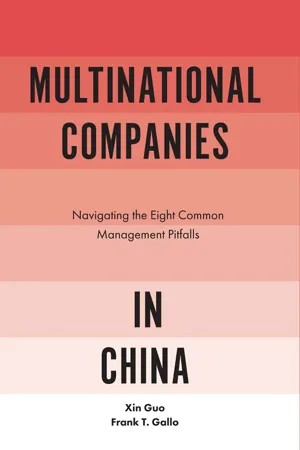
Multinational Companies in China
Navigating the Eight Common Management Pitfalls
- 216 pages
- English
- ePUB (mobile friendly)
- Available on iOS & Android
eBook - ePub
Multinational Companies in China
Navigating the Eight Common Management Pitfalls
About this book
This book explores some of the most common mistakes made by multinational companies doing business in China, in both cultural and managerial contexts. These shared mistakes could be as far-reaching as managing talent, local vs. global decision making, or could be as mundane as managing title, pay and performance. Many mistakes are rooted in a lack of understanding of the Chinese market in two areas: the unique talent and culture environment, and the immense opportunity potential. Very often, MNCs' global or local leaders lack the ability to make discretional decisions with one-size-fits-all approaches under the cloak of global consistency, or treating a China operation as one-of-the outfits (and a small one in the world revenue pool), even though they understand the market potential in theory. MNCs have enjoyed great success in China while many others have yet to realize their opportunities. China business continues to grow, and opportunities continue to develop. This book will guide business leaders on how to avoid the most common management pitfalls in China business, and will help the capitalize on the huge opportunity that remains in this region.
Information
PART I

THE OVERVIEW
1
MULTINATIONAL COMPANIES IN CHINA — AN INTRODUCTION
The world’s economy is going through dramatic change. China’s economy is very much a driver of this, as this fast growing second-largest economy in the world moves from an investment- and export-driven country, to a domestic consumption-driven country. Most multinational companies in China enjoy a profitable business. According to one of the latest reports by the American Chamber of Commerce in China Business Climates Studies, 71% of American companies are profitable here (AmCham China, 2014). Another latest report by the American Chamber of Commerce in China White Paper shows that 69% of American companies operating in China plan to increase their investment during the next year (AmCham China, 2015). In fact, for many of these companies, the China profit contribution continues to outdo their peers in other markets for total global profits. For some companies, the majority of their global profits come from their China operations. How to better manage operations and put them on a more sustainable growth trajectory is increasing on the mind of executives who are running businesses in China or have global responsibilities.
CHINA’S AMAZING ECONOMIC STORY
China is on everyone’s mind these days. It holds over one-fifth of the world’s population. While some of the populace is still quite poor, the growing economy has allowed a sizable number to become affluent over just this past generation. These nouveau riche are more optimistic about their future and therefore more willing to spend extravagantly than ever before, all adding up to a very comfortable future-focused lifestyle. However, this wasn’t always the case.
While China has led the world’s economies in centuries gone by, the last century has seen China being left behind. There are strong arguments as to why this has been. But no matter the reason, the reality is that only 50 years ago there were stories of people sucking nutrients from tree leaves in order to survive.
However, ever since the economic transformation led by Deng Xiaoping began in 1978, the economic train has not stopped running. A large percentage of the population has emerged from poverty. In 1978, China’s GDP accounted for 1.8% of the global total. That number had changed to 12.3% after only 35 years (China National Bureau of Statistics, 2013). There is a large and comfortable middle class, and there are also many who, by any standards, are very rich.
Economic reform in China was carried out in two stages. First, it was the decollectivization of agriculture lands. In this phase, farmers were allowed to operate their farms independently and strive for a profit. Their primary responsibility was to feed their families and then sell their surpluses for a profit. No longer were they entirely dependent on meeting impossible production quotas and losing nearly all of what they produced to the cities. Second, it was the opening up of the country to allow foreign investment, and that phase has never stopped. Today, in 2015, although global economic conditions have been leading many foreign companies to rethink how they manage their China investments, few of them are willing to abandon this enormously important market.
Owing to these successful moves, China has evolved to become one of the largest and most advanced economies in the world today. The country has provided perhaps the best example ever of how you go “from rags to riches.” China’s GDP has grown more than 10-fold since the early stages of the reform. Local farmers and entrepreneurs have been getting rich and a plethora of multinational companies have found their way here; all with the intention of fulfilling their own China dreams.
OPEN AND REFORM
In 2015, China’s “open and reform” policy is in its 37th year. Multinational companies have been arriving in droves during the past 20 years. Rather as the China market has changed dramatically, so have the reasons for coming. Multinational companies’ business strategies for operating have gradually shifted as China has evolved. They began by tapping into the vast low-cost labor pool, and now that labor costs have raised considerably, multinationals are no longer here to simply take advantage of the low-cost labor market they originally came after. Rather, they now stay in order to get a piece of the enormous market opportunity offered by 1.3 billion potential consumers. The scale of their presence in China and the staffing of their operations have varied over time. However, some mistakes of managing these businesses are strikingly common. Before examining the mistakes specifically and how to correct them, let us examine the issues that underlie them.
MANAGING TALENT
In the past three decades, China has been celebrated as the “promised land” for multinational companies. The low-cost labor force, effective infrastructure, and an increasingly wealthy population were extremely attractive attributes for corporations looking for the next growth hotspot. But as the roaring economy started to slow down and consumers begin to mature, the market dynamics for multinationals in China are quickly changing. Ever since multinational companies came into China, the ongoing theme has been shortage of talent. Now, with little improvement in that area, a new twist is added to this dilemma — the rapid and ongoing increase of labor costs, not just for management of talent, but at all workforce levels. The lack of improvement of the talent environment is not in absolute terms. Thanks to the economic development, several millions of college graduates walk into the labor market each year, and the majority of multinational and local companies pour gazillions of funds into training and development. China is churning out more talent than any other country at any other time. Unfortunately, the demand is certainly outpacing the supply. For decades, China has been one of the largest recipients for direct foreign investment, and now China is also becoming the largest outbound investor globally. All of these activities are relying on “seasoned talent.” There were just not enough seasons in the past three decades.
China is a resourceful country; there are no doubts about that. But how can it satisfy its foreign companies when many of the fresh graduates and young talent lack the linguistic abilities and business acumen to take on many of the roles needed by multinationals? Despite China’s enormous pool of university graduates, almost 7 million in 2013 and expected to peek at 7.4 million in 2016, a recent study conducted by Time magazine suggests that fewer than 20% of Chinese job candidates, on average, would be suitable for work in a foreign company. That already low number is reduced because China is the fastest growing domestic economy and it absorbs most of those who prefer to work for local companies. In the last few years, multinational companies are yielding to the good local companies which are now most sought after by Chinese employees. This change is sinking in gradually as multinationals are losing their once unique advantages; higher pay, better benefits, and well-organized training programs, just to name a few. Now, the leading local companies are getting caught up in these areas and are offering something the multinationals could not — a better chance at rapid career advancement especially at mid- to senior-level positions. (More on this will be elaborated upon later.) This points to a looming shortage of homegrown talent that inadvertently afflicts serious damage to the multinationals in China and the growing number of Chinese companies with global ambitions.
Furthermore, with a very young average age of employees, how can they compete with their more experienced counterparts in other countries? For example, the average age of an engineering manager in the United States is 35 years old. In China it is 25. Many of these “managers” have very little work experience and absolutely no management experience. How can they successfully do the jobs they are being asked to do?
This lack of sufficient talent supply, with an ever-increasing demand for more, is causing many multinationals to wonder how they can continue to be profitable. Some are rethinking how they can operate here. Although few are simply packing up and going home, many are diversifying their operations to other locations in Asia and South America, where costs are still low and talent is more readily available. One such example is a technology firm in Qingdao, started by an American and two Chinese partners in 2003. They grew from just the founders to over 1500 employees with two additional locations beyond the Qingdao headquarters. But, for the reasons mentioned earlier, they believe their growth in China will be considerably hampered. As such, rather than their prior strategy of looking to grow in other Chinese locations, they are opening a facility this year outside China in Bangalore, India, and another back in the United States. Of course, some of this investment diversification is economically driven as China’s labor costs are creeping up higher at a faster rate than ever.
BUDGETING HEADCOUNT
The headcount budget has long been a gauge to manage cost and productivity in Western societies. But unconditionally applying that tool to manage businesses in China could easily derail the best intentions.
All departments in a business need to plan and submit a budget to determine future staffing needs. Knowing department budgets can help identify open positions that have not been filled. It can also determine the eventuality of rising benefit costs for a company. If a department is regularly under or over budget, it is time to consider realigning its organizational structure to more efficiently appropriate these funds. That is where budgeting headcount comes into the picture. In recent years, as the overall economy oscillates up and down, and the ever more rigorous labor protection laws are initiated and enforced, Western companies are extremely vigilant about watching over headcount situations at all levels of the company. However, the considerations for doing this (managing headcount) effectively in China are very different from how it is done in the West. For example, a headcount budget mentality normally requires strict adherence to quotas. That makes sense when an economy is stagnant or otherwise relatively stable. On the contrary, in a dynamic market like China, the concept of managing headcount without considering the growth potential of the economy makes no sense and is often done to the detriment of the multinational company in China.
DEFINING THE ASIA PACIFIC REGION
The Asia Pacific region has become a simple and clean way to cut organizations geographically. However, this otherwise expedient approach has many implications that are often overlooked by multinationals. For example, there is little in common with advanced economies like Australia, Japan, and Singapore and those of China and India. This false connection can often lead to business disruption. Culturally, Australia is very close to the developed countries in the West, and yet, it is often considered as the Asia regional center for multinationals. In addition, if not literally the physical regional center, many critical lead roles are filled by Australians. Interestingly, it takes longer to travel from Beijing to Melbourne than from Beijing to New York or other major European capital cities. So this seemingly neat grouping, when under close examination, can be very incongruous and sometimes considered outlandish by Chinese professionals. Nevertheless, this seemingly foolhardy practice continues to this day. A manager in Guangzhou, China, where the labor supply is relatively dynamic and rich, needs to depend on a decision from Singapore or Sydney in order to effectuate a hire, a fire, or a promotion. Does this make sense?
MANAGING IN A MATRIX
The very common multinational matrix structure has unforeseen consequences in countries like China where Confucianism and hierarchy are considered normal. While many multinationals in China try to address this issue, its mere presence becomes an extra and perhaps unnecessary hurdle. The two very basic conditions to apply matrix management structure are often overlooked. That is, a matrix structure firstly requires a relatively mature audience and adequate talent in the organization. Secondly, it works best in organizations with critical mass. For many companies’ China operations, one or the other, or sometimes both, of these requirements are missing. Sometimes this structure is forced on them conveniently for the very reason that they are small and, hence, does not seem to need special treatment. An exception in China can only make the global structure inconsistent and not as neat as some multinationals would like it to be seen. To some executives in China, this approach is often seen as a case of slaughtering tomorrow’s business on the altar of yesterday’s business. That is, we often force markets like China, with enormous growth potential, to knuckle under a system that often makes no sense here, simply in order to maintain a global consistency with how we manage. Is this really what the original designers of matrix management had in mind when they developed the system? Not likely!
MANAGING TITLES AND SALARY
Title and salary inflation in China has been an irksome issue for multinational corporate headquarters for the past 20 years. Some companies have managed this well while many others failed miserably with rigid global mandates that totally fly in the face of Chinese wisdom. Generally, when companies in China follow corporate global policies, it can provide a useful guideline. However, when it comes to the uniqueness of China’s talent environment, discretional local decisions are essential to attract and retain certain key talent. Surely, in the larger scheme of things, talent is replaceable. In China’s talent situation however, replacing critical talent could take a very long time — much longer than typically is the case in the West. It could very well delay a company’s business goals considerably and perhaps cause the company to miss many opportunities. To lose key talent simply because of a title makes no sense.
In China, titles carry a much more important meaning than in the West. When one consulting company’s managing consultant came to China, this executive team challenged him to call himself the China CEO. He said this was wrong. He was the managing consultant. After the team convinced him however, how he would get more respect from clients and would be more likely to effectuate sales, they came to a reasonable compromise. Chinese business cards are two-sided. One is in Chinese and the other is in English. In this case, the solution was to identify himself in English as the Managing Consultant but on the Chinese side to describe him as the China CEO. This seemingly simple solution is used successfully in China with sales reps, engineers, and other client-facing professionals who need to demonstrate a significant place in the hierarchy for their clients without jeopardizing a corporate system that is less sensitive to the issues of status and face that might be the case in China. (In fact, in at least one case we are aware of, the headquarters’ executives are not even aware of what the Chinese translation says on the business card.)
Related to the issue of titles is the way that companies manage performance, sometimes causing the controversial management practice of “curving.” In China there are often unintended consequences of this approach, especially given the Chinese inclination toward inclusion and collectivism. Like the matrix management structure, “curving” performance ratings also requires certain conditions in order for the tool to yield desired results in China. The talent pool should reach a critical mass first, especially when the majority of your target audience is on the up ticking trends of learning skills and gaining experiences. Unfortunately, these unique features of the China talent environment are often overlooked and undesired consequences ensue when this approach is rigorously enforced at the global level. While the global trend of using curving has declined considerably over the years, it is unfortunately still often used in China, much to the detriment and dismay of the Chinese workforce.
SOLVING ISSUES LOCALLY VERSUS GLOBALLY
China operations for multinationals should not be treated just as a foreign subsidiary for low-cost manufacturing and distributing products and services from the home country. Failing that, some global firms have lost their meaningful presence in China and have missed major opportunities. The China market has evolved continuously over the past 30 years. Originally, China was a low-cost labor market and low-end mass production hub — condescendingly referred to as “the world’s production shop.” But now we are witnessing the formation of the largest consumer market in the world for many product and service categories. Some multinational companies have constantly recalibrated their China strategies to demand their local management teams to develop local solutions for local problems while some have missed the best opportunities to follow this historical transformation and become bewildered at the realization of their being out of pace and obsolete.
Surely, we understand and respect the need to have global oversight for major projects and we realize that sometimes they will conflict with local ideas. But when it is the norm that all significant operational decisions are made at headquarters rather than in China, we are dramatically hampering the local executives on the ground in China from exercising their best judgment. When we do so, we not only potentially damage our decision-making, but we also often frustrate local executives who feel forced to jump ship. This can be a loss that takes years to overcome in China.
MANAGING EXPATRIATES
Expatriates are an important part of the workforce for global companies. Unfortunately, many companies use them as extremely expensive patches to fix management and operational problems. China is no exception. The ability to manage expatriates effectively has less to do with operational cost effectiveness, but more to do with the company’s need to link their China operations successfully with the corporate headquarters. To the eyes of local employees, expatriate management represents the company’s commitment to China, trust of locals and hence, their future with the company. If expatriates are not viewed as long term, committed leaders in China, they often lose credibility.
Recently, a statement from the LinkedIn global vice president and China managing director, Warren Shen, has been widely shared on the local multimedia platform WeChat. “If a multinational internet company wants to be successful in China, it must fulfill three conditions, (1) nurturing and respecting local leaders; (2) putting into place an organization structure where local leaders are left with room to make discretional decisions; and (3) developing ...
Table of contents
- Cover
- Title Page
- Part I The Overview
- Part II Eight Common Mistakes
- Part III What is Next for Multinationals in China?
- Part IV Human Resource Practices — Areas of Convergence and Divergence Between China and the West
- Part V Epilogue
Trusted by 375,005 students
Access to over 1.5 million titles for a fair monthly price.
Study more efficiently using our study tools.
Frequently asked questions
Yes, you can cancel anytime from the Subscription tab in your account settings on the Perlego website. Your subscription will stay active until the end of your current billing period. Learn how to cancel your subscription
No, books cannot be downloaded as external files, such as PDFs, for use outside of Perlego. However, you can download books within the Perlego app for offline reading on mobile or tablet. Learn how to download books offline
Perlego offers two plans: Essential and Complete
- Essential is ideal for learners and professionals who enjoy exploring a wide range of subjects. Access the Essential Library with 800,000+ trusted titles and best-sellers across business, personal growth, and the humanities. Includes unlimited reading time and Standard Read Aloud voice.
- Complete: Perfect for advanced learners and researchers needing full, unrestricted access. Unlock 1.5M+ books across hundreds of subjects, including academic and specialized titles. The Complete Plan also includes advanced features like Premium Read Aloud and Research Assistant.
We are an online textbook subscription service, where you can get access to an entire online library for less than the price of a single book per month. With over 1.5 million books across 990+ topics, we’ve got you covered! Learn about our mission
Look out for the read-aloud symbol on your next book to see if you can listen to it. The read-aloud tool reads text aloud for you, highlighting the text as it is being read. You can pause it, speed it up and slow it down. Learn more about Read Aloud
Yes! You can use the Perlego app on both iOS and Android devices to read anytime, anywhere — even offline. Perfect for commutes or when you’re on the go.
Please note we cannot support devices running on iOS 13 and Android 7 or earlier. Learn more about using the app
Please note we cannot support devices running on iOS 13 and Android 7 or earlier. Learn more about using the app
Yes, you can access Multinational Companies in China by Xin Guo,Frank T. Gallo in PDF and/or ePUB format, as well as other popular books in Business & Human Resource Management. We have over 1.5 million books available in our catalogue for you to explore.