eBook - ePub
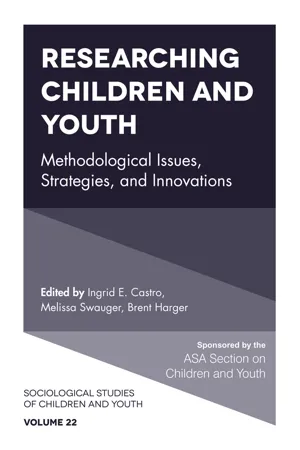
Researching Children and Youth
Methodological Issues, Strategies, and Innovations
- 425 pages
- English
- ePUB (mobile friendly)
- Available on iOS & Android
eBook - ePub
Researching Children and Youth
Methodological Issues, Strategies, and Innovations
About this book
Researching Children and Youth: Methodological Issues, Strategies, and Innovations, part of the Sociological Studies of Children and Youth series, seeks to fill a void in current publications directly addressing the problems and pitfalls that often accompany researching children and youth in today's society. Sociologists face increasingly limited access to children and youth given their "vulnerable" status, growing requirements from Institutional Review Boards, and more restricted access from organizations and educational institutions. As a result, researchers must be creative in the pursuit of researching kids and teens. Chapters in this volume address such topics as participatory and feminist ethnographic approaches, digital mining, children's agency, and navigating IRBs. The importance of contextualizing sociological research with children with special consideration of space, location, and identity thematically runs throughout all of the contributions to this volume.
Information
METHODOLOGICAL INNOVATIONS: VISUALS, MEDIA, AND TECHNOLOGY
“IS THAT A MOM AND DAD CHURCH?” CHILDREN’S CONSTRUCTIONS OF MEANING THROUGH FOCUS GROUP INTERVIEWS
ABSTRACT
Children are not clay tablets upon which adults can etch predetermined futures. Rather, children are active agents who repeatedly interact with various social fields. Religion, one of those fields, is a major social institution that influences one’s religious beliefs as well as one’s secular behavior. Studying children’s views on religion and how they relate to their religious communities makes explicit the ways children actively participate in their own religious socialization. Consequently, this study is an examination of children’s participation in their religious communities at two evangelical Protestant churches in Northern California utilizing focus group interviews of children as a way to get at children’s collaborative constructions of meanings. Consistent with current understandings in the sociology of childhood, findings indicate that children separate themselves from those of adults within their own “kid congregations” that are distinctly separate from the adults. Moreover, this research addresses a gap in the sociological literature regarding how children talk about their relationships to their church communities; it has implications for how one interprets and approaches current and future studies investigating how children relate to their religious communities.
Keywords: Children; religion; focus group interviews; child-centered
A few years ago, one of the parents at a church where I served as the director of children’s religious education approached me. She was observing our weekend programming for elementary school-aged children and noticed that her son was more interested in playing with his friend next to him than the lesson being taught at the front of the room. When she confronted him about this behavior he replied, “But Henry says we’re supposed to have fun. It’s one of the rules.”
Technically, he was right. One of the instructions was: “Expect to learn something and have fun doing it.” Up to that point, I assumed the meaning of “fun” was self-evident. “Having fun” meant the lessons and activities were to be enjoyable, as opposed to boring. I was completely unaware of the dissonance between my definition of “fun” and this child’s understanding of what it meant to “have fun.” Over the months that followed, I turned a critical lens on my taken-for-granted assumptions regarding how children learned what was taught during Sunday school and how these adult- and child-based constructions related to the church. I pulled apart the curricula we used, I scrutinized the conversations my colleagues and I had about best practices in children’s ministry, and I re-examined the many books, articles, and blog posts I had read or authored. Among all of those resources on the religious education of children, I found few instances where children were consulted on their thoughts and views about attending church. I came to the realization that underlying my “child-targeted” approaches to relating with children in a church context was an adult-centric construction of how children connect with the church (Ridgely, 2012). It was this revelation that led me to turn my sociological lens toward an exploration of the ways children construct their relationships with the churches they attended.
One way to better understand how religion affects secular behavior is to examine how religious norms are reinforced in their lives and how children are socialized into those norms (White, 1968). According to the 2004 U.S. Census Bureau Survey of Income and Program Participation (SIPP),1 68% of children 6–11 years old attended some sort of religious service, social event, or education program at least once a month. An examination of the literature revealed two dominant explanations for children’s religious socialization: children’s social learning formed through early entry into congregational life (Dudley, 1999) and “transmission” or “inheritance” of religious values by way of parental and familial influences (Gunnoe & Moore, 2002; Hoge, Petrillo, & Smith, 1982; Myers, 1996). These perspectives on religious socialization, however, focused on children as passive receptors of religious norms rather than as active agents who participate in their socialization.
My search for child-centered perspectives on children’s participation in religion uncovered a dearth of scholarship focused on the voices of children regarding their relationships with the churches they attended. Much of the research relied on the accounts of adolescents above the age of 13 or secondary accounts from adults (Beste, 2011). Several quantitative studies, for example, identified dominant indicators of adolescents’ church attendance behaviors (Hoge & Petrillo, 1978), their attitudes toward church and religion (Smith & Denton, 2005; Smith, Denton, Faris, & Regnerus, 2002), as well as how adolescents defined their religious identities (Lopez, Huynh, & Fuligni, 2011). While these studies offered insights into the transition of religious beliefs and practices from adolescence to adulthood (Smith & Denton, 2005), children’s voices as experts of their own experiences were silent. Even when children’s views were solicited in religious research (Gunnoe & Moore, 2002; Harms, 1944; Holifield, 2007), children were approached from the standpoint of who they would become as adult religious adherents. In her research with children exposed to domestic violence, Mullender (2006) attributed the lack of children’s voices in sociological research to a belief that children were unreliable witnesses of their own experiences. Likewise, when it comes to child religious studies, Beste (2011) and Boyatzis (2011) separately noted that most research in this area was based on a cognitive understanding of faith formation (Fowler, 1981) and downplayed young children’s abilities to discuss their religious views and experiences.
Over the past 30 years, there has been a growing body of social science literature articulating what it means to engage children as more than objects of study, but to instead view them as key informants in research (Beste, 2011; Thomas, 2007). A few examples include Corsaro’s (2003) ethnography of preschoolers’ peer group formation, Thorne’s (1993) insight into how elementary school-aged children socially construct gender in their interactions with each other, Mullender’s (2006) exploration of how children exposed to domestic violence talk about their experiences, de Castro’s (2012) study of children’s views of their participation in Brazilian schools, and Blanchet-Cohen and Rainbow’s (2006) child-centered analysis of children’s participation in the 2002 International Conference on the Environment held in Canada.
As a result of this paradigm shift, religious studies featuring children as key informants have modestly increased (Bales, 2005; Beste, 2011; Boyatzis, 2011; Dillen, 2007; Ridgely, 2011; Ridgely, 2012). I discuss some of these studies later on in this chapter. These and similar studies challenge conventional psychological development approaches that interpret children’s religious experiences through rigidly defined Piagetian cognitive stages (Fowler, 1981). Instead, these studies opt for a more interpretive model, recognizing that children are social agents with their own religious understandings (Beste, 2011; Boyatzis, 2011; Dillen, 2007).
In the sections that follow, I begin by briefly addressing child-centered sociological research. Second, I provide a detailed discussion of my methodology, which incorporated the use of children’s drawings within the context of focus group interviews. I end with a concise analysis and discussion of the focus group interview data, with an emphasis on how children collaboratively construct their relationship with the churches they attend.
DEVELOPMENTAL STUDIES OF CHILDREN AND RELIGION
As scholars in the sociology of religion sought explanations for how religious institutions transmitted norms and values, a few studies pointed to early socialization into religious norms, values, and beliefs (Hunter, 1991; Lenski, 1961). Harms (1944) analyzed children’s drawings of their religious thoughts and experiences and articulated children’s progressive understanding of religious concepts. Later, Fowler (1981) expounded upon Harms’ findings articulating distinct and progressive stages of faith formation. Following a Piagetian-inspired model of cognitive development, Fowler described faith formation as a linear set of stages beginning at birth when children associated experiences of their environment with feelings of safety or mistrust toward the divine. Within the context of Fowler’s (1981) stages, children did not develop their religious identities until 12 years of age. Later studies by Dudley (1999) and Smith and Denton (2005) suggested that children were socialized into their religious beliefs through parental example and early religious instruction.
These and other early studies (Hoge & Petrillo, 1978; Smith et al., 2002) on children and religion, while providing insight into the religious lives of children, relied on accounts of adults and adolescents or compared children’s experiences with those of adults. Early studies of children in religion failed to interpret children’s accounts of their religious experiences from a child-centered perspective. Lenski (1961) reinforced this bias toward leaving children’s voices out of the literature on children in religions, stating, “All intelligent human action presupposes assumptions about the nature of the forces which ultimately shape the nature and destiny of man. Only small children and persons of subnormal intelligence are non-religious in our sense of the term” (p. 299). In other words, early social research on children in religions assumed that children were incapable of understanding, let alone expertly testifying about, their religious experiences.
INTERPRETIVE SOCIOLOGICAL CHILD RELIGIOUS STUDIES
More recently, social researchers began to enlist children as key informants in research (Shanahan, 2007). Children have shifted from subjects of research to expert consultants of their religious experiences and understandings. As a result, researchers were able to study the mutual effects children and religious institutions have on each other rather than focusing on children as adult worshippers in the making. Unfortunately, a search of the sociological literature reveals a scarcity of child-centered studies on children and religion.
Dillen (2007) argued that children were co-creators with adults in the understanding of religious concepts. Rather than approaching religious education where adults unilaterally pass information down to children, Dillen (2007) advocated for a more communicative approach. This approach allowed for children and adults to exchange and negotiate meanings of religious concepts leading to refined or even new understandings. Similarly, Beste (2011) focused on how children’s interpretations of a particular church ritual revealed, “children are actively co-constructing meaning and reality as opposed to merely absorbing and internalizing the teachings of adults” (p. 346). Furthermore, Beste (2011) suggested that engaging children as religious and moral agents might positively affect religious adherence into adolescence and young adulthood. A final study using children as key informants of children’s religious experiences examined children’s interpretations of the Catholic ritual of First Communion (Bales, 2005). Through participant observation of First Communion classes and interviews of children, parents and church leaders, Bales (2005) revealed that children interpreted the role and significance of church rituals independently of how adults viewed similar rituals. Additionally, Bales (2005) argued that age was a distinct sociological factor that should be considered (in addition to race, gender, and socioeconomic status) in sociological studies of religion.
While the above research brings to light young children’s abilities to substantively reflect on their religious beliefs, rituals, and experiences, there is a lack of literature exploring how children construct their relationships to their religious communities. While Bales (2005) suggested that children did not feel like they were a part of the adult church community, she had no data or analysis examining children’s articulation of this separation or the implications this sense of separation has on the study of children in religions. My research addresses this gap in the literature by utilizing a multi-modal approach to focus group interviews as a way to explore how children meaningfully relate to their churches.
METHODOLOGICAL AND ETHICAL CONSIDERATIONS
Blumer (1969) stated that one of the objectives of symbolic interactionism is “lifting the veils that obscure and hide what is going on” (p. 39) in an area of group life. In order to “lift the veil” on the religious socialization of children, it is important to explore how children socially construct their relationships with the churches they attend. The methodology for this research utilized Blumer’s (1969) contention that one’s methodology must be grounded in the qualitative exploration of the actions, interactions, and experiences of people within their respective worlds. Therefore, I used multiple qualitative methods, including focus group interviews and participant observation, to examine the social world of children’s religious education at two evangelical Protestant churches in Northern California.
As I gathered and analyzed data, I worked to conform to the ethical standards set forth by the American Sociological Association’s (ASA) “Code of Ethics and Policies and Procedures of the ASA Committee on Professional Ethics” (1999),2 specifically Article 12.04, which addresses informed consent when working with children. The biggest hurdle to surmount was obtaining Institutional Review Board (IRB) approval. Similar to Swauger (2009), a number of my colleagues tried to dissuade me from pursuing research with children because of...
Table of contents
- Cover
- Title Page
- The Continued Importance of Research with Children and Youth: The “New” Sociology of Childhood 40 Years Later
- Section I Methodological Issues: Ethics, Locations, and Roles
- Section II Methodological Strategies: Theory, Agency, and Voice
- Section III Methodological Innovations: Visuals, Media, and Technology
- About the Editors
- About the Authors
- Index
Trusted by 375,005 students
Access to over 1.5 million titles for a fair monthly price.
Study more efficiently using our study tools.
Frequently asked questions
Yes, you can cancel anytime from the Subscription tab in your account settings on the Perlego website. Your subscription will stay active until the end of your current billing period. Learn how to cancel your subscription
No, books cannot be downloaded as external files, such as PDFs, for use outside of Perlego. However, you can download books within the Perlego app for offline reading on mobile or tablet. Learn how to download books offline
Perlego offers two plans: Essential and Complete
- Essential is ideal for learners and professionals who enjoy exploring a wide range of subjects. Access the Essential Library with 800,000+ trusted titles and best-sellers across business, personal growth, and the humanities. Includes unlimited reading time and Standard Read Aloud voice.
- Complete: Perfect for advanced learners and researchers needing full, unrestricted access. Unlock 1.5M+ books across hundreds of subjects, including academic and specialized titles. The Complete Plan also includes advanced features like Premium Read Aloud and Research Assistant.
We are an online textbook subscription service, where you can get access to an entire online library for less than the price of a single book per month. With over 1.5 million books across 990+ topics, we’ve got you covered! Learn about our mission
Look out for the read-aloud symbol on your next book to see if you can listen to it. The read-aloud tool reads text aloud for you, highlighting the text as it is being read. You can pause it, speed it up and slow it down. Learn more about Read Aloud
Yes! You can use the Perlego app on both iOS and Android devices to read anytime, anywhere — even offline. Perfect for commutes or when you’re on the go.
Please note we cannot support devices running on iOS 13 and Android 7 or earlier. Learn more about using the app
Please note we cannot support devices running on iOS 13 and Android 7 or earlier. Learn more about using the app
Yes, you can access Researching Children and Youth by Ingrid E. Castro, Melissa Swauger, Brent Harger, Ingrid E. Castro,Melissa Swauger,Brent Harger in PDF and/or ePUB format, as well as other popular books in Social Sciences & Children's Studies in Sociology. We have over 1.5 million books available in our catalogue for you to explore.