eBook - ePub
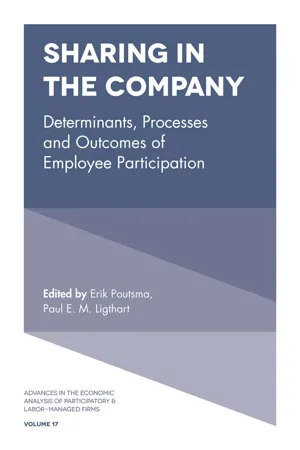
Sharing in the Company
Determinants, Processes and Outcomes of Employee Participation
- 176 pages
- English
- ePUB (mobile friendly)
- Available on iOS & Android
eBook - ePub
Sharing in the Company
Determinants, Processes and Outcomes of Employee Participation
About this book
This volume gathers recent insights into the determinants, developments and outcomes of employee share ownership. It focuses on a number of new emerging themes in the literature and tests some of the relationships using several, notable European datasets. The authors discuss employee share ownership from the perspective of strategic human resource management (SHRM) and present the 'contextual SHRM model,' where employee ownership is influenced by several environmental pressures, which indicated the need for five specific 'fits' of employee ownership. These fits are: fit of employee ownership with strategy of the firm, with the organizational cultural heritage, with the wider social cultural environment; fit with other HRM practices (internal fit); fit with personal characteristics of employees. The authors explore these fits with several new emerging theories and demonstrate what firms that want employee ownership to be an effective HRM policy need to do.
Information
Topic
EconomiaSubtopic
Economia del lavoroFIRM FOUNDATIONS FOR DEMOCRACY? WORKER OWNERSHIP AND CONTROL IN ADVANCED CAPITALISM
ABSTRACT
This chapter maps existing patterns of broad-based worker ownership and control in contemporary advanced capitalism and considers future possibilities for expanding democracy within firms. Section one discusses worker ownership and control arrangements in relation to different theories of the firm and shows how these arrangements map onto different national systems. Section two compares Germany, which is characterized by worker control without ownership, and the United States, which is marked by worker ownership without control. Section three explores three pathways through which broad-based worker ownership and control might be deepened and more strongly coupled in the future.
Keywords: Democracy; capitalism; employee ownership; unions; cooperatives
JEL classifications: J51; J54; J83; M12; P13; P16
INTRODUCTION
Who governs? And how? These questions are at the core of democratic rule in modern society, the role of government vis-à-vis the polity (Dahl, 2005). There is also a body of work that has considered these questions in relation to the organizations that are basic building blocks of economic life under capitalism: firms (Dow, 2003; Driver & Thompson, 2002; Scherer & Palazzo, 2011). Of late, the governance of firms has received heightened attention as part of a larger set of conversations about issues of socioeconomic inequality, financial instability, and environmental degradation. At stake are big questions about the relationship between politics and economics, capitalism and democracy, the governance of firms and the governing authority of nations (Karns & Karen, 2004; Przeworski, 2016; Wood, 2007).
Whether and how the governance of firms should be construed as a matter for democratic institutions to take up are certainly not settled questions. For many, the problem is to further disentangle firms from the overbearing influence of government, unleashing the forces of creative destruction that will drive economic and social progress (Schumpeter, 2013). For those who disagree with this premise, notions of what is to be done are often linked to some conception of corporate accountability (Blair, 1995). In the context of liberal democracy, arguments along these lines do not generally suggest that the government should take on the day-to-day tasks of running the economy. Instead, the question is how democratic institutions can strengthen the accountability of firms to the communities – local, national, and global – in which they are embedded (Abdelal & Ruggie, 2009).
According to this latter perspective, the key issue is how the governance of firms is shaped by externally imposed constraints. More specifically, in an era of market liberalization, the concern is with submitting firms to greater regulatory discipline (Stiglitz, 2009). But, deep analysis of the varying forms that governance can take within firms – the ways power is distributed, different interests are reconciled, decision are made – often remains outside the ambit of this perspective. To raise this is not to suggest that the focus should be displaced from the environment surrounding firms to what is happening on the “inside.” Instead, the task is to better understand how systems of governance defined by geographic, sectoral, and other boundaries connect with firm-level governance arrangements (Crouch, 2005; Hall & Soskice, 2001; Hollingsworth, Schmitter, & Streeck, 1994).
There is a body of work in political economy that can be tapped to illuminate some of these connections (Valor, 2005), but it is incomplete. This chapter focuses on a specific dimension of governance within firms: the place that workers occupy in structures of corporate ownership and control. The existing literature does a reasonably good job of capturing the control dimension and how it varies over time and across countries, outlining differences in institutions that shape the expression of collective power and voice at the workplace (Thelen, 2001; Western, 1997). However, variation in arrangements that extend ownership to a broad base of workers largely eludes its grasp. This gap in the existing literature leaves us with a truncated understanding of existing organizational patterns. It also constrains our theoretical imagination about the kinds of reform projects that might be possible (Wright, 2010).
The chapter begins by laying some conceptual foundations, discussing worker ownership and control in relation to different theories of the firm, discussing key mechanisms through which they are realized in practice, and briefly sketching what we know about patterns of variation in the realm of postwar advanced capitalism. Then, the chapter deepens the analysis of cross-national variation through a closer examination of the United States and Germany, two countries that are often taken as paradigm cases of different national “varieties” of capitalism. Finally, the paper concludes by drawing out some implications for thinking about the future of worker ownership and control in advanced capitalism.
MAPPING WORKER OWNERSHIP AND CONTROL
Four Theories of Firm Governance
Different views on firm governance can be sketched in broad strokes using three basic categories: owners, manager, and workers (Gourevitch & Shinn, 2005).1 We can begin, in fact, with an even broader distinction between “capital” and “labor.” The emergence of capitalism in England and elsewhere entailed a series of contested historical processes whereby people were separated from their traditional means of subsistence, coming to rely on wage labor in order to earn a living (Brenner, 1977).2 This is what allowed those with resources at their disposal to become capitalists, deploying “free” labor in more profitable configurations.3
The growing scale and complexity of firms was accompanied by a split in the category of capital, as owners increasingly hired managers to oversee their enterprises. Managerial hierarchies and organizational bureaucracies have been developed with eye toward promoting greater efficiency. They have also been designed to neutralize the unruliness of workers (Burawoy, 1982; Marglin, 1996), and, particularly in cases where workers have an endowment of hard-to-replace firm-specific skills, to secure their continued commitment (Estevez-Abe, Iversen, & Soskice, 2001). Owners have thus delegated authority as a means of imposing tighter control over the functioning of their firms, including the activities of workers. But there is a tension underlying this control dynamic. Owners devolve control without being sure that managers will act in their best interests.4
The “managerial” view of the firm is organized around the idea that professional managers are best positioned to use resources efficiently, suggesting that vesting authority in the hands of well-trained top managers will tend to enhance firm performance. This view is well exemplified by Chandler (1977), who traced the historical processes through which managerial functions gradually became uncoupled from ownership. Chandler claimed that the organizational structure of firms tends to follow from the strategic vision of its managers. He also argued that firms were better off when professional managers enjoyed the latitude to effectively carry out these functions. According to Chandler, professional managers have often risen through the ranks of the firm. This gives them intimate knowledge of the business and its competitive environment, and it makes them well-suited to orchestrate the firm’s activities.
The “shareholder” view of the firm springs from the concern noted above about the potentially diverging interests of owners and managers. Even if immediate control rests in the hands of managers, the shareholder perspective is preoccupied with ensuring that ultimate control continues to reside with owners. Formulated in part as a way of dealing with increasingly dispersed ownership in the context of large, publicly traded firms, this view has often used the language of “shareholder democracy” to advance its claims (Fairfax, 2008).
Writing in the 1930s, Berle and Means (1932) helped to lay down some early intellectual foundations for the shareholder view. Observing the increased dispersion of ownership in the early twentieth century, they expressed concern about what they saw as a growing lack of managerial accountability. In the 1970s, Jensen and Meckling (1976) extended this line of argument to more fully elaborate the shareholder view, offering what was to become a common justification for why the “agency” of managers should be constrained. While managers, workers, and creditors are all guaranteed fixed payments, returns to shareholders vary based on the firm’s performance. Shareholders bear the most risk and should be the “residual claimants.” Accordingly, measures should be taken to ensure that managers (the “agents”) will maximize the returns to shareholders (their “principals”), and Jensen and Meckling recommended stock options as a means of promoting this alignment.
A third perspective takes the discussion beyond the relationship between owners and managers, arguing that a wider range of interested parties should play a role in the governance of firms. Berle and Means provided a bridge to this “stakeholder” view of the firm. They were concerned about the assertion of managerial authority at the expense of shareholders. But they also argued that shareholders in widely held companies tend to be far removed from any active role in exercising stewardship over their assets. As such, the claims of shareholders need to be balanced against the interests of others who have a stake in the firm’s activities, including workers and the surrounding community.
Blair (1995) offers a rationale for advancing the stakeholding claims of workers. She argues that workers – particularly those with highly firm-specific skills – are confronted with risks of their own. They cannot readily move from one firm to another without facing substantial losses in income, and their wages often do vary based on the firm’s performance. For Blair, this means that workers, too, can legitimately be regarded as residual claimants, lending credence to the idea that they should exert some measure of control over how the firm operates and how the income it generates is distributed.5
Finally, a fourth perspective poses a more fundamental challenge to the basic categories and assumptions underlying all of the other approaches (Rothschild & Russell, 1986). Even the stakeholder view tends to allow that labor will ultimately remain a “junior partner” to capital, leaving intact the basic property rights of a separate class of owners. Under a “democratic” view, the firm is owned and controlled by its members. In the work of thinkers such as Dahl (1986) and Ellerman (2015), this democratic view has been built around the notion that the right to self-government should extend into the sphere of work.
As with democracy in general, there are different forms that democracy can take within firms. There are various kinds of decision rules – e.g., consensus-based or majoritarian (Dryzek, 1997). Moreover, these decisions can be made via deliberative “direct” democracy, “representative” democracy, “associational” democracy, or some combination of these forms (Saward, 2003). As discussed below, in situations where democratically organized firms achieve substantial scale, there is a tilt toward more representative modes of governance. Still, both in theory and practice, the democratic view tends to be characterized by the notion that all members of a firm should ultimately have an equal share in the enterprise and an equal say in how it goes about its business.
Worker Ownership and Control in Practice
How do existing mechanisms that promote broad-based worker ownership and control map onto these different conceptions of the firm? Unions are the most widespread existing mechanism for promoting worker voice and control rights. In their prevailing form, they embody the stakeholder view. Through collective bargaining, they advance claims for improved job quality, including higher wages and stronger benefits. They can also afford workers a measure of input into work rules, the configuration of workplaces, and, in some cases, firm-wide governance decisions (Freeman & Medoff, 1985). Even at the upper limits of their influence in the contemporary landscape, however, union do not tend to challenge capital’s basic property rights, assuming their place as capital’s junior partner (Unger, 1998).
Unions have not always conformed to this model. The Knights of Labor, a union federation that saw its membership peak during the 1880s, organized some 200 worker cooperatives during this period, helping to fuel the first major wave of worker cooperative development in the United States (Eiger, 1985). For the Knights, the formation of worker cooperatives was driven in part by the notion that conventional employment relations failed to provide ordinary working people with true economic independence (Gourevitch, 2011). In the early part of the twentieth century, the Industrial Workers of the World (a.k.a., the “Wobblies”) organized in the United States and other countries in support of worker self-management within firms (Dubofsky & McCartin, 2000).
By the mid-twentieth century, however, as part of the postwar bargain, unions in today’s economically advanced countries had largely congealed into a form that was in keeping with the stakeholder model. They leveraged this position to play a crucial role in promoting “shared growth” during the so-called golden era, applying press...
Table of contents
- Cover
- Title Page
- Sharing in the Company: Introduction to the Volume
- Employee Ownership and High-Performance Work Systems in Context
- Which Companies Adopt Sharing Arrangements and Why?
- Who Participates in Share Plans and Why?
- How Has Employee Share Ownership Evolved in the Global Context?
- Firm Foundations for Democracy? Worker Ownership and Control in Advanced Capitalism
- Index
Trusted by 375,005 students
Access to over 1.5 million titles for a fair monthly price.
Study more efficiently using our study tools.
Frequently asked questions
Yes, you can cancel anytime from the Subscription tab in your account settings on the Perlego website. Your subscription will stay active until the end of your current billing period. Learn how to cancel your subscription
No, books cannot be downloaded as external files, such as PDFs, for use outside of Perlego. However, you can download books within the Perlego app for offline reading on mobile or tablet. Learn how to download books offline
Perlego offers two plans: Essential and Complete
- Essential is ideal for learners and professionals who enjoy exploring a wide range of subjects. Access the Essential Library with 800,000+ trusted titles and best-sellers across business, personal growth, and the humanities. Includes unlimited reading time and Standard Read Aloud voice.
- Complete: Perfect for advanced learners and researchers needing full, unrestricted access. Unlock 1.5M+ books across hundreds of subjects, including academic and specialized titles. The Complete Plan also includes advanced features like Premium Read Aloud and Research Assistant.
We are an online textbook subscription service, where you can get access to an entire online library for less than the price of a single book per month. With over 1.5 million books across 990+ topics, we’ve got you covered! Learn about our mission
Look out for the read-aloud symbol on your next book to see if you can listen to it. The read-aloud tool reads text aloud for you, highlighting the text as it is being read. You can pause it, speed it up and slow it down. Learn more about Read Aloud
Yes! You can use the Perlego app on both iOS and Android devices to read anytime, anywhere — even offline. Perfect for commutes or when you’re on the go.
Please note we cannot support devices running on iOS 13 and Android 7 or earlier. Learn more about using the app
Please note we cannot support devices running on iOS 13 and Android 7 or earlier. Learn more about using the app
Yes, you can access Sharing in the Company by Erik Poutsma, Paul E. M. Ligthart, Erik Poutsma,Paul E. M. Ligthart, Takao Kato in PDF and/or ePUB format, as well as other popular books in Economia & Economia del lavoro. We have over 1.5 million books available in our catalogue for you to explore.