eBook - ePub
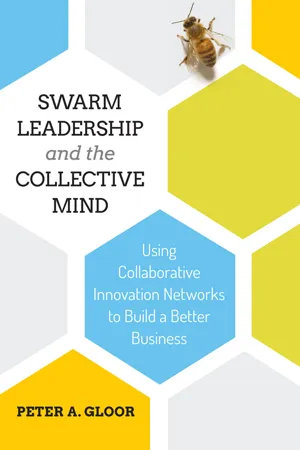
Swarm Leadership and the Collective Mind
Using Collaborative Innovation Networks to Build a Better Business
- 280 pages
- English
- ePUB (mobile friendly)
- Available on iOS & Android
eBook - ePub
Swarm Leadership and the Collective Mind
Using Collaborative Innovation Networks to Build a Better Business
About this book
This book helps you to become the leader of your own swarm by building its collective consciousness. A successful swarm business channels the competitive energies of all stakeholders towards collaboration. The journey from homo competitivus to homo collaborensis starts with recruiting and building an intrinsically motivated group of early enthusiasts, the Collaborative Innovation Network. These teams of homo collaborensis combine the four principles of social quantum physics to create collective consciousness: empathy that builds entanglement, and reflection that leads to personal reboot and refocus. Once the team is operational, its collaboration can be tracked and boosted using the "six honest signals of collaboration", patterns of collaboration, which will further increase the performance of the swarm. The six honest signals are central leadership, rotating leadership, balanced contribution, responsiveness, honest sentiment, and shared context. These concepts are illustrated with examples from leading organizations based on decades of research by the author at MIT, ranging from the creation of the Web, Uber and Airbnb to Fortune 500 high tech firms and healthcare organizations.
Information
1
INTRODUCTION
CHAPTER CONTENTS
- Swarm leadership means listening first.
- Swarms practice competitive collaboration, not collaborative competition.
- The five-layer model of collaboration for individuals, organizations, and society.
Steve Jobs did not create Apple! Of course, Steve Jobs started Apple — together with Steve Wozniak! But he did not create it. He could never have done it on his own. Steve Jobs created the swarm that created Apple. From the very first day on, he was relying on untold legions of engineers, scientists, technicians, accountants, and janitors — not to speak of 4000 years of accumulated wisdom, and scientific and technological expertise accumulated from Chinese, Indian, Mesoamerican, Greek, Roman, German, English, French, and American philosophers, scientists, engineers, and entrepreneurs.
One human on its own is as useful as a single ant in creating the next Tesla, Apple, Google, or Facebook. However, just like the ants or the bees, a swarm of humans can do amazing things. And just like a swarm of ants or bees, the human swarm needs a queen bee, which is where Steve Jobs, Larry Page, Mark Zuckerberg, or Elon Musk comes in. The key, however, to their endeavor is communication! Only by communicating their goals, and channeling the accumulated energy and wisdom of their swarm can they set out to create the next big thing changing the world.
The goal of this book is to describe how to communicate to bring together groups of people to innovate. Better communication leads to better collaboration, which leads to more innovation. The information stored in a single neuron in the brain only becomes meaningful through the massively parallel network of connecting axons and synapses. This is no different for thousands of human brains, which can only work together to innovate by communicating with each other in the best possible way.
The future of business is swarm business — whether it’s at Uber, Airbnb, Tesla, or Apple, it’s not about being a fearless leader, but about creating a swarm that works together in collective consciousness to create great things that change the world. This book helps you to become the leader of your own swarm by building its collective consciousness. A successful swarm channels the competitive energies of all stakeholders toward collaboration, demonstrated by exemplary swarm leaders such as Steve Jobs or Elon Musk, and exemplary swarm businesses such as Airbnb and Uber. The art is to select, grow, and nurture the right swarm. The overlooked secret of swarm businesses like Airbnb or Uber is not the genius of Uber and Airbnb’s CEOs, but the pride all Airbnb landlords take in their apartments, and Uber drivers in their cars, forming a cohesive swarm delivering a superb experience to the customer.
This book takes you on a journey from homo competitivus to homo collaborensis. It explains how you as an individual, as a member of an organization, and as part of society can become more collaborative, and why this is good not just for society and the organization, but also for you. In a parallel to quantum physics, this book introduces social quantum physics, defining four key principles of social quantum physics: empathy leading to entanglement, and reflection leading to reboot and refocus. Collaborative organizations combine these four principles to build collective consciousness: deep empathy that builds an entangled team, and self-reflection that leads to constant self-criticism and refocus. Once the team is operational, its collaboration can be tracked and boosted using the “six honest signals of collaboration,” patterns of collaboration which will further increase the performance of the swarm. The six honest signals are central leadership, rotating leadership, balanced contribution, responsiveness, honest sentiment, and shared context. In their way of working together, team members apply the five ethical laws of collaboration: transparency, fairness, honesty, forgiveness, and listening. By operating according to these laws of collaborative ethics, such groups work together as collaborative teams, entangled in collective consciousness. Their journey starts with recruiting and building an intrinsically motivated group of early enthusiasts, the Collaborative Innovation Network (COIN). The fundamental concepts are illustrated with a wealth of examples from leading organizations based on decades of research by our team at MIT, ranging from Uber and Airbnb over open source communities to Fortune 500 high-tech firms and healthcare. These examples will tell you, as an individual, how becoming more collaborative will give more meaning and satisfaction to your professional life. They will also tell the managers of an organization how they can leverage their teams’ creative energies to increase organizational performance. And finally, they will lay out a way forward for society, toward a more collaborative and less competitive future.
1.1. SWARM BUSINESS IS COMPETITIVE COLLABORATION, NOT COLLABORATIVE COMPETITION
Humans have always been torn between competition and collaboration. This apparent contradiction of the benefits of collaboration puzzled Charles Darwin, as evolutionary survival of the fittest should favor the most competitive at the expense of the most collaborative. Research of the last 50 years indicates the opposite. Super-social species like ants, bees, and humans have been spectacularly successful at the expense of more solitary and competitive species. The conclusion is that humans need to channel their competitive energies toward supporting collaboration — a process I call competitive collaboration. This is in contrast to collaborative competition, where humans collaborate to compete more effectively. Musicians in an orchestra are competitive collaborators; they collaborate to play the most beautiful music. Orchestra and audience are all elated and happy after the concert, with individual competition between the musicians channeled toward a superior collaborative experience. A soccer game demonstrates the opposite process of collaborative competition. The two soccer teams play against each other with each team internally collaborating to compete for victory, with one team ending up as the winner, leaving the other, unhappy team in the dust, together with its disappointed fans.
We can find similar examples in industry, where more collaborative companies leave the most competitive ones behind. Texas energy company Enron was hailed the most innovative company six years in a row by Fortune magazine. CEO and former McKinsey consultant Jeffrey Skilling had introduced an up-or-out process where the least performing 15% of the workforce were yanked out every year, leading to a culture of backstabbing and mutual denigration. In 2002, Enron went bankrupt, when its large-scale corporate fraud was exposed. Compare this with company W. L. Gore & Associates, inventors and manufacturers of waterproof fabric Gore-Tex. In contrast to Enron’s short rise and demise, Gore & Associates has been consistently successful since 1958, when Bill Gore left his position at Du Pont to start a company in the basement of his house. With over 10,000 employees in 2015, Gore & Associates still lives by the core principles of its founder, which he described as freedom, fairness, commitment, and waterline. Associates have the freedom to help others grow in knowledge, skill, and responsibility. They should be fair against everybody they get in contact with. Associates are in a position to make their own commitments. Before engaging in a situation that might impact the waterline of the company by “sinking the ship,” they should engage in consultation with other associates. In combination, these four principles result in a uniquely collaborative culture with highly engaged employees putting the long-term interest of the firm before their own individual interests.
While it is the communication among swarm members, which is key for the uniquely collaborative and innovative climate, it is the leaders who put it into place. Steve Jobs was not the first charismatic leader to start something radically new. Qin Shi Huang, the first Emperor of China, unified his country with an iron fist. Whoever incurred his wrath was put to death, together with their relatives up to the third degree. In one instance, 460 scholars owning forbidden books were buried alive. Qin Shi Huang was so much afraid of the afterlife that he had an army of 6000 terracotta warriors built to protect him. Leaders have come a long way since Qin Shi Huang, but even today there are still adherents of Qin Shi Huang’s approach. When I worked in 2001 as a consultant for the ill-fated merger between Daimler and Chrysler, Juergen Schrempp, the CEO of DaimlerChrysler and main architect of the merger, was commanding his enterprise from his war room outside Stuttgart, Germany, surrounded by triple rows of computer monitors manned not by Terracotta warriors, but by scores of assistants attending to all his whims. Or take Donald Trump, who loves to fire people, and loathes losers.
It is time for a new type of leader. Linus Torvalds, the creator of Linux, Tim Berners-Lee, who created the World Wide Web, and Jimmy Wales, the founder of Wikipedia, are exemplars of this new style of collaborative leadership. They are the undisputed queen bees of swarms of thousands of open source developers and Wikipedia editors. And yet neither Linus, Tim, nor Jimmy have the authority to fire any of their subordinates. Rather they lead by example and conviction, by carrying the responsibility for their respective projects. They constantly worry about the success of their innovations, and are themselves the chief creators, designers, and builders of their products. They are also evangelists and teachers, the flag bearers of their innovation, incessantly singing the praises of the merits of their “labor of love.” They are also entrepreneurs, securing funding and engineering the growth of their enterprise. They are a new species of leaders, moving from Donald Trump-style “home competitivus” toward “homo collaborensis,” rechanneling innate human competitive energy toward collaboration.
Creative swarms are the main carriers of change. They move us from a world driven by competition toward altruistic collaboration. This new style of swarm-based collaborative leadership leads to intrinsically motivated groups where there are only winners, no losers. Swarm-based leadership moves from collaborative competition to competitive collaboration: Two soccer teams playing against each other collaborate to compete, while within the team the players compete to collaborate. Today’s society and economy demonstrate more and more examples of competitive collaboration. For example, on the Stack Overflow website, millions of highly skilled programmers assist novices solving software problems, developing an invaluable resource of programming skills along the way — all without being paid a dime. All these exemplars of swarm-based leadership follow the framework of Collaborative Innovation Networks (COINs), progressing from COIN to Collaborative Learning Network (CLN) to Collaborative Interest Network (see Chapter 4). Collaboration in COINs is based on social quantum physics, most prominently entanglement between two people over long distance, and the Heisenberg uncertainty principle — a system that is measured will change its behavior. Entanglement in quantum physics means that if two geographically separated particles are entangled, if one particle changes, for example, its spin angle, the other will change it the same way at the same time, independent of location (see Section 3.7). The Heisenberg uncertainty principle states that the more accurately one property of a particle is measured, the less accurately other complementary properties of the particle can be measured (see Section 3.8). Collaboration in human networks follows the same two principles of entanglement and reflection. Just as entangled particles will move in parallel, entangled people will too; for example, look at a Jazz band grooving in synch. Just like with Heisenberg uncertainty, reflecting on one’s behavior will change the behavior. Self-organizing swarms apply the five laws of collaboration: transparency, fairness, honesty, forgiveness, and listening. Six honest signals of collaboration developed over 10 years of research by our team at MIT show how everybody can communicate to collaborate in small teams, measuring interpersonal interaction through social networking: strong leadership, balanced contribution, rotating leadership, responsiveness, honest sentiment, and shared context (see Chapter 5).
1.2. THE FIVE-LAYER MODEL OF COLLABORATION
I propose a five-layer model of communication applied to building creative swarms. Protocol stacks composed of layered models of communication levels are popular for describing physical communication networks, most prominently the Internet. The idea is that when computers talk to each other, the software that does the talking between computers can be modeled on different layers of abstraction. For instance, when you read a Wikipedia article on your Web browser, your browser — independent of whether it is Firefox, Internet Explorer, Safari, or Chrome — talks with the Wikipedia Web server to load the entire page. On a lower level, the Wikipedia article page is broken up into pieces of text described in a language called HTML. On the next lower level, these HTML text pieces are decomposed into a sequence of bits by the Wikipedia Web server and sent over the Internet to your browser, where your computer reassembles the bit stream into HTML text fragments, which are then shown to you as the Wikipedia article page. In this book, I introduce a similar protocol stack of five layers of communication among humans. Figure 1 (see page 11) shows these five layers of human communication. This five-layer model extends my earlier work on COINs with four additional layers that gove...
Table of contents
- Cover
- Title Page
- 1 Introduction
- 2 Foundations of Swarm Leadership
- 3 The Physical Layer: Collective Consciousness
- 4 The Networking Layer: COINs
- 5 The Signal Layer: Six Honest Signals of Collaboration
- 6 The Ethical Layer: Five Laws
- 7 The Collaboration Layer: From Homo Competitivus to Homo Collaborensis
- 8 Becoming a Collaborative Individual
- 9 Becoming a Collaborative Organization
- 10 Building a Collaborative Society
- Biography
- Reference
- Index
Trusted by 375,005 students
Access to over 1.5 million titles for a fair monthly price.
Study more efficiently using our study tools.
Frequently asked questions
Yes, you can cancel anytime from the Subscription tab in your account settings on the Perlego website. Your subscription will stay active until the end of your current billing period. Learn how to cancel your subscription
No, books cannot be downloaded as external files, such as PDFs, for use outside of Perlego. However, you can download books within the Perlego app for offline reading on mobile or tablet. Learn how to download books offline
Perlego offers two plans: Essential and Complete
- Essential is ideal for learners and professionals who enjoy exploring a wide range of subjects. Access the Essential Library with 800,000+ trusted titles and best-sellers across business, personal growth, and the humanities. Includes unlimited reading time and Standard Read Aloud voice.
- Complete: Perfect for advanced learners and researchers needing full, unrestricted access. Unlock 1.5M+ books across hundreds of subjects, including academic and specialized titles. The Complete Plan also includes advanced features like Premium Read Aloud and Research Assistant.
We are an online textbook subscription service, where you can get access to an entire online library for less than the price of a single book per month. With over 1.5 million books across 990+ topics, we’ve got you covered! Learn about our mission
Look out for the read-aloud symbol on your next book to see if you can listen to it. The read-aloud tool reads text aloud for you, highlighting the text as it is being read. You can pause it, speed it up and slow it down. Learn more about Read Aloud
Yes! You can use the Perlego app on both iOS and Android devices to read anytime, anywhere — even offline. Perfect for commutes or when you’re on the go.
Please note we cannot support devices running on iOS 13 and Android 7 or earlier. Learn more about using the app
Please note we cannot support devices running on iOS 13 and Android 7 or earlier. Learn more about using the app
Yes, you can access Swarm Leadership and the Collective Mind by Peter A. Gloor in PDF and/or ePUB format, as well as other popular books in Business & Human Resource Management. We have over 1.5 million books available in our catalogue for you to explore.