eBook - ePub
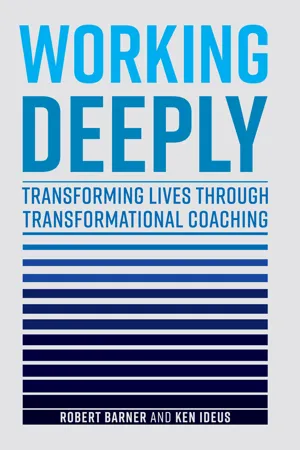
Working Deeply
Transforming Lives Through Transformational Coaching
- 240 pages
- English
- ePUB (mobile friendly)
- Available on iOS & Android
eBook - ePub
About this book
Coaching serves as a catalyst for supporting clients in their self-exploration and personal growth. In many instances, that growth has the potential to be transformational. Working Deeply is a guide for executive coaches and leadership development professionals to help them foster their clients' efforts in deep transformational learning. To facilitate this process, the authors introduce theories, concepts, and applied techniques for undertaking transformational coaching, and provide coaching cases and examples illustrating the use of these tools. They also introduce readers to a variety of research studies on such topics as mindfulness, mindsets, future selves, and narrative analysis, and discuss the application of this research to the area of transformational coaching. Finally, they explore how coaches can shape their perspectives and approaches to enable positive transformation. What readers will take from Working Deeply something of value that will help them develop their ability to support their coaching clients, and strengthen their practice as coaching professionals.
Information
1
BEGINNING THE DEEP DIVE
EXPLORING THE OCEAN OF MEANING
We would like you to form a mental picture of what happens between a coach and her client during a coaching engagement. In this picture, visualize the coach as swimming through an ocean of meaning; one comprised of the client’s worldview. Encompassed in this vast body of water are all of the factors that come into play as the client attempts to make sense of himself as both an organizational member and leader. This includes his relationships with others in his organization, the current work challenges he is facing, his history of leadership successes and setbacks, his goals and values, and those decisions and actions he has taken (or is considering taking), that will strongly shape his ability to excel as a leader in his organization.
This metaphor of the client’s “ocean of meaning” is one that is derived from the paradigm of constructivism, which views learning as an active process in which we strive to derive meaning from our life experiences by reflecting on those experiences (Barner & Higgins, 2007; Hoskins, 1995). As each of us attempts to integrate these life experiences into a coherent whole, we construct stories or narratives that help us to explain to ourselves, and others, how we interpret the events in our personal lives and the world around us (Ford, 1999). In applying this metaphor to the discipline of coaching, we contend that our coaching clients achieve their most profound learning when they are encouraged to step back and examine the meaning that they assign to their work and life experiences, and what these experiences reveal to them about the views they hold of their past, present, and envisioned futures as both leaders and human beings.
As coaches, our encounters with new clients typically begin at the “surface” of this ocean of meaning. Here, we are talking about the bare observable facts that we learn about the client’s work history, leadership competencies, behavior, organizational setting, performance against organizational expectations, and formal leadership role. All of this information is both useful and necessary. At the same time, the danger here is that it is easy to become so focused on looking for ways to accelerate our clients’ desired performance improvements, that we miss opportunities to help these leaders engage in a more in-depth self-exploration of their work experiences. Extending our ocean metaphor, another way of saying this is that we can become so fixated on “increasing our swimming speed” that we run the risk of remaining at the ocean’s surface throughout most, or all, of the coaching engagement.
In this book, we would like to propose an alternative way of thinking about the coaching process, which is that we become more potent as coaches when we shift our efforts from trying to swim faster, to diving more deeply into our client’s worldview. We would contend that the coaching approach we choose to employ, and the type of coaching–client relationships that we form, lead us to operate within one of three different levels of the coaching process. As we move from the surface of the ocean (Level 1) to the ocean floor (Level 3), several things happen that allow us to form more in-depth, meaningful coaching–client relationships, while supporting more significant, sustainable, and successful changes on the part of our clients. In the remainder of this chapter, let’s briefly consider the characteristics of each level.
LEVEL 1: GIVING ADVICE
The coach who stays at the surface of the ocean assumes the coaching role of advice giver. If you were watching a coaching–client interaction taking place behind a soundproof glass window, the coach–client interactions that characterize Level 1 coaching would be easy to spot, even without the benefit of sound. You might notice that the coach tended to take the lead in the discussion, while the client appeared to be more quiet and passive. You would also see that the coach did most of the talking while the client did most of the listening. In other words, at this level the client is highly dependent upon the coach for needed information, resources, and advice.
If you were to turn up the sound in a Level 1 coaching session you would notice that the coach’s questions were primarily designed to gather discrete information about the client’s history, presented performance issues, and work setting. Examples would include the number of people in the client’s reporting structure, or how often the client conducts team meetings, or the client’s relationships with his peers and organizational stakeholders. The underlying assumption on which this style of inquiry is based is that when combined, these data points somehow form a composite, comprehensive picture of a client’s work experience. Armed with useful information about the client’s presented problem, organizational context, and coaching goals, the coach would then quickly shift to providing the client with advice regarding the most effective way to deal with whatever presented problems that this leader is encountering at the moment, such as conflicts with managers, subordinates, or peers.
For his part, in a Level 1 coaching interaction the client is tasked with clearly formulating the presented problem, partnering with the coach to gather and organize background information related to that problem, and follow the coach’s direction on targeted skill development. This development may take the form of correcting problematic behaviors, such as the tendency to become harsh and critical when giving feedback to subordinates. It may also involve helping the client build his repertoire of new skills to prepare for a new organizational role or setting, such as a promotional opportunity to an expansion of an organizational function.
As we have mentioned, Level 1 coaching is the level at which coaching is typically initiated. In addition, quite often a client and the client’s organization will contract for goals that are initially framed in terms of this coaching level. An example would be the client who needs to quickly identify ways to set tough performance standards for his team, while remaining supportive and collaborative with those direct reports. At the same time, our position is that Level 1 can be regarded as the beginning of a journey that, as it develops, should deepen as it matures.
For those coaches who work exclusively in Level 1, there are three big caveats to consider. The first is that they may tend to treat all coaching opportunities, even those that require deep coaching, as Level 1 engagements. We refer to this embedded coaching issue as “surface skimming.” The second caveat is that such coaches may overlook opportunities that spontaneously arise in the coaching setting for helping their clients discover critical insights about themselves as leaders, and as human beings. Finally, a coaching relationship that is mismatched to Level 1 encourages passivity on the part of the client, by nurturing the client’s dependency on the coach for advice and direction. The end result is that each time the client faces a new challenge he must go back to the well to ask for help and advice.
LEVEL 2: ENCOURAGING INSIGHT AND SELF-REFLECTION
Coaches who are able to make the transition from Level 1 to Level 2 understand that anyone who wants to make significant and sustainable changes in their life needs to be willing to ask themselves a few serious questions. These questions include what they hold to be important in their lives, what they want to create within their futures, and how they may be supporting or inadvertently sabotaging their own success. In other words, as coaches work within Level 2 they help their clients gain insight through self-reflection. To support self-reflection, coaches begin to shift away from the use of data-gathering questions, to questions that encourage their clients to explore how they are working for, or against, their own personal goals as individuals and organizational leaders. Examples might be:
- “Earlier you mentioned that you are considering (taking a certain action). How would taking this action support your long-term personal and leadership goals?” or
- “If you imagine yourself observing your work situation six months from now, ideally what would be different? What would you notice that would tell you that your effectiveness as a leader or manager has improved?”
Rather than providing the client with packaged solutions to these work issues, at Level 2 the coach encourages the client to do the hard work of identifying and evaluating alternative options that may be available for addressing those issues. This is not to say that the coach takes on a completely non-directive role with the client and completely refrains from offering advice, feedback, or suggested options for action. The coach will certainly weigh-in on the relative effectiveness of different decisions and actions, but only after the client has performed some initial self-assessment of those options. In addition, coaches who are operating at Level 2 encourage their clients to seriously explore all of the ramifications of taking critical actions and making key decisions.
All leaders have some behavioral patterns that consistently work for them, while others may prove problematic. An important part of the insight a client gains at Level 2 comes when that individual begins to identify the conditions under which certain ineffective patterns are more likely to occur, and the potential long-term impact that those patterns are likely to have on her as a person and leader. These elements of behavior, context, and impact can be expressed in a variety of ways, but they always contain the following elements of self-reflection:
When the following type of situation occurs…
within this context…
I tend to do the following…
which has the following impact on others, on my performance as a leader, and on my own personal long-term goals…
The endgame of this type of analysis is not to help the client to gain better hindsight (“Looking back on it, I see that I never should have sent out that email …”), but rather to be better able to anticipate the onset of situations that can trigger certain critical behavioral patterns, and become more adept in managing those patterns in a way that is consistent with her goals. As someone once said, “people who try to drive by staring through their car’s rear-view mirror tend to have a lot of accidents.”
LEVEL 3: FACILITATING TRANSFORMATIONAL LEARNING
Transformational Learning: The Client’s Perspective
For many coaching clients, engaging in coaching work within Levels 1 and 2 may suffice to support their development needs. There are, however, other clients who may desire to use their coaching experience to dive deeper into their personal learning. When these situations arise, coaches need to be prepared to determine how they will respond to them. For some of these leaders, the tipping point for entering coaching will involve a traumatic work experience, which arrives in the form of a demotion, poor performance review, or escalating conflicts with managers, peers, and/or work teams. In any of these situations, leaders may wake up to discover that their old patterns of behavior are no longer effective, forcing them to call into question long-held assumptions about personal goals, values, and even their sense of self.
Such emotionally significant life experiences represent what adult development researcher Jack Mezirow (1991) has termed disorienting dilemmas — those personal crises of self-identify that can serve as the initial catalyst for deep transformational learning. Mezirow (1991) has described transformational learning as the process by which an individual critically reflects on those core values, beliefs, and assumptions she holds about herself and the world around her. Another definition of transformational learning, and one that resonates with how the two of us view this process, is offered by Dr. Gail Wade from Widemer University, who defines transformational learning as a “multidimensional concept, a dynamic, uniquely individualized process of expanding consciousness whereby an individual becomes critically aware of old and new self-views and chooses to integrate these views into a new self-definition” (Wade, 1998, p. 713).
So what exactly happens to someone who is engaging in transformational learning? As a starting point, during transformational learning the learner turns her reflecting lens back on herself, to become more aware of those beliefs, biases, and assumptions that inform her views. As she does so, the learner is faced with the challenge of constructing new ways of thinking and behaving, and of finding ways of integrating the new with the old. As we will discuss later in Chapter 6, transformational learning can also be viewed from a narrative perspective. By this, we mean that when we encounter life events that do not readily conform with, or somehow cannot be enfolded within, our current life stories, we are left with only two options. We can either distort this new learning to protect our existing story, or we can engage in the transformative process of constructing a new, more inclusive and adaptive life story that incorporates this new learning. Viewed from this perspective, transformational learning involves re-authoring the stories that we have constructed about ourselves and our world.
Transformational learning has traditionally been viewed as a personal change process that might occur over several years. At the same time, we believe that in today’s volatile, high-intensity world, the speed at which change events are contracting forces many leaders to reevaluate the basic core assumptions under which they operate on a more truncated basis; in some cases, the time period being a few months. This perspective is consistent with how the concept of transformational learning has continued to evolve over time. As Jack Mezirow continued to evolve his views of transformational learning (Dirkx, Mezirow, & Cranton, 2006), he arrived at the position that such learning can be either epochal or incremental. In the former situation, significant events in an individual’s life, such as the birth of a child, loss of a job, or being thrust into a highly challenging expat assignment, may pose personal transitions that are so significant as to force that person to step back and reappraise her life. As an incremental process, transformational learning can occur more slowly through the series of interactive dialogues that occur between coach and client over several weeks or months, with the leader’s gradual accumulation of insights eventually leading to a progressive shift in that client’s meaning perspectives.
For some leaders, transformational learning can take the form of a rather rational and analytical process, as these professionals systematically reevaluate and assess long-held beliefs and assumptions about themselves and their world. On the other hand, several researchers and educators in the field of transformational learning, such as John Dirkx and Edward Taylor, have suggested that such learning can involve a strong emotional “shift” on the part of learner. As coaching practitioners, we believe that the degree to which transformational learning takes an emotive and intuitive form is directly related to the degree to which the client is working with coaching issues that are directly related to their core identity. In the latter case, we are talking about situations in which a client comes face-to-face with new information that poses a serious challenge to the assumptions they hold about who they are and how they operate in the world. Such information can have a high level of emotional significance for a person, since by definition it exposes them to greater personal vulnerability. We discuss this coaching scenario in greater detail later on in Chapter 3.
In summary, transformational learning is more than learning more about the world. Rather, it is a way of being that profoundly changes how we learn about ourselves as human beings in the world. It requires individuals to step back and be aware of the suppositions and assumptions that inform their view of their lives and their worlds. In this sense, transformational learning is not just a byproduct of personal learning; rather it requires a different way of personally engaging in learning, one that is increasingly open to other perspectives on issues, and is more critically self-reflective.
Transformational Learning: The Coach’s Perspective
For coaches, transformational learning represents a great paradox. On the one hand, it represents a critical and sometimes life-changing learning process for the coaching client. On the other hand, transformational learning requires a high level of personal disclosure and emotional risk taking on the part of the client. For this reason, we never position transformational learning as an explicit goal of coaching. We can’t conceive of a scenario in which a coach turns to her client and says, “John, how would you feel about setting a coaching goal of moving to a deeper level of transformational learning in say … three months?” That being said, as we will emphasize throughout this book, we believe that opportunities for transformational learning exist within every coaching engagement. As coaches, our responsibility is to know both how to recognize these moments when they arise and how to shift our practice to support our client’s desire to engage in, and fully benefit from, these types of deep learning experiences.
Level 3 coaching is accompanied by a significant shift in the coaching–client dialogue, from an interactive process that is more formulaic and transactional to one that is more transformational and catalytic. Before entering this level, the coach and client are likely to have spent a great deal of time discussing such things as the creation of action plans, interpreting feedback obtained from key stakeholders, and testing options for strengthening certain leadership behaviors. Although these conversations are all valid and necessary components of executive coaching, they are not in themselves transformative. What is more important is that at level 3 the coach begins to change the nature of the coach–client conversation, with the intent of helping the client immerse himself in a deeper level of self-discovery and insight. True transformational conversations are those that speak to what is most meaningful, engaging, and (quite often) emotionally charged for the client. For instance, the client may come to realize that she has been holding on to certain long-cherished but inaccurate assumptions regarding what it takes to be a “great leader.” Concurrently, the client may come to better understand the internal approach/avoidance tug-o-war that often accompanies difficult transformational change. The following Case in Point on “Indecisive Ian” provides an example of this type of scenario.
Case in Point: Indecisive Ian
Some time ago, I (Bob) undertook a coaching assignment with Ian, the News Director of a Broadcast Station. Ian’s manager, the station’s General Manager (GM), had defined the presented problem as one of “poor work organization” and “indecisiveness” on the part of this coaching client. Specifically, broadcast networks operate under very tight (4-hour) time windows for taking a news broadcast from initial inception to airtime. The GM felt that Ian would create an initial plan each day, only to revise it as the news team got closer to airtime. This created a lot of havoc and discord in the news department, and resulted in news productions that sometimes suffered in quality or overran production budgets.
Soon after I began working with Ian I realized that, being new to the station, he was very concerned about being accepted by his work team. In attempting to be accepted, Ian gave out signals that he was very responsive to everyone’s input. The difficulty was that for his team, Ian’s “responsive” behavior came across as making him appear uncertain and lacking in self-confidence. A typical scenario would be that Ian would set a production plan in the morning, only to change it when his plan was challenged by one of his team members. (“Did you see how Channel X led off their news program last night? We should do something like that!”) Another team member would then challenge this new direction, leading Ian to scurry off in a totally different...
Table of contents
- Cover
- Title Page
- 1 Beginning the Deep Dive
- 2 The Use of Self in Coaching
- 3 Opening the Door to Transformational Learning
- 4 Turning the Mirror on Ourselves as Coaches
- 5 We Are Verbs, Not Nouns
- 6 Finding Your Ally
- 7 Story Time
- 8 Pulling from the Future
- 9 Coaching — A Multicultural Perspective
- 10 Staying on the Path
- References
- Index
Trusted by 375,005 students
Access to over 1.5 million titles for a fair monthly price.
Study more efficiently using our study tools.
Frequently asked questions
Yes, you can cancel anytime from the Subscription tab in your account settings on the Perlego website. Your subscription will stay active until the end of your current billing period. Learn how to cancel your subscription
No, books cannot be downloaded as external files, such as PDFs, for use outside of Perlego. However, you can download books within the Perlego app for offline reading on mobile or tablet. Learn how to download books offline
Perlego offers two plans: Essential and Complete
- Essential is ideal for learners and professionals who enjoy exploring a wide range of subjects. Access the Essential Library with 800,000+ trusted titles and best-sellers across business, personal growth, and the humanities. Includes unlimited reading time and Standard Read Aloud voice.
- Complete: Perfect for advanced learners and researchers needing full, unrestricted access. Unlock 1.5M+ books across hundreds of subjects, including academic and specialized titles. The Complete Plan also includes advanced features like Premium Read Aloud and Research Assistant.
We are an online textbook subscription service, where you can get access to an entire online library for less than the price of a single book per month. With over 1.5 million books across 990+ topics, we’ve got you covered! Learn about our mission
Look out for the read-aloud symbol on your next book to see if you can listen to it. The read-aloud tool reads text aloud for you, highlighting the text as it is being read. You can pause it, speed it up and slow it down. Learn more about Read Aloud
Yes! You can use the Perlego app on both iOS and Android devices to read anytime, anywhere — even offline. Perfect for commutes or when you’re on the go.
Please note we cannot support devices running on iOS 13 and Android 7 or earlier. Learn more about using the app
Please note we cannot support devices running on iOS 13 and Android 7 or earlier. Learn more about using the app
Yes, you can access Working Deeply by Robert Barner,Ken Ideus in PDF and/or ePUB format, as well as other popular books in Business & Human Resource Management. We have over 1.5 million books available in our catalogue for you to explore.